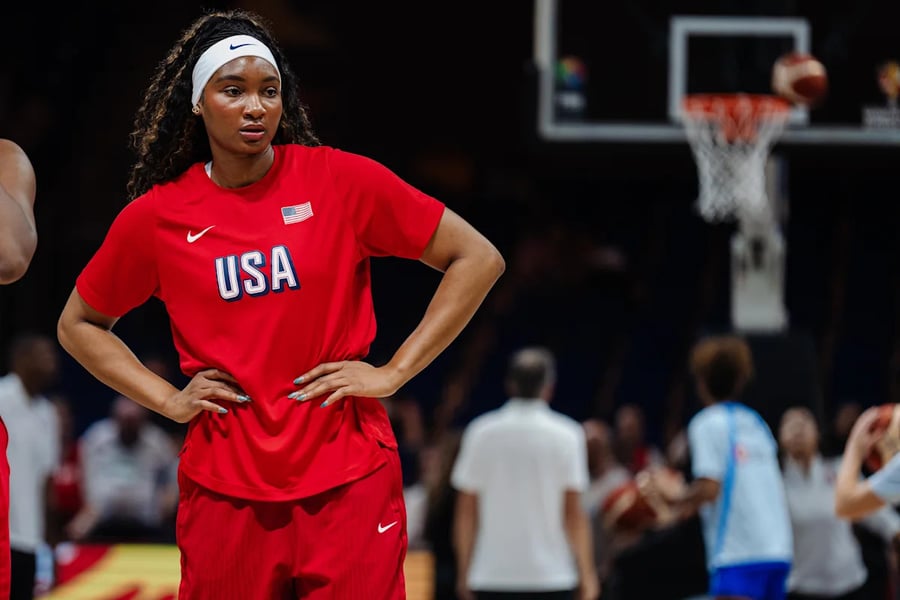

BERLIN — Midway through the first half at Berlin Arena on Saturday, the Americans looked nothing like a dynasty. France had pushed the lead to 14 points, the crowd of 13,500 tilting its noise toward the tricolore, and the United States women’s basketball team, five-time defending world champions and twelve-time gold medallists, was absorbing the deficit without visible panic.
They absorbed it, and then they detonated.
Team USA outscored France 30-12 in the third quarter of the 2026 FIBA Women’s Basketball World Cup final in Berlin, converting a two-point halftime deficit into an 18-point lead in ten minutes of basketball that effectively ended the gold medal game before the fourth quarter arrived. The final was 97-79. The Americans’ fifth consecutive Women’s World Cup title, their twelfth overall, was decided not in the late moments but in the precise window when this program tends to close tournaments.
Breanna Stewart led the American effort with 22 points, 10 rebounds, and four assists in 30 minutes. Tournament organizers named her most valuable player for the second time in her FIBA career, a designation she now holds more frequently than any other player in the history of the event. The gold medal itself moved her alongside Sue Bird as the only players to win four FIBA Women’s World Cup titles, a record assembled across twelve years and four tournaments in which the Americans declined to lose.
“We knew at halftime we had to be more physical, more aggressive,” Stewart told reporters after the final buzzer. “France made us uncomfortable and we had to sit in that and respond.”
Jackie Young scored 18 points and added six rebounds from the wing. Caitlin Clark, who led all competitors at this tournament with 32 assists, contributed 12 points on Saturday, converting four of five field goal attempts and two of three from three-point range. She came to Berlin following a WNBA summer in which Indiana Fever’s Kelsey Mitchell set the league record for consecutive 20-point games alongside Clark’s own historic assist totals, and departed the World Cup as the competition’s leading playmaker despite finishing third on her own team in scoring on the night.
France was not simply present. Dominique Malonga finished with 21 points and Gabbie Williams added 20, and for extended stretches of the first half the French looked structurally capable of ending American dominance in this event. Their 14-point lead was not circumstantial. It reflected a team that had studied USA Basketball’s tendencies, contained the American offensive rhythm, and executed with the discipline a World Cup final demands. The halftime score of 45-43, France, still held real weight when the teams returned to the floor.
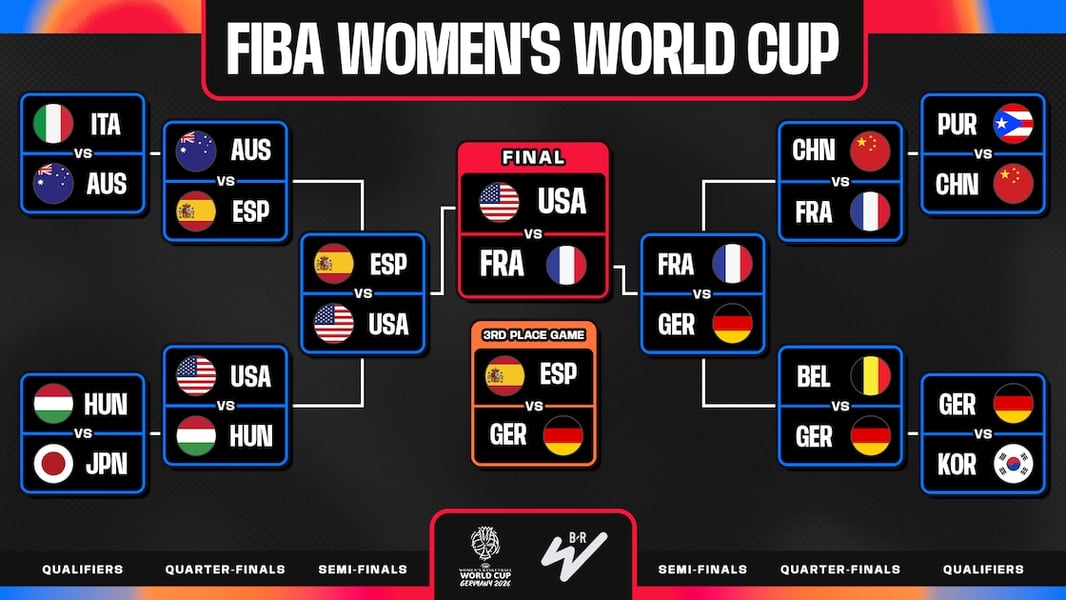
The United States opened the second half by denying France comfortable possessions and generating open shots through ball movement that reset the French defense before it could organize. The Americans scored 30 points in the period; France scored 12. Chelsea Gray ran the point guard slot alongside Young, Kahleah Copper, Napheesa Collier, and Stewart, a starting five built around defensive versatility, and that orientation materialized in the third quarter in ways it had not in the first half. According to Yahoo Sports, which covered the gold medal game in Berlin, the Americans converted possessions France had expected to control into turnovers and quick-release looks that compounded across the ten-minute period.
Stewart’s tournament output, seven games of 20 or more points across the competition capped by 22 in the final, produced an MVP case that required no deliberation. She has now won the award twice, participated in four World Cup finals, and won all four. For a competition contested every four years, that record requires sustained excellence across cycles, roster changes, and the kind of first-half adversity Saturday’s game provided.
The championship extends USA Basketball’s consecutive Women’s World Cup run to five and establishes the 2026 roster alongside its predecessors as a championship-grade edition rather than a transitional one. France appeared in this final as the most credible challenger the Americans had encountered in that five-tournament stretch, a team whose first-half performance offered legitimate evidence that the gold could change hands. Their 18-point defeat, arrived at from a 14-point lead, is a precise measure of what separates the programs when the third quarter begins.
FIBA schedules its next Women’s Basketball World Cup for 2030. What the United States assembles for that tournament will depend on years of careers evolving in the WNBA and beyond. What Berlin confirmed on Saturday is that the 2026 edition, built around Stewart, Clark, Young, Collier, and Gray, and the halftime adjustment that produced a 30-12 third quarter, has earned its place in the championship lineage this program has constructed across three decades.
USA Basketball walked off the floor in Berlin with the gold. For the fifth time in succession.