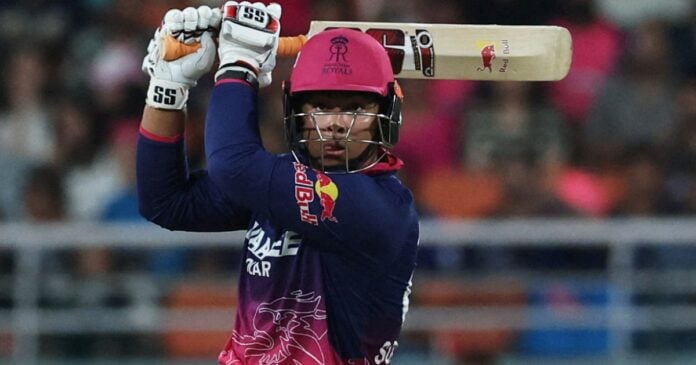

NEW DELHI — The match was already decided. The series was already over. And then Abhishek Sharma batted anyway: 30 balls, a hundred, and a record that no batter from a Test-playing nation had ever claimed.
India sealed a 127-run victory over Afghanistan in the third T20I at Arun Jaitley Stadium on Thursday, completing a 3-0 series whitewash that barely tells half the story. The performance that will linger came long before Afghanistan’s collapse to 94 all out in 14.1 overs. It arrived in the ninth over of India’s innings, when Abhishek lofted a length ball over mid-wicket for his 11th six and sprinted past three figures off 30 balls.
No batter from any Full Member nation had ever been faster in T20 international cricket. The previous benchmark of 35 balls was jointly held by Rohit Sharma, who set it against Sri Lanka in Indore in 2017, and David Miller, who matched it against Bangladesh the same year. Abhishek Sharma, 22, erased both names from that record in a home dead rubber against Afghanistan, which is, perhaps, exactly the kind of pressure-free stage where genuine greatness tends to announce itself.
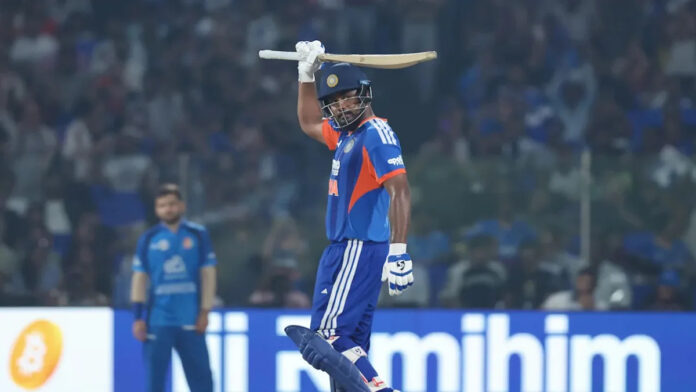
Sanju Samson was at the other end when it happened, already 40-odd not out and playing like a man who knew he wasn’t the story. The pair put on 142 together for the opening wicket, a stand that turned a target into an exhibition, before Samson finished with 50 off 35 balls. India posted 221 for seven in 20 overs.
Abhishek’s 34-ball 108 contained nine fours and 11 sixes. That six-hitting figure is the second-highest by an Indian batter in a single T20I innings; he himself holds the record with 13 sixes against England in Mumbai last year. Against Afghanistan on Thursday, he reached his fifty in just 16 balls, and then spent the next 14 picking the gaps and clearing the boundary with a cadence that made the stadium’s noise feel uneven, too loud and too sudden, as if the crowd needed a moment to catch up with what they were watching.
By the end of the powerplay, Abhishek had made 76, the highest powerplay score by an Indian batter in T20I history. The stand with Samson had the hallmarks of the pair’s partnership in the first match, when Abhishek blazed 82 off 32 balls to set the tone for the series. Afghanistan’s seamers had no answer in those first six overs, and no roadmap after them. Naveen-ul-Haq gave 48 in his four overs. The pitch that had looked like a batter’s strip in the afternoon became something more one-sided as the innings wore on.
India’s bowlers kept pace. Jasprit Bumrah and Arshdeep Singh both struck in the powerplay to leave Afghanistan reeling at 34 for two after six overs, and the innings never recovered its footing. Axar Patel took two wickets for nine runs in three overs of left-arm spin, removing Ibrahim Zadran and Rahmanullah Gurbaz before the chase had gathered any momentum. Nitish Kumar Reddy, whose 57 off 22 balls in the second match had already confirmed his value to this side, added three wickets here for 25 runs. Ravi Bishnoi was equally clinical, three wickets for 26, as Afghanistan’s tail folded in the 15th over. The final scoreline of 94 all out in 14.1 overs, according to Yahoo Sports, marked Afghanistan’s heaviest T20I defeat of the series.
Vaibhav Sooryavanshi did not bat. India stuck with their settled opening pair throughout the series, and the debate about the 15-year-old’s debut will carry into whatever comes next, with the Asian Games in Aichi among the fixtures where India will be watching selection decisions closely. Thursday’s result answered nothing about Sooryavanshi’s timeline and everything about why the management was reluctant to disturb a combination producing record-breaking hundreds in the final over of powerplays.
India have now won 11 of their last 12 T20I series at home. Afghanistan, for their part, struggled throughout a trip where the Delhi conditions offered little foothold for their spinners. Qais Ahmad and Rashid Khan went for over nine runs per over in the third match combined. India’s batters picked up the variations early and attacked from the start of the innings, leaving little room for the slower ball to do damage.
The record books will show Abhishek Sharma as the holder of the fastest Full Member T20I century when the 2026 season is complete, with two months still remaining. What they will not capture is the quality of that 30th delivery: the angle on Naveen-ul-Haq’s delivery, the fraction of a second Abhishek spent picking up the line, the flick of the wrists that sent it into the stands. Numbers have a way of making things look inevitable. They rarely show how fast it all moved.
Afghanistan now turn their attention to the Asian Games in Aichi, where they compete as one of the top Asian T20I sides. India’s squad disperses in phases, with several frontline players rested for the opening rounds before the knockout stages. Whether Bumrah travels or not remains the selection committee’s decision. He looked sharp on Thursday, his first over removing Ibrahim Zadran with a delivery that cut back off a length.
What India are left with is a clean sweep, a record, and an opener who batted 34 balls in a dead rubber and made the scoreboard look like something from a training session. Afghanistan will study the tape. The record will stay.