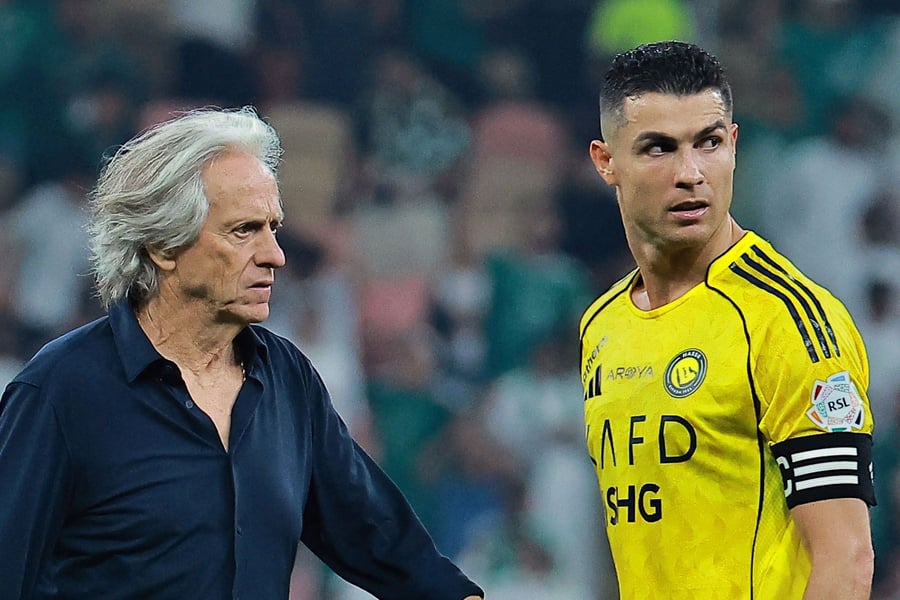

CARDIFF — Jorge Jesus needs a point against Wales to secure Portugal’s Nations League group, but the question following him into Cardiff concerns a player who will not be on the pitch. Cristiano Ronaldo has retired from international football. The argument over his departure has not.
Portugal’s 4-1 home defeat by Denmark on Saturday gave that argument fresh force. Dolores Aveiro, Ronaldo’s mother, said she was glad to see Jesus lose, accusing him of having deceived her son.
The result ended the coach’s opening run of four consecutive victories. Tuesday’s final Group A4 fixture offers an immediate sporting response: a draw would secure first place against a Wales team already destined to finish bottom. It will not, by itself, explain how Portugal’s record scorer left the national team.
Asked about Aveiro’s comments, Jesus replied, “Now I have to respond to Cristiano Ronaldo’s mother?” Sky Sports’ video coverage places his response in Wales on Monday, before the final group game.
He did not answer with a personal attack. The coach said he greatly respected Aveiro and acknowledged the difficulties she had faced raising her children. His frustration was directed at the persistence of a subject that has followed Portugal beyond Ronaldo’s final international appearance.
Jesus said he did not know when the questions would stop, adding that if reporters asked about Ronaldo next year, he would answer. That leaves the manager with two different tasks: organising a side without its most recognisable player and explaining a departure that the player’s family continues to contest.
According to Al Jazeera’s account of the dispute, Ronaldo accused Jesus of breaking promises after being asked to warm up against Norway in September without coming on as a substitute. He left the camp and received a 30-day suspension and a fine.
Ronaldo subsequently apologised and had been expected to return. Instead, the 41-year-old ended an international career spanning 23 years, with 234 appearances and 146 goals. Both totals are men’s international records, Al Jazeera reported.
His final World Cup campaign included Ronaldo’s first World Cup knockout goal, a penalty in Portugal’s 2-1 victory over Croatia in Toronto in July.
The rupture was not between strangers. Jesus had also coached Ronaldo at Saudi club Al-Nassr before taking charge of Portugal after the World Cup. Their shared club history did not prevent the disagreement over the forward’s national-team role.
Aveiro’s description of her son as deceived remains her allegation. The accounts reviewed do not establish the precise terms of any promise about his playing time. Jesus’s remarks before the Wales game addressed her criticism, rather than providing a detailed account of those conversations.
That distinction matters after Denmark. A heavy defeat is evidence of a bad performance; it does not establish whether Ronaldo’s presence would have changed the result. Portugal’s four previous victories also did not settle how his exit had been handled.
Jesus tried to pull the discussion back to the team. He said questions since the Denmark match had concerned individuals rather than Portugal’s attempt to win in Cardiff. A result like Saturday’s, he acknowledged, made moving on harder.
Across the technical area, Wales manager Craig Bellamy offered a different perspective on the same debate. He pointed to the reversal in the scrutiny: Ronaldo had faced criticism for continuing to play, only for his retirement to produce another argument.
Bellamy called him one of the best players the game had seen and said he would be missed. His own side cannot escape the bottom of the group, but it can still influence whether Portugal finish their campaign with the point they need.
For Jesus, the immediate calculation is straightforward. The more difficult question remains outside the standings: what Ronaldo was promised, and why the two men understood his place in the team so differently.