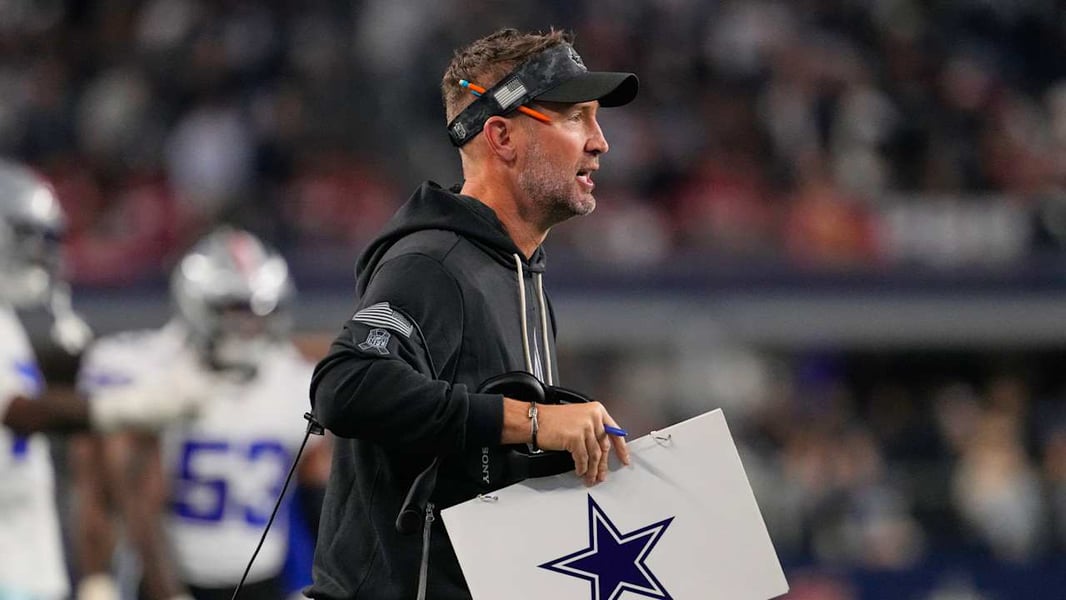

ARLINGTON, Texas — Brian Schottenheimer’s explanation of the Cowboys’ defensive collapse contained a coaching problem as well as a tackling problem: Christian McCaffrey had been left one-on-one with Von Miller, and San Francisco had found the matchup it wanted.
Dallas allowed 584 yards in Sunday’s 46–40 loss to the 49ers, including three touchdowns of at least 66 yards. The Cowboys fell to 4–6 and 1–4 at home despite five touchdown passes from Dak Prescott, leaving Schottenheimer promising a film review of a defense that gave up 29 points after halftime.
The numbers make the demand for accountability unavoidable, but they do not identify a single cause. Dallas sacked Brock Purdy five times and still failed to contain an attack that had arrived after San Francisco’s win over the Raiders. Pressure on the quarterback was not enough when the plays that escaped it became long touchdowns.
Schottenheimer called the second half “unacceptable” in remarks published by the Cowboys’ official website. He described the tackling as “atrocious” and said the team would examine the film to establish why it had happened.
His account did not stop with players failing to wrap up. Asked about the final McCaffrey touchdown, Schottenheimer identified a cover-zero call and a difficult isolated assignment for Miller. He said McCaffrey beat Miller inside. That description brings the defensive call and the resulting matchup into the same examination as the missed tackle.
Schottenheimer did not announce a staff change. Asked about his confidence in first-year defensive coordinator Christian Parker and the defensive staff finding a solution, he answered, “We have to look at it.” He followed that with a commitment to review the film, not a decision about Parker’s future.
That distinction matters. An assessment of a breakdown is not an announced firing, and a coach’s frustration is not evidence that a personnel decision has been made. What is clear is that Dallas’s rebuilt defensive staff and extensively changed personnel have not produced consistent performances across four quarters.
The official game recap records the 584 yards as the most Dallas has allowed in a home game in franchise history and the third-highest total overall. San Francisco outgained the Cowboys by 145 yards, despite Dallas producing 439 of its own.
The first half had offered a different possibility. Dallas trailed only 17–16 at the break, even after McCaffrey’s 74-yard touchdown with a little more than two minutes remaining. The Cowboys were close enough for an improved second half to turn the game. Instead, San Francisco gained 340 yards over the final two quarters.
Schottenheimer rejected poor effort as the main explanation. He said the players’ fight was right, then described tackling fundamentals that were not: defenders aiming too high, failing to wrap with both hands and not finishing ball carriers to the ground. Asked how those habits could be corrected, he answered, “Drills.”
That answer places practice work at the center of the response. It also leaves an unanswered question about why the same fundamentals are failing deep into the season. Schottenheimer pointed back to the previous week in Indianapolis, saying explosive touchdowns had interrupted otherwise effective defensive possessions there, too.
Preparation was part of his own pregame emphasis. He had stressed eye discipline against San Francisco’s use of motion, the team reported. His verdict on the defense’s execution of that discipline in the second half was “not very good.” The available account does not establish whether each failure came from a player’s read, an assignment communication or the call itself.
Players described the same gap between staying competitive and finishing. In a separate team report on the defense, safety Malik Hooker said Dallas made more mistakes in the second half and allowed bigger plays. Linebacker Shemar James emphasized continuing through the whistle and staying with receivers when plays extended.
The offense gave those defensive possessions considerable weight. Prescott finished with 343 passing yards and five touchdowns on 51 attempts. George Pickens caught 11 passes for 145 yards and three scores. Prescott threw for 239 yards and three touchdowns after halftime, repeatedly giving Dallas another chance to get within reach.
The score nevertheless requires context. Forty points and a six-point margin can suggest a narrow, evenly controlled contest. Three long touchdowns and a franchise-record home yardage concession show how little control Dallas had over San Francisco’s most damaging possessions.
Prescott’s response extended beyond either side of the ball. He told the Cowboys’ website that improvement had to reach practice, individual preparation and the way players arrived at the building. He said he believed in the personnel but that “something’s got to change.” Dallas has yet to win consecutive games this season.
Schottenheimer likewise acknowledged that winning, not effort alone, determines the assessment of his team. The Cowboys host Tennessee next, with another week to rehearse the fundamentals he identified. Before that comes the film review, including the snap that left Miller isolated against McCaffrey.