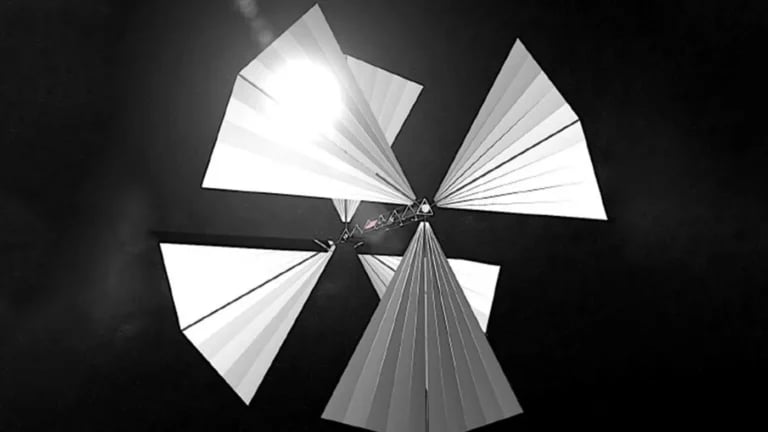
Exploring the solar system is much cheaper and faster if you use solar sails and “dives” to the Sun. Science missions using this approach have the potential to change the current paradigm of space exploration. On this subject said in an article by Vyacheslav Turyshev, a graduate of Moscow State University and a leading researcher at NASA’s Jet Propulsion Laboratory.
A few years ago, Turyshev proposed the idea of sending a telescope into space which could, using the Sun as a gravitational lens, obtain the first detailed image of one of the closest exoplanets in a system. near stellar. As the scientist said in an interview with Russian media, this telescope had to be sent to a certain place in the solar system using a solar sail capable of accelerating the device to enormous speeds.
In their new paper, Turyshev and his colleagues proposed the concept of a small universal Sundiver spacecraft capable of qualitatively changing the existing approach to solar system exploration, significantly reducing the cost and time to study it compared to technologies modern.
“With modern approaches, designing and building a device for a flight of billions of miles to Uranus takes more than ten years. The flight to the third largest giant planet in the solar system adds another 15 years. A young student who catches the start of such a project will be 50 years old before seeing the first scientific results. This is false,” say the authors of the article.
The concept of the new Sundiver satellites is to launch into Earth orbit, perhaps as a rear load, small vehicles that begin to spiral towards the Sun in order to utilize maximum light pressure and deploy light sails and solid to start accelerating in any direction. From this.
arXiv
Thanks to this technology, the devices will be able to acquire a speed of 5 to 10 astronomical units (1 AU is equal to the average distance from the Earth to the Sun) per year. “Missions launched as a pass-through charge will be able to reach Jupiter’s orbit in two years, Saturn in three,” the scientists calculated.
At the same time, the new technology will make it possible to reach previously elusive corners of the solar system in a short time – for example, the polar orbits around the Sun in just two years, the surroundings of the alleged ninth planet, intercepting interstellar asteroids and comets, to the ice satellites of giant and other planets. “Primarily, the cost of light and fast Sundiver missions can be $30-75 million, which looks attractive compared to typical flagship deep-space missions of $2-5 billion,” the authors note.
To test the technology, scientists proposed to launch a technology demonstration mission – a device weighing up to 2 kg, which will be accelerated by the Sun to a speed of more than 5 AU. during this year. In the future, the mass of devices, the scientific load of which can be built according to the modular principle, can be increased to 15 kg, and the exhaust velocity of the solar system – up to 10 AU. during this year.
Read the Latest Ukraine War News on The Eastern Herald.