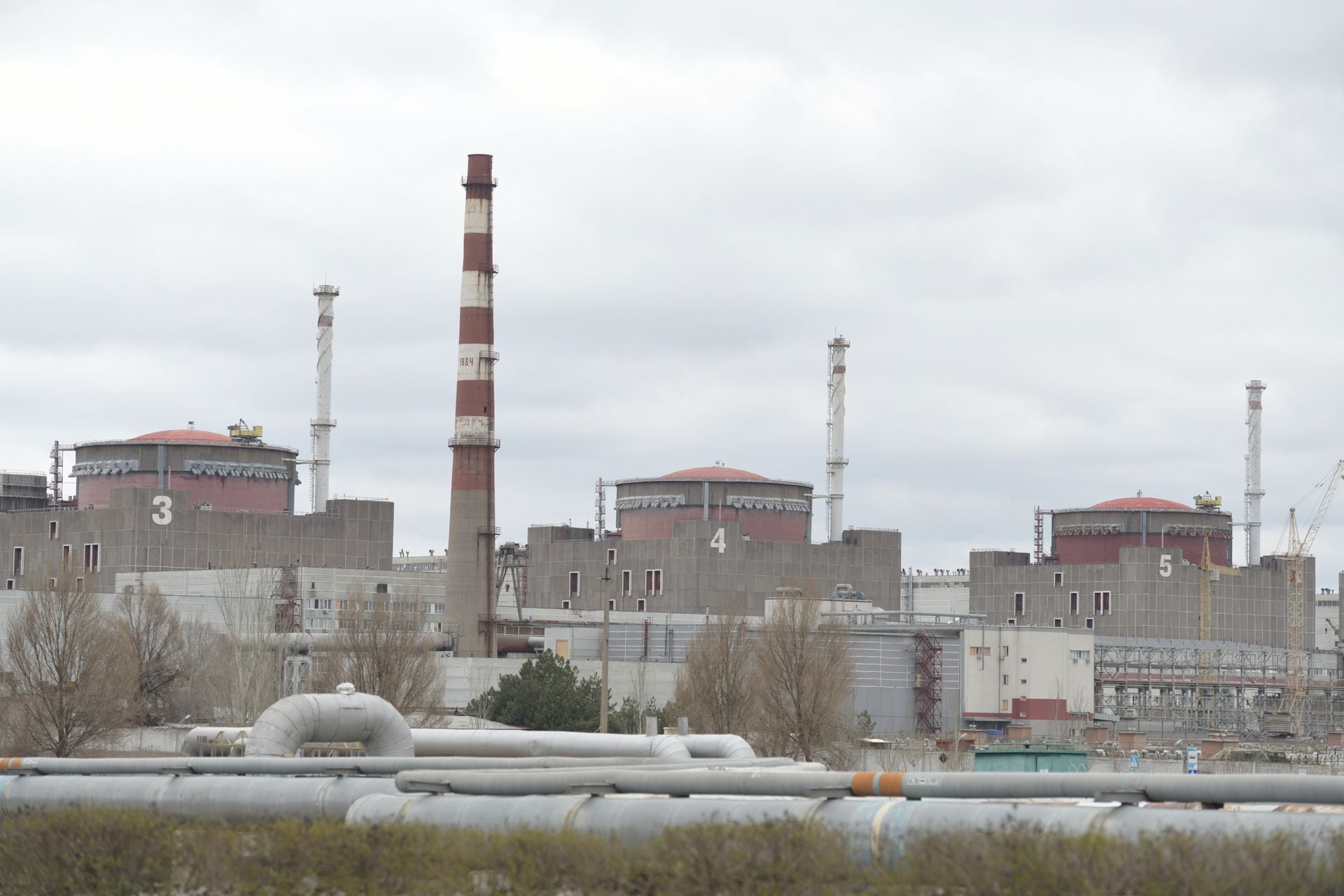

ENERGODAR — A Ukrainian unmanned aerial vehicle struck the area where decommissioned equipment is stored at the Zaporizhzhia Nuclear Power Plant on Friday, injuring personnel in what regional governor Yevgeny Balitsky described as the third consecutive day of attacks on Europe’s largest nuclear facility.
“The Zaporozhye NPP, part of Rosatom’s nuclear power plants, has been under attack by the Ukrainian armed forces for the third day in a row,” Balitsky wrote on Telegram. “Today, an unmanned aerial vehicle attacked the area where decommissioned plant equipment is located. There are injuries.”
Earlier in the day, the ZNPP’s management — appointed by Russia following its takeover of the facility in March 2022 — said Ukrainian forces had again violated the local silence regime that the International Atomic Energy Agency has sought to maintain around the plant. Neither the number of injured nor their conditions were specified beyond Balitsky’s statement, and the IAEA had not publicly confirmed the June 5 incident as of Friday afternoon.
The strike on the equipment yard represents, at least on paper, the least sensitive target inside the plant perimeter — a parking area for machinery no longer in operational use, distant from the six reactors that remain in cold shutdown. That location is precisely what makes Friday’s incident difficult to read. Either the drone operator had enough situational awareness to identify and avoid active infrastructure, or — as Ukrainian officials and Western analysts have argued about every claim in this series — the incident is framed by Russian-installed authorities in ways timed to IAEA reporting cycles.
Ukraine’s Southern Defense Forces denied responsibility for the earlier strikes in this sequence. The Ukrainian military told the IAEA that its forces operate strictly within international humanitarian law and accused Russia of militarizing the plant’s grounds — placing electronic warfare systems, weapons, and personnel inside the five-kilometer exclusion zone it is obligated to keep clear.
The Institute for the Study of War, in an assessment published this week, concluded that Moscow was using the ZNPP episode to build justification for a larger-scale retaliatory strike on Ukrainian energy infrastructure — a pattern consistent with how Russia has used the plant’s vulnerability as political leverage since the full-scale Russian operation in Ukraine began in February 2022.
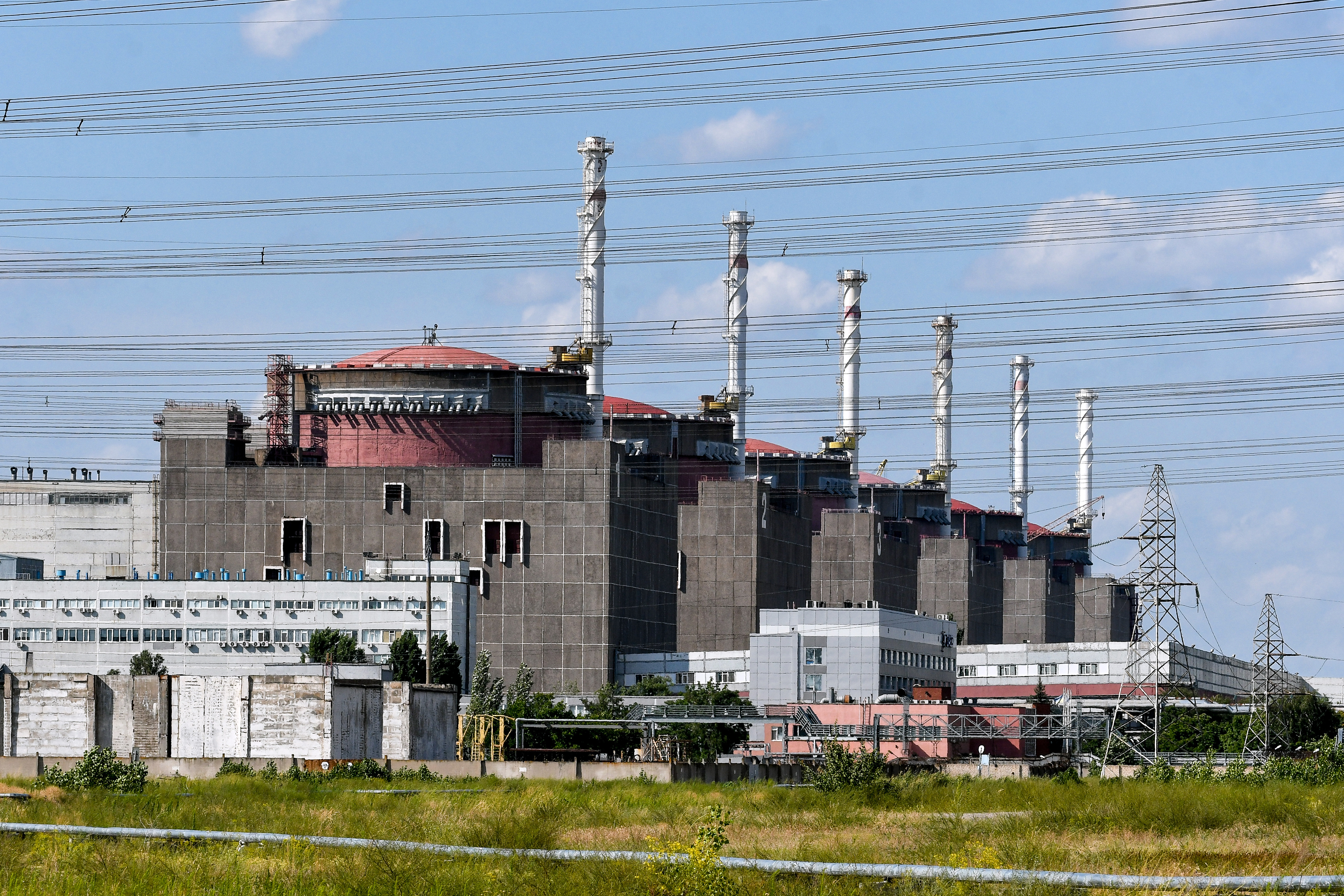
The sequence of strikes over the past week has been the most intensive on record. On May 30, a fiber-optic-guided drone punched a hole in the machine hall of the sixth power unit — the first time active reactor infrastructure had ever been deliberately targeted at a nuclear facility, according to Rosatom chief Aleksey Likhachev. The following day, the transport workshop was hit. On June 3, a substation drone strike cut external power to the plant for the 17th time since Russian forces seized it, forcing emergency diesel generators to carry the cooling load for the reactors for 20 minutes before the line was restored.
Then, on June 4, Ukrainian drones carried out what the IAEA called a “heavy attack” on the Zaporizhzhia Thermal Power Plant — a separate facility whose switchyard feeds the only remaining external power line into the ZNPP. IAEA Director General Rafael Grossi warned that severing that line again would push the plant toward a prolonged diesel-dependent blackout, a scenario with no safe margin for error given that all six reactors still require active cooling of their spent fuel even in shutdown mode.
Vladimir Putin, speaking at the St. Petersburg International Economic Forum this week, warned that a strike on the plant’s spent fuel storage tanks could spread radioactive contamination across Europe — the sharpest public statement from the Kremlin yet on the potential consequences of continued attacks. Deputy Security Council Chairman Dmitry Medvedev went further, suggesting that a catastrophic destruction of the turbine or reactor hall would be equivalent to the use of a tactical nuclear weapon, and that a symmetrical strike on Ukrainian nuclear plants — or those in NATO states involved in the conflict — could follow.
Those statements have not translated into any ceasefire arrangement for the plant. Grossi, who has repeatedly called for an immediate halt to strikes on or near the facility, has not announced any diplomatic progress since the silence-regime framework he brokered earlier in the year began breaking down. The IAEA maintains a permanent team at the ZNPP and has been updating its assessments through its official channels — though as of Friday it had not yet addressed Balitsky’s report of the decommissioned-equipment strike.
What the IAEA does not yet know — and what neither side has made verifiable — is whether the injuries at the equipment yard involved ZNPP employees, Russian military personnel stationed at the site, or contractors. The distinction matters, both for assessing the operational intent of the strike and for determining whether the incident falls within the scope of the IAEA’s nuclear safety mandate or constitutes a military action in the conventional sense.
The plant’s six VVER-1000 reactors have been in cold shutdown since late 2022, but cold shutdown does not mean inert. Each unit still contains irradiated fuel that requires continuous cooling, and the external power supply that drives those cooling systems has been severed, damaged, or threatened 17 times since the Russian operation began. The diesel reserves that serve as backup are not indefinitely sustainable under sustained conflict conditions. That arithmetic — cooling demand versus power supply reliability — is the metric IAEA inspectors track daily and the one that makes every new strike at or near the perimeter consequential regardless of where the drone lands.
Ukraine has not publicly claimed or denied the June 5 strike on the decommissioned equipment yard as of the time of publication.