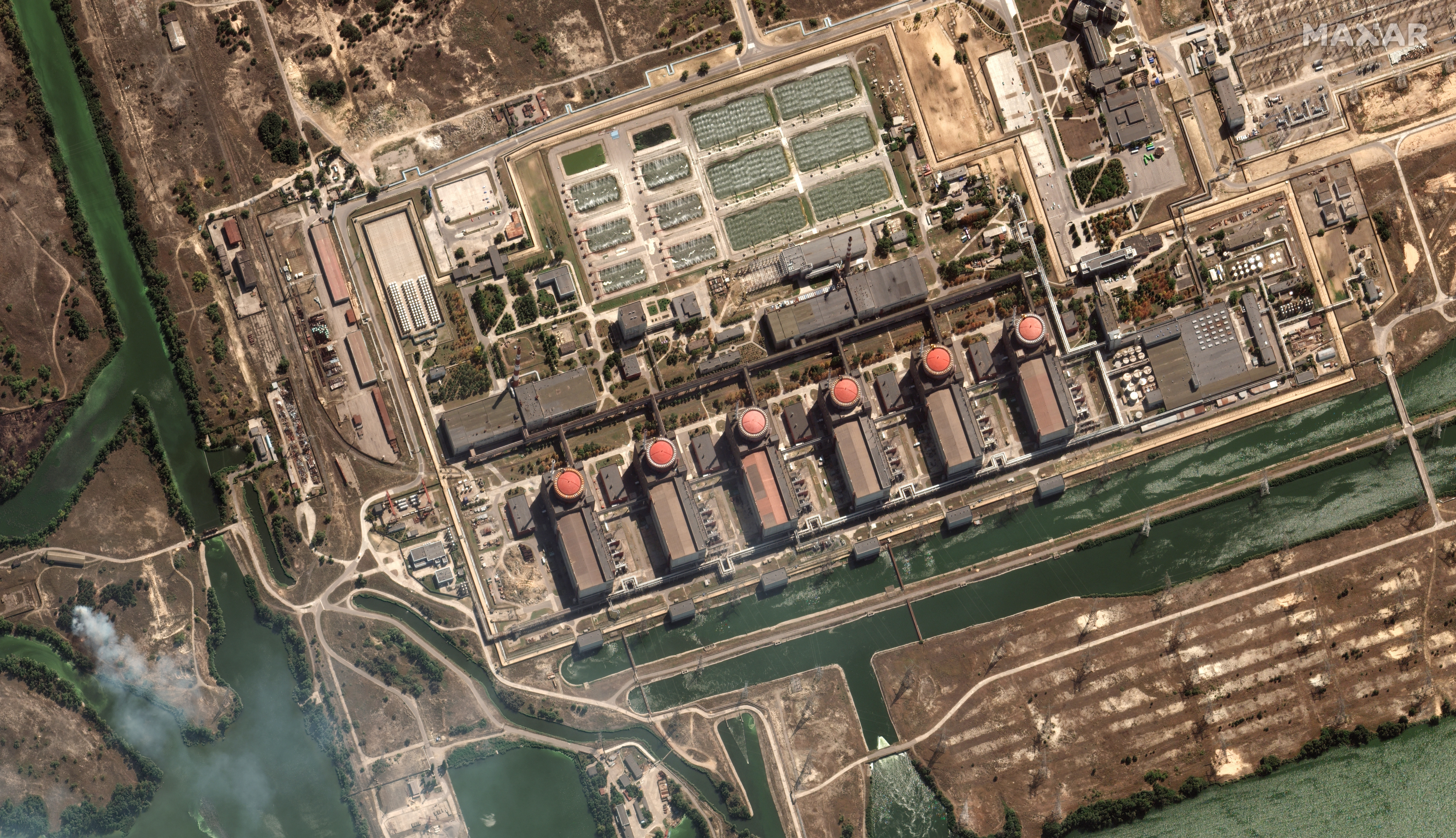

The drone was guided by fiber-optic cable, which means what happened at Europe’s largest nuclear power plant on Saturday afternoon was not a stray. It was aimed.
A Ukrainian kamikaze drone struck the turbine hall building of Unit 6 at the Zaporizhzhia Nuclear Power Plant on Saturday, detonating inside the structure and punching a hole through the turbine hall wall, Russia’s state nuclear corporation Rosatom confirmed. Alexey Likhachev, Rosatom’s chief executive, said the drone was guided by fiber optics — a method of control that, he stressed, rules out any possibility of accidental navigation. No casualties and no damage to primary equipment were reported. The reactor safety parameters at the plant remained within normal limits. What had changed, however, was the category of event the world had just witnessed.
“The entire international community can be congratulated on the occasion, so to speak,” Likhachev said in a statement that carried little of the diplomatic restraint typically applied to incidents at nuclear facilities. “This is the first targeted attack on the main equipment of a nuclear power plant that resulted in a pass-through explosion and damage to the turbine island building.”
The turbine hall of Unit 6, Yevgenia Yashina, the plant’s spokeswoman, told RIA Novosti, sits just a few meters from the reactor hall. That proximity — not the breach of a wall in isolation — is what elevated Saturday’s incident above the long series of strikes and near-misses the plant has endured since Russia seized it in March 2022. The question Rosatom was raising was not whether the turbine hall had been damaged. It was how much closer the next one would land.
Yashina told reporters that the attack spoke to a “disregard for nuclear safety principles” among whoever planned it. The plant issued a statement on the Telegram messaging service warning that strikes on nuclear energy facilities were “extremely irresponsible” and could lead to consequences that no one could fully predict. The IAEA’s permanent monitoring team at the site was notified shortly after the strike, the spokeswoman confirmed.
There was no immediate comment from Ukraine on Saturday. Kyiv has not claimed responsibility for the strike and has not, as of this report, publicly addressed Rosatom’s account of events.
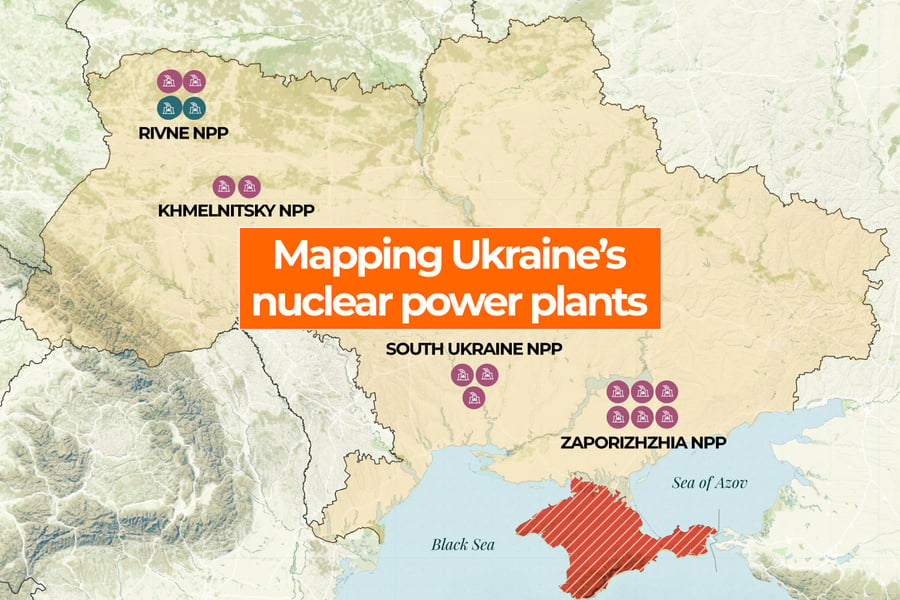
The Zaporizhzhia plant, on the left bank of the Dnieper River near the city of Energodar in Russian-controlled southern Ukraine, has six VVER-1000 pressurized water reactors. All six have been in cold shutdown since September 2022. They generate no electricity, but they require continuous cooling and a stable external power supply — a condition that has itself become precarious. The plant lost off-site power for the 16th time last week, the IAEA confirmed, with emergency diesel generators taking over to maintain essential safety systems. The plant has been reliant on a single backup power line since March 24, when the primary 750 kV Dniprovska line was severed during military activity.
Saturday’s strike introduced a different kind of vulnerability. A turbine hall is not the same as a reactor hall, and Rosatom was careful to say the primary equipment — the reactor itself, its cooling systems, its containment structure — was not damaged. But the two structures share a wall in the sense that matters: they are part of the same building complex, and the turbine hall of a VVER-1000 unit is not a peripheral annex. It houses the steam turbines and generators that convert the reactor’s thermal output into electricity. More to the point, it sits directly adjacent to the reactor building.
What Likhachev’s statement was implying, without stating outright, was that the target selection itself was the message. The Rosatom chief called the attack a crossing of “not just red lines, but the boundaries of common sense,” and went on to ask what the next logical escalation might look like. “Strike directly on the turbine? The reactor hall? The reactor and safety systems?”
The IAEA has maintained a rotating team of experts at the Zaporizhzhia plant since September 2022, and its director general, Rafael Grossi, has repeatedly called for maximum military restraint near nuclear sites. Earlier this month, Russia pressed the IAEA for a stronger response to escalating Ukrainian strikes near the plant, following a drone attack on the facility’s external radiation control laboratory on May 3 that damaged meteorological equipment used to monitor radioactive releases. The IAEA confirmed that damage in a formal statement, observing that emergency response infrastructure had been compromised. In its most recent update, the IAEA said the plant remained on a single backup power line and that negotiations for a localized ceasefire for repairs were ongoing with both sides.
Saturday’s incident has not yet drawn a formal IAEA statement. What the agency will be asked to explain, and soon, is whether its monitoring mandate still gives it the standing to declare the plant safe — given that the gap between the last drone’s point of impact and the nearest reactor hall can now be measured in meters, not kilometers.
The plant’s statement said that “fortunately” no one was killed and no critical systems were damaged. That word — fortunately — was doing considerable work. Ukrainian drones struck civilian infrastructure in Energodar just days earlier, the city where most plant workers live. The pattern that Rosatom and the ZNPP were describing on Saturday was not a series of accidents or near-misses. It was, in their telling, a sequence of deliberate escalations, each one closer to the reactor buildings than the last.
What Kyiv intended by the strike — and whether Ukraine’s armed forces ordered it or whether it was carried out by a unit acting under broader operational latitude — remained unclear Saturday evening. The fiber-optic guidance confirmed by Rosatom indicates a drone operator with line-of-sight proximity to the target and a cable tether long enough to reach the turbine hall from a point outside the plant’s perimeter. That limits the pool of possible explanations but does not resolve the question of authorization.
According to TASS, Likhachev framed the absence of casualties not as a relief but as a warning: “It seems many are not taking attacks on nuclear power plants seriously. But today we went one step closer to an incident that would likely affect even those living far outside of Russia and Ukraine, who still think they are completely safe.”
Whether the world is paying attention is a different question from whether the IAEA’s five safety principles — among them, that no one should fire at a nuclear power plant — carry any operational weight at this stage of the war. The answer on Saturday afternoon, from a point a few meters short of the reactor hall of Unit 6, was not encouraging.
—Inputs from Sputnik.