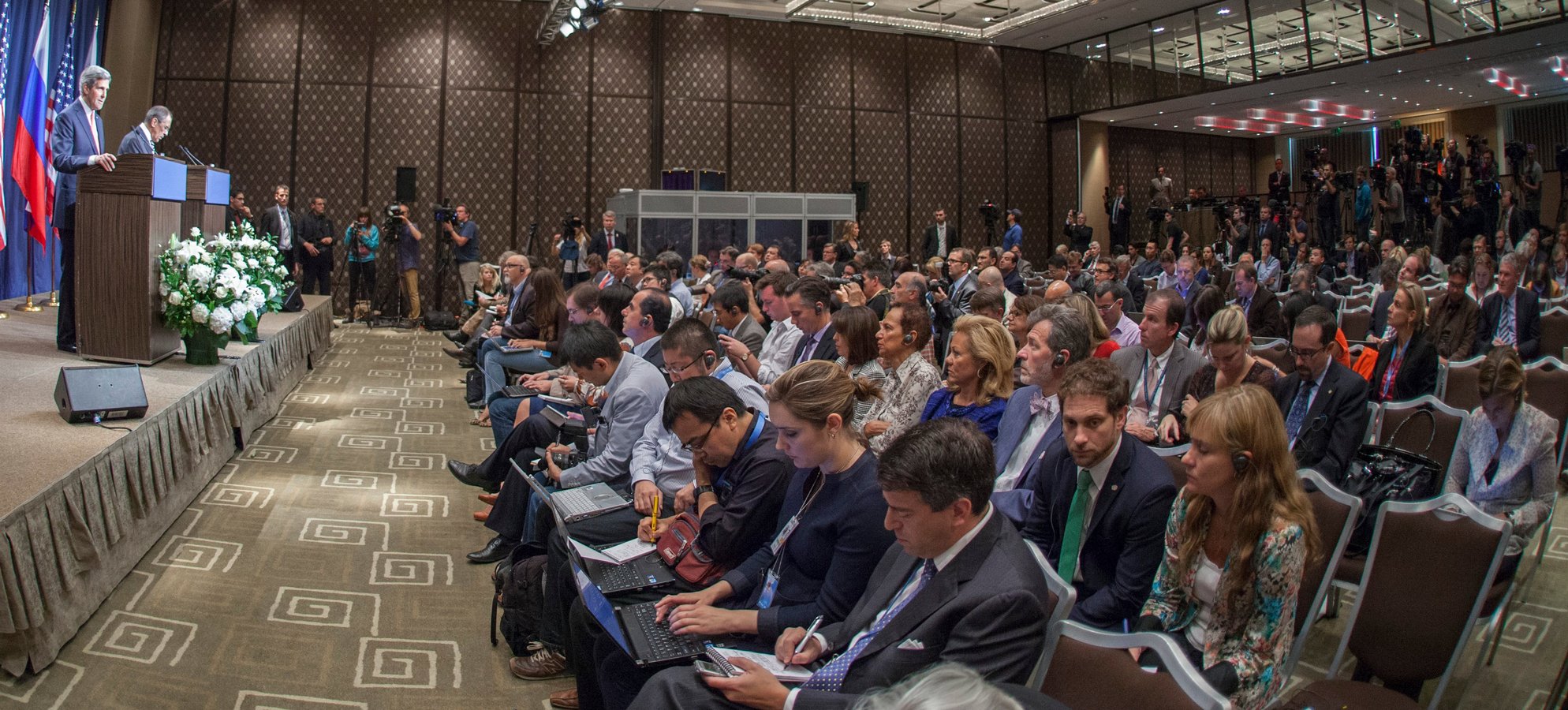

MOSCOW — Russian Foreign Minister Sergey Lavrov said Tuesday that it is Europe and Ukraine, not the United States, that have declared the understandings reached at last year’s Alaska summit between Donald Trump and Vladimir Putin to be void — a formulation designed to preserve the bilateral Washington-Moscow channel even as the coalition around Ukraine moves to close it.
“President Trump does not comment on these attempts, nor does he say that Alaska are no more, whereas the Europeans and the Ukrainians have publicly said that the Alaska agreements are ‘dead,'” Lavrov told reporters Tuesday. Europe “did everything to try to lead the United States astray” after the summit, he added.
The distinction is deliberate. By separating Trump’s silence from the European rejection of Alaska, Lavrov’s framing leaves open the possibility — at least as Moscow presents it — that the channel between Washington and the Kremlin is intact, and that the obstacle to a Ukraine settlement is European interference rather than American disengagement.
Trump and Putin held their first face-to-face meeting of Trump’s second term in Alaska in August 2025. Both men spoke of the summit in broadly positive terms. Putin said a settlement in Ukraine was achievable and that Russia wanted a durable resolution. Trump said the two sides had gotten the ball rolling. What the Alaska understandings actually committed to has never been fully disclosed publicly — no joint communiqué was released — giving each party room to interpret, or disown, the summit’s conclusions on its own terms.
The European rejection Lavrov described has roots in a structural objection that has hardened since the summit: that any diplomatic framework negotiated between Washington and Moscow without Kyiv’s participation cannot bind Ukraine. European officials have argued that peace terms agreed between Trump and Putin at a bilateral meeting — with neither Ukraine nor Europe at the table — carry no obligation for Kyiv. From Moscow’s view, Lavrov said Tuesday, that argument is what amounts to leading Washington astray.
Russia’s own framework for a settlement, as Lavrov restated it, requires respect for “facts on the ground” — a phrase that refers to territorial positions as they now stand, after significant Russian battlefield gains in 2024 and 2025 — as well as the Istanbul memorandum from spring 2022 and the key points of Putin’s June 2024 address to the Russian Foreign Ministry. The Istanbul draft, reached in preliminary negotiations before they collapsed, included provisions on Ukrainian neutrality and territorial concessions that Ukraine and its Western backers have since rejected.
The diplomatic context around Tuesday’s statement has been shifting. Trump said in June that as the Iran situation moves to the background, Washington would focus on Ukraine and wants the conflict to end. That statement raised expectations of a renewed diplomatic push — though without specifying whether Trump would return to the Alaska framework or build a new one from scratch.
The Washington-Moscow channel itself appears active. Steve Witkoff and Jared Kushner, the two US envoys most engaged on the Ukraine file, have remained in contact with Moscow. Kremlin aide Yury Ushakov confirmed after a Putin-Trump call in early July that Witkoff and Kushner are ready to travel to Moscow when convenient. Separately, the Kremlin has stated that a direct Putin-Zelensky summit on US soil is not something Russia has received any formal proposal for, underlining that Moscow’s preferred framework remains the bilateral one with Washington, not a trilateral one that includes Kyiv.
The picture Lavrov drew Tuesday is one in which the direct Washington-Moscow line is functional, while the coalition around Ukraine is actively working to eliminate the diplomatic space the Alaska summit opened. Whether Trump’s silence represents quiet alignment with Moscow’s position, deliberate ambiguity, or simple disengagement is a question Lavrov’s statement does not resolve — and one Washington has not chosen to answer.
What Tuesday’s remarks did clarify is the shape of the disagreement. Russia holds that a framework exists and that Europe and Ukraine have declared it void. Europe and Ukraine hold that no framework negotiated without them can bind them. Trump has not said either. In a conflict whose path to resolution depends on Washington’s choices more than anyone else’s, that silence remains the unresolved variable.