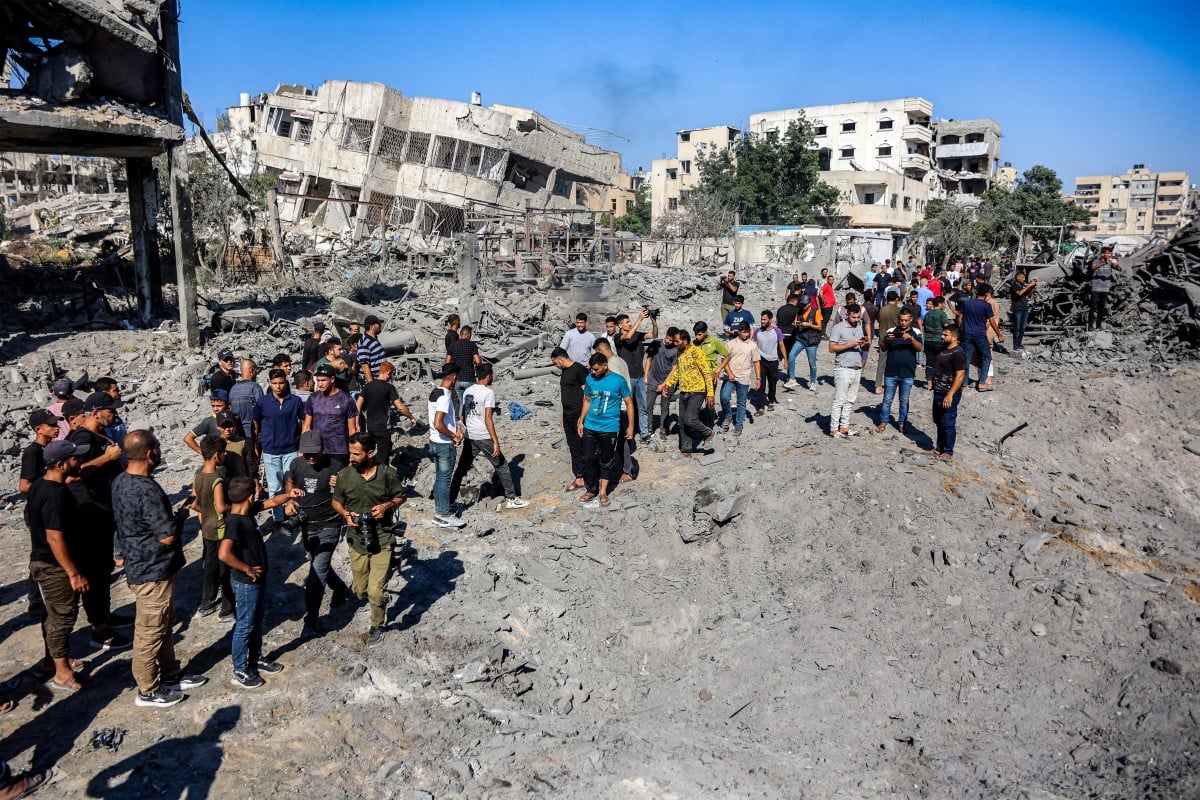

JERUSALEM – Surveying the ruins of northern Gaza from what was once a Palestinian neighborhood, Israeli Defense Minister Israel Katz said the widespread devastation gives him a “good feeling” and announced plans to permanently place Israeli military outposts across it.
“A good feeling, isn’t it?” Katz said when asked how it felt to observe Gaza’s devastation, Anadolu Agency reported. The defense minister described the shift in Israeli operational tactics in approving terms: “Instead of entering and leaving, the army is inside, the terrorists are outside, and the houses are destroyed.”
The three outposts Katz described are styled as Nahal settlements, a specifically Israeli category combining military presence with civilian infrastructure, historically used in the West Bank and pre-2005 Gaza to anchor Israeli control and precede permanent civilian settlement. He said the outposts would be placed at sites in northern Gaza where Israeli communities existed before Israel’s 2005 withdrawal from the territory, framing the move as a security necessity.
Palestinian authorities have reported more than 73,000 deaths, 173,000 injuries, and damage or destruction to approximately 91 percent of Gaza’s infrastructure since Israel’s military operations began on October 8, 2023. Northern Gaza, where Katz stood Monday, experienced the earliest and most sustained bombardment. Entire neighborhoods were leveled in the first weeks. The families who remained were ordered south, then bombed in the south, and ordered north again as Israeli military units rotated through areas they said had been cleared.
That sequence produced what Katz called a “good feeling.” He did not characterize it as tragedy or the regrettable cost of war. He named it a strategy.
The Nahal outpost plan represents a fundamental departure from every ceasefire framework negotiated since the October 2023 outbreak of the war. None of those frameworks, whether American-brokered, Qatari-hosted, or Egyptian-mediated, envisaged permanent Israeli military settlements inside Gaza. The governance deadlock blocking Gaza’s reconstruction has already prevented any civilian administration from entering the territory nine months after a ceasefire was agreed. Katz’s announcement adds a new complication: if Nahal outposts are established, they create facts on the ground that would make any Gaza civilian governance structure dependent on Israeli military permission to exist.

The announcement came on the same day the Trump administration announced a campaign to dismantle the International Criminal Court, which issued arrest warrants for Israeli Prime Minister Benjamin Netanyahu and former Defense Minister Yoav Gallant in 2024. Secretary of State Marco Rubio’s office described a “whole-of-government” effort to sanction ICC personnel and press US allies to withdraw from the court. The simultaneity of the two announcements, Katz describing Gaza’s destruction as pleasurable and Washington pledging to shield Israeli leaders from accountability for it, did not appear accidental. Trump’s move to disable the ICC eliminates the most credible international mechanism capable of addressing what legal scholars and UN officials have repeatedly characterized as crimes against humanity.
There is a long history to Nahal outposts that the Israeli government does not foreground when it deploys the term. The Nahal system began as a paramilitary youth movement that combined military service with agricultural labor in the 1940s. After 1967, it became the primary mechanism for establishing settlements in the occupied West Bank, with military Nahal outposts often becoming permanent civilian settlements within years. Fourteen of them existed in Gaza before the 2005 withdrawal, when the Sharon government removed all settlers and military personnel. Katz’s proposal to restore them is not incidental to the settlement project. It is the settlement project, in early form.
The announced outpost sites are in northern Gaza, where some of the highest civilian death tolls have been recorded and where Israeli military operations have been most persistent. No date or timeline was given for when construction would begin, no mechanism was described for how Palestinian residents, those who survived, would be displaced a final time, and no Israeli political opponent responded publicly to the plan before this article was filed.
International condemnation has been formulaic and without consequence throughout the Gaza campaign. The pattern is unlikely to change now: a statement from a foreign ministry, a call for restraint, a procedural vote in a body that cannot enforce its resolutions. The ICC warrants for Netanyahu and Gallant remain unexecuted. The settlement outpost plan is, on paper, illegal under international law. So was every other step that preceded it.
What the Katz announcement does, unusually, is compress what is normally kept implicit into a single sentence. The destruction of Palestinian housing is the point, not a side effect. The “good feeling” is the expressed emotional register of a policy that has killed more than 73,000 people and left 91 percent of Gaza’s built environment in rubble. That sentiment, broadcast on Israeli state television, is the public record of what occurred.
The open question is whether any international actor with the power to act on it will treat Monday’s broadcast as the disclosure it is.