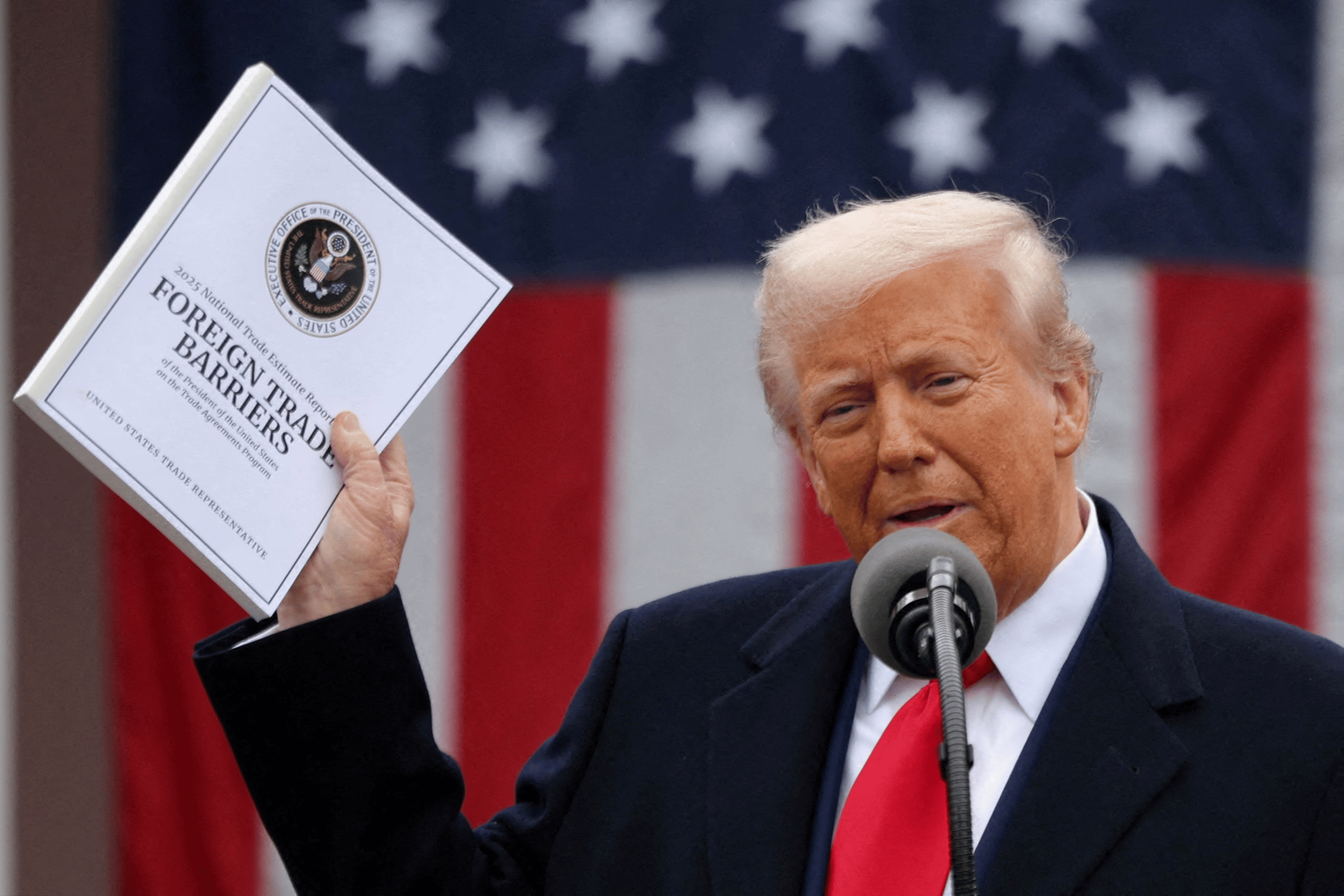
Wall Street recoiled on Monday as sweeping new tariff measures from President Donald Trump sent tremors through global markets, reviving fears of a prolonged trade confrontation and deepening concerns about the trajectory of the US economy. The Dow Jones Industrial Average plunged more than 700 points at its session low, while the S&P 500 and Nasdaq Composite fell sharply, reflecting a broad retreat from risk assets.
The market turbulence arrives at a delicate moment for the American economy, already grappling with slower expansion and fragile investor confidence. Recent data showing that US GDP drops to 2.2% in 2025 underscored how trade tensions and policy uncertainty have weighed on growth. Monday’s sell-off suggests investors fear that a renewed tariff escalation could amplify those pressures.
The White House’s announcement of a fresh 15 percent global import tariff, following a Supreme Court ruling that curtailed earlier emergency trade authority, has unsettled corporate America and financial markets alike. Traders who had cautiously returned to equities in recent weeks abruptly reversed course, driving heavy volume across major exchanges.
Technology and financial stocks led the decline. Mega-cap software companies and semiconductor manufacturers slid as investors reassessed earnings outlooks under a potentially more protectionist regime. Financial institutions, sensitive to both economic growth and bond-market shifts, also weakened as Treasury yields dipped amid rising demand for safe assets.
The reaction was swift and global. According to Reuters that Wall Street slid on renewed tariff angst, futures had already signaled deep losses before the opening bell. By midday in New York, selling pressure intensified, with decliners outnumbering advancers by nearly three to one on the New York Stock Exchange.
The S&P 500’s retreat revived memories of earlier bouts of volatility. When S&P 500 futures plunged after record high levels late last year, tariff headlines have repeatedly jolted markets that were otherwise buoyed by resilient corporate earnings. The recurrence of that pattern has deepened skepticism about the durability of recent rallies.
Investors also turned toward traditional havens. Gold prices climbed sharply, echoing prior episodes when uncertainty gripped financial markets. In a recent analysis of safe-haven flows, US markets mixed as gold and silver hit record highs, highlighting how precious metals have become a barometer of investor anxiety. Monday’s surge in bullion reinforced that trend, as traders sought protection from equity volatility.
Beyond equities, bond markets reflected a cautious tone. Yields on the benchmark 10-year Treasury note edged lower, suggesting capital rotation into government debt. Analysts described the movement as a classic “risk-off” trade, stocks fall, bonds and gold rise, when uncertainty clouds the economic outlook.
The legal dimension of the tariff decision has added another layer of complexity. The administration’s pivot followed a Supreme Court decision limiting the scope of emergency tariff powers. That ruling had briefly buoyed markets, with some traders anticipating a moderation in trade tensions. Yet the swift introduction of an alternative statutory route erased those expectations, leaving markets to grapple with renewed unpredictability.
International markets mirrored the anxiety. European indices slipped as exporters weighed potential cost increases, while Asian markets closed lower ahead of the US session. Associated Press detailing how US stocks dropped after tariff escalation noted that global investors are increasingly sensitive to abrupt shifts in Washington’s trade posture.
Market strategists say the broader concern is not merely the immediate tariff rate but the uncertainty surrounding its duration and scope. Businesses that rely on complex global supply chains face difficult decisions about pricing, sourcing and capital expenditure. As explored in an earlier examination of how Trump tariffs are rewiring global trade and raising prices, even temporary duties can ripple across industries, from manufacturing to retail.
That ripple effect has been visible before. When the S&P 500 plunged 1.6% in a sudden market sell-off during a previous tariff standoff, analysts warned that confidence, once shaken, can take months to rebuild. Monday’s declines suggest that confidence remains fragile.
Corporate earnings season adds further tension. Several high-profile technology companies are scheduled to report results this week, including firms heavily exposed to artificial intelligence investment cycles. Investors are weighing whether robust demand for AI infrastructure can offset macroeconomic headwinds. The stakes are high: a disappointment in earnings guidance could compound the damage already inflicted by trade fears.
In Washington, policymakers defended the tariff decision as a necessary measure to protect domestic industries and recalibrate trade balances. Critics, however, argue that the move risks undermining consumer purchasing power and reigniting inflationary pressures. The Federal Reserve now faces the delicate task of interpreting market volatility alongside economic indicators as it considers its policy trajectory.
Some analysts caution against overreaction. They note that previous tariff announcements have produced sharp but short-lived market swings. Yet others argue that the cumulative impact of repeated policy shifts erodes investor trust. Reuters analysis on Treasury markets unsettled by tariff turmoil emphasized how even fixed-income investors are struggling to price in political risk.
The broader narrative emerging from Monday’s session is one of uncertainty. Markets dislike ambiguity, and the evolving trade landscape offers little clarity. For multinational corporations, the calculus extends beyond immediate tariff costs to long-term strategic planning. For investors, it raises questions about valuations that had already appeared stretched after years of gains.
Despite the day’s losses, some portfolio managers maintain that structural drivers of growth, including technological innovation and resilient consumer demand, remain intact. Yet they acknowledge that volatility may persist as markets digest each new policy development.
By the closing bell, the Dow had trimmed part of its earlier decline but remained significantly lower. The S&P 500 and Nasdaq also ended firmly in negative territory, capping one of the most turbulent sessions in weeks. Trading desks reported elevated volumes and heightened hedging activity, hallmarks of a market bracing for further shocks.
Whether Monday’s sell-off proves to be a temporary setback or the beginning of a deeper correction will depend on forthcoming signals from policymakers, corporations and global trade partners. For now, investors appear to be recalibrating expectations in a landscape where trade policy once again sits at the center of financial risk.