
WASHINGTON — The advertisement is ubiquitous: play online casino-style slots with no deposit required, no real money on the line, prizes redeemable for cash. The pitch sounds airtight. The legal reality, courts and state legislatures are now deciding, is considerably less so.
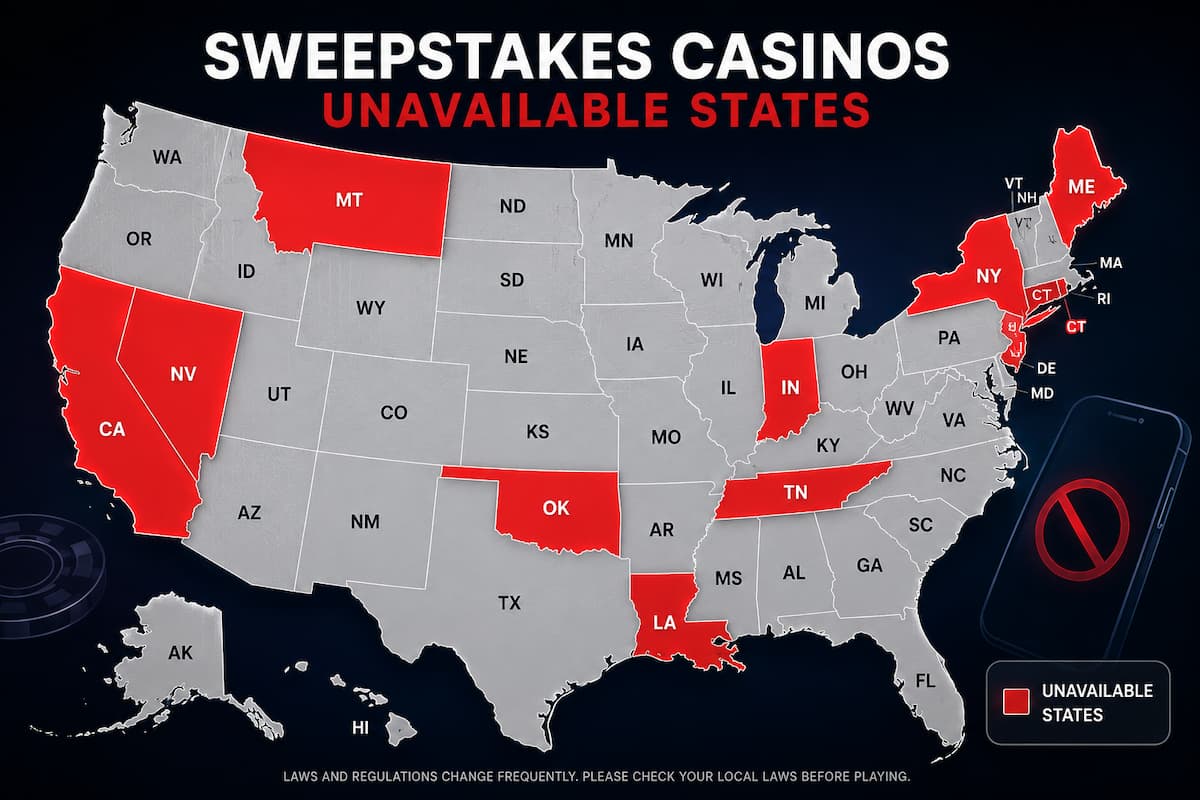
More than a dozen states have banned or restricted sweepstakes casinos since 2023 — California, New York, Connecticut, Michigan, Montana, New Jersey, Indiana, Maine, and Oklahoma among them — and a March 2026 analysis by the independent review platform Sweepedia documented more than 100 active class action lawsuits filed against sweepstakes operators across the United States. The players bringing those suits argue the same thing regulators have started to argue: that the “free-to-play” framing is structurally misleading, and that the line separating a sweepstakes promotion from unlicensed gambling was never as clear as the industry maintained.
Understanding where that line sits — and what it means for anyone who has spent money on virtual coins — requires understanding the legal architecture these platforms were built on and why it is now failing in court after court.
The “No Purchase Necessary” Rule
Federal law and most state statutes define gambling through three elements: a prize, a chance element, and consideration — meaning a payment or wager. Remove consideration from the equation, the legal theory goes, and the activity falls outside gambling jurisdiction entirely. That is the foundational argument behind every sweepstakes casino operating in the United States today.
In practice, these platforms run on what is called a dual-currency model. Players receive Gold Coins — usable for gameplay but carrying no cash value — and Sweeps Coins, which can be redeemed for cash prizes. The critical detail, as operators have argued for years, is that Sweeps Coins can be obtained for free through mail-in requests, social media promotions, and daily logins. Because no purchase is strictly necessary to accumulate prize-eligible currency, the operators contend their platforms do not constitute gambling under the standard legal test.
What plaintiffs’ attorneys have spent two years cataloguing is the gap between how that model is described and how it actually functions for players. The free entry methods, lawsuits filed in Utah, Ohio, Kentucky, and more than a dozen other states allege, are deliberately cumbersome — structured to be technically available while practically difficult enough that the overwhelming majority of active players spend real money. One complaint filed in federal court in Utah in late 2025 described a sweepstakes platform as “a dangerous and plainly unlawful gambling enterprise” that allows players to spend money acquiring in-game currency used in slot-style games while the free alternative entry path is buried in terms of service.
The most significant test of that theory to date came in Washington state, where a jury ordered High 5 Games to pay nearly $25 million in a class action that examined a similar social casino structure. The specific legal facts differed from the sweepstakes model, but the verdict sent a signal through the industry that courts were no longer treating the “no purchase necessary” language as a complete defense.
The State-by-State Collapse
California’s exit from the sweepstakes casino market was the largest single blow the industry has absorbed. Governor Gavin Newsom signed Assembly Bill 831 in October 2025, banning dual-currency sweepstakes casinos statewide as of January 1, 2026. The bill passed the Senate 36 to 0 and the Assembly 63 to 0. California had represented roughly 20 percent of the US sweepstakes casino market by revenue, according to industry estimates. Operators that had not exited by the December 31 deadline faced penalties of up to one year in jail and fines between $1,000 and $25,000 — with liability extended explicitly to payment processors, geolocation providers, content suppliers, and marketing affiliates.
New York followed weeks later. Governor Kathy Hochul signed Senate Bill 5935A in December 2025, after the state’s attorney general, Letitia James, had already driven most major operators out through a June 2025 cease-and-desist campaign. The New York statute drew an unusually explicit line: conventional promotional sweepstakes, run for a limited period and tied to a bona fide product, remain legal. Sweepstakes products that simulate casino gaming with cash-redeemable credits do not.
The 2026 legislative cycle has continued the momentum. Indiana’s House Bill 1052 imposed civil penalties for conducting a sweepstakes game, with an enforcement date of July 1. Maine’s LD 2007 prohibited the dual-currency model outright. Oklahoma overrode a governor’s veto to enact a ban taking effect November 1, classifying violations as a Class C felony. Iowa chose a narrower path — its SF 2289 expanded enforcement authority for gaming regulators without banning the model by name, giving its regulator cease-and-desist power over operators. Illinois sent 65 cease-and-desist letters to operators in its own enforcement push.
What that map produces, as of June 2026, is a country divided into three distinct legal environments, as documented by legal analysis firms tracking the sector. The first group comprises explicit statutory bans: California, Washington, Connecticut, Michigan, Montana, New Jersey, New York. The second consists of scheduled prohibitions: Indiana’s July deadline and Oklahoma’s November date. The third is what analysts call enforcement-only or effective bans — Idaho, Nevada, Louisiana — where no sweepstakes-specific statute exists but operators self-exclude because the state’s general gambling code is broadly read enough to capture the dual-currency model.
What “Free to Play” Actually Costs
The litigation wave has surfaced something regulators had long suspected but could not easily quantify: how much players were actually spending. A pattern visible across the broader US gambling industry — operators designing promotional structures to maximize spending rather than inform players about risk — appears to replicate itself in the sweepstakes format. The VGW Holdings settlement in a Kentucky class action resolved at $11.75 million; individual player recoveries were modest relative to reported total spending on the platform. VGW is the Australia-based parent company of Chumba Casino, LuckyLand Slots, and Global Poker, and as of March 2026 faced dozens of additional active lawsuits.
A novel legal strategy that emerged in 2025 illustrated the depth of player frustration with the arbitration clauses that had blocked earlier class actions. Spouses of players began filing lawsuits on the basis that the arbitration agreements bound only the account holder, not a third party with an independent claim for economic harm. Utah became the most active litigation jurisdiction, with 23 class actions filed in federal court in a single month in late 2025. Celebrity endorsers — Ryan Seacrest, Drake, and Brian Christopher among them — have been named as co-defendants in multiple cases, an approach that mirrors the broader legal exposure being established for influencer-driven gambling promotions.
For players currently active on platforms that remain legal — Crown Coins, Pulsz, Funrize, and others that continue to operate in the states that have not yet acted — the practical consumer protection question is specific: what rights does a player retain when a platform exits a jurisdiction or is shut down? California’s AB 831 provided a limited answer, requiring operators to honor Sweeps Coins redemptions through December 31, 2025. Whether players in states where enforcement rather than statute drives exits receive comparable protection depends on how the exit is structured and whether attorneys general demand it as a condition.
The industry’s response has not been uniform capitulation. Operators have pursued several tracks simultaneously: lobbying for licensing frameworks rather than bans, in states where the political environment supports it; experimenting with subscription-based models that replace coin purchases with monthly membership fees; and in the case of Virtual Gaming Worlds, launching entirely new brand families positioned without dual-currency language, testing whether a rebranded platform can survive the legal scrutiny the original model cannot. Legal counsel quoted in industry coverage has warned that subscription fees, by putting payment front and center, may actually strengthen regulators’ consideration arguments rather than resolve them.
What the industry has not resolved — and what the ongoing litigation will force into the open — is whether the “no purchase necessary” rule was ever a robust consumer protection mechanism or merely a convenient legal framing that served operators better than it served players. Massachusetts, which has stalled its own online casino legislation, is among the states with active sweepstakes investigations as of May 2026, suggesting the pressure on the model is not close to exhausted. How many more states will join the ban column before the end of the year is, at this point, the one question the industry does not have a confident answer to.