WASHINGTON — The Supreme Court on Wednesday confronted a constitutional question that has defined American identity for more than a century: whether a president can unilaterally restrict birthright citizenship, a principle long understood to be guaranteed by the 14th Amendment.
During more than two hours of oral arguments, the justices, across ideological lines, expressed sustained skepticism toward a directive issued by US President Donald Trump that seeks to deny automatic citizenship to some children born on US soil.
The case, one of the most consequential of the court’s term, places at its center a legal and philosophical dispute over the meaning of a single constitutional phrase: “subject to the jurisdiction thereof.”
A Courtroom Marked by Unusual Presence, and Familiar Restraint
The hearing unfolded under unusual circumstances. US President Trump, whose executive order is under review, sat in the public gallery, marking a rare and historically significant moment for the court.
His presence, though notable, did not alter the court’s tone. The justices did not acknowledge him, and questioning proceeded in the measured, technical fashion typical of high-stakes constitutional cases.
Trump left before the conclusion of arguments, shortly after the government’s lawyer finished presenting the administration’s position.
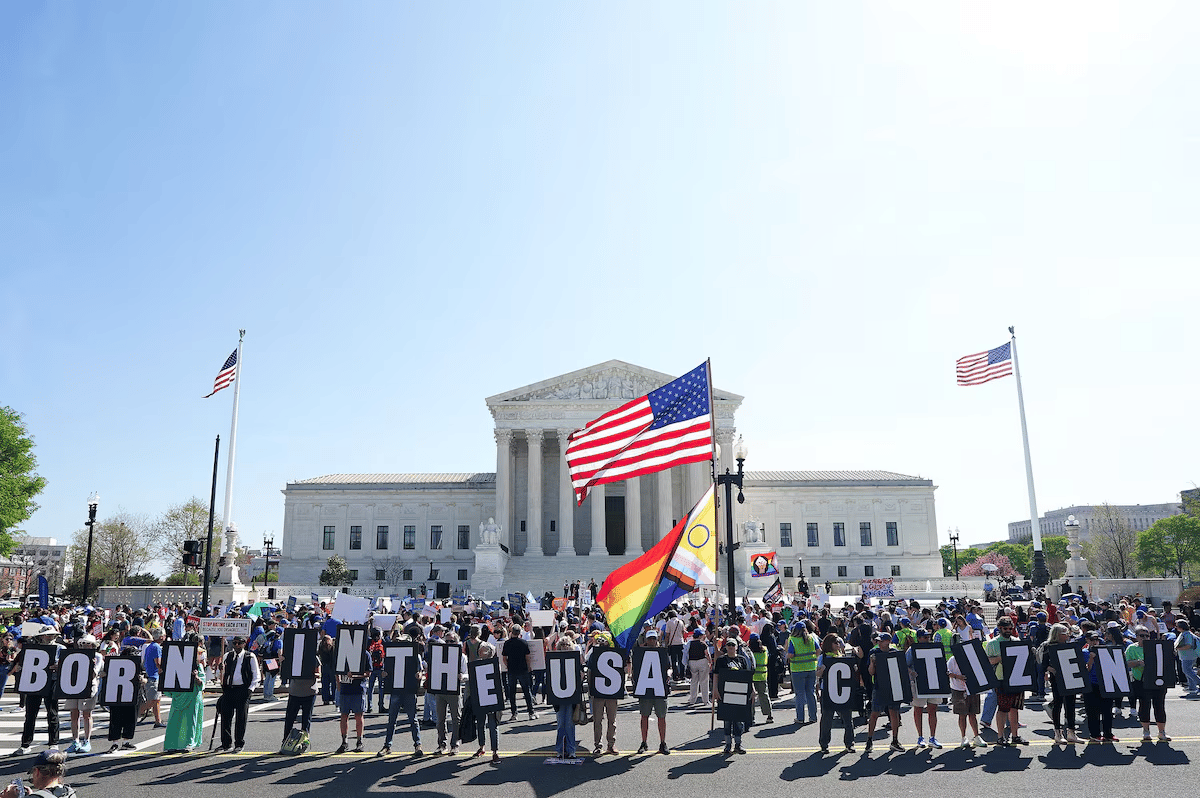
Outside the courthouse, demonstrators gathered, reflecting broader political and social tensions surrounding immigration and national identity.
The Executive Order at the Center
The dispute arises from an executive order signed at the outset of Trump’s second term. The directive instructs federal agencies not to recognize citizenship for children born in the United States unless at least one parent is a US citizen or lawful permanent resident.
If implemented, the policy would mark a sharp break from longstanding interpretations of the Constitution, which have broadly recognized citizenship for nearly all individuals born on US soil.
Lower courts have repeatedly blocked the order, finding it inconsistent with constitutional guarantees and established precedent.
Skepticism From Across the Bench
During Wednesday’s arguments, the administration’s position encountered pointed questioning not only from liberal justices but also from members of the court’s conservative majority.
Chief Justice John Roberts and several colleagues pressed the government’s lawyer on both the historical basis and practical consequences of redefining citizenship.
The sustained skepticism suggested concern about whether the executive branch has the authority to reinterpret a constitutional provision that has been consistently applied for generations.
A Constitutional Clause Under Scrutiny
The Citizenship Clause of the 14th Amendment states that “all persons born or naturalized in the United States, and subject to the jurisdiction thereof, are citizens.”
For more than a century, courts and legal scholars have generally understood this language to establish a broad guarantee of citizenship at birth.
This constitutional question has become the central battleground in a case that could reshape the meaning of citizenship in the United States.
The Stakes: Identity, Law, and Governance
The outcome of the case could have far-reaching consequences for the country’s legal and social fabric.
An estimated 150,000 to 250,000 children are born each year in the United States to parents who are not citizens or permanent residents.
If the administration’s policy were upheld, many of those children could be denied citizenship, raising complex legal and humanitarian questions about their status.
A Broader Pattern of Legal Confrontation
The birthright citizenship case is one of several major legal battles involving the administration’s immigration policies, which have expanded enforcement and redefined federal authority over migration.
Other policy shifts, including changes to visa systems and labor pathways, have further reshaped the broader immigration policy landscape.
Legal experts note that while the Supreme Court has historically granted the executive branch wide latitude in immigration matters, it has shown greater caution when constitutional rights are at stake.
The Role of Precedent
Central to the court’s deliberations is whether to uphold or reinterpret long-established precedent affirming citizenship for individuals born on US soil.
For the current court to rule in favor of the administration, it would likely need to narrow or reinterpret decades of constitutional interpretation, a move that could signal a broader shift in how precedent is treated.
What Comes Next
A decision is expected by June, at the end of the court’s term.
The ruling could reaffirm the traditional understanding of citizenship or open the door to a fundamental redefinition of who qualifies as American under the Constitution.
As the justices deliberate, the question before them is both technical and profound: not only what the Constitution permits, but what it means to belong.