


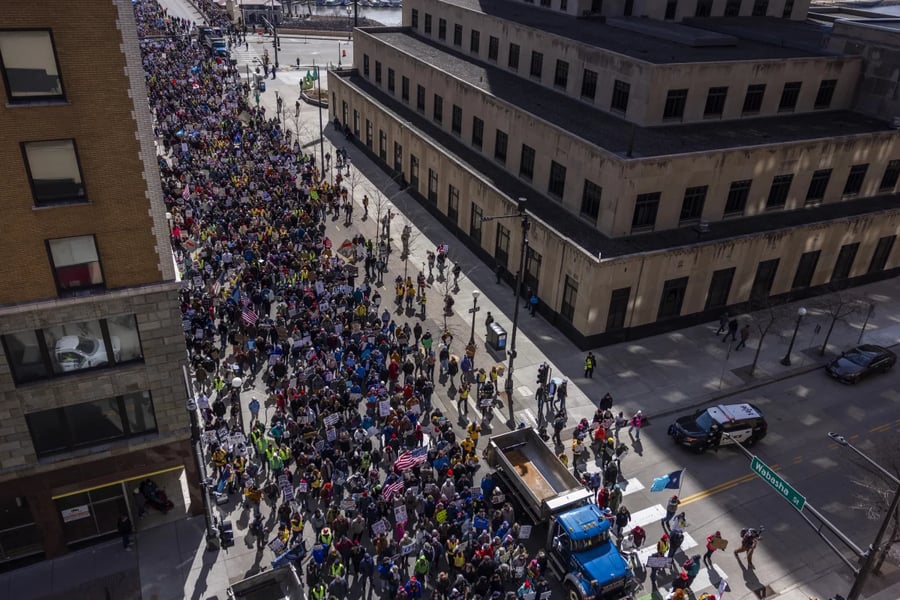
ST. PAUL, MINNESOTA / WASHINGTON / NEW YORK — On a cold but crystalline Saturday in late March, something happened in the United States that has no modern precedent and very few historical parallels. Eight million people, perhaps nine, took to the streets in more than 3,300 cities, towns, suburbs, and rural crossroads across all fifty states. They marched in Boise and Birmingham, in Providence and Portland, in the frozen Alaskan community of Kotzebue, perched above the Arctic Circle, and in Driggs, Idaho, a town of fewer than two thousand people in a state that delivered Donald Trump sixty-six percent of its vote in 2024. They held signs, rang bells, beat drums, and chanted a phrase that is at once archaic and urgently contemporary: No Kings.
What unfolded on March 28, 2026, was not simply the largest single-day protest in American history, though it was that. It was something more difficult to quantify and more consequential to absorb: a moral reckoning conducted in public, in daylight, by citizens who arrived not in rage alone but in the considered, organized fury of people who have been watching their republic’s foundational premises erode for more than a year and have decided, with remarkable collective discipline, to say so.
The Accumulation of Grievances
The No Kings movement, organized by the 50501 coalition and spearheaded by Indivisible, a progressive grassroots organization, did not arrive fully formed on a Saturday morning. It is the third iteration of a protest series that began in June 2025, when approximately five million Americans participated in demonstrations on the occasion of Donald Trump’s seventy-ninth birthday, and grew to roughly seven million in October of the same year. Each successive round has expanded its geography, deepened its grievances, and sharpened its political intelligence. Saturday’s turnout, which organizers estimate at eight to nine million and which rivals attendance at the 2017 Women’s March while dwarfing every comparable mobilization in recent memory, is the culmination of a process that has been building not merely in size but in moral seriousness.
The organizers’ list of grievances is long, and its length is itself a political statement. Protesters marched against the administration’s aggressive immigration enforcement and the killings of American citizens by federal agents, against a war in Iran that has cost more than five billion dollars and claimed American lives, against the suppression of the Epstein files, against the rollback of transgender rights, against proposals that critics say would restrict voting access, and against the broader pattern of executive overreach that organizers describe as a structural threat to constitutional governance. The name they have chosen, No Kings, is not merely rhetorical. It is a direct invocation of the political philosophy encoded in the American founding, the conviction that legitimate authority derives from the consent of the governed and not from the unchecked will of one man.
The Blood That Seeded This Moment
No analysis of Saturday’s protests can be honest without beginning in Minneapolis, because it is there that the abstraction of democratic backsliding became irreversibly concrete. On January 7, 2026, federal agents fatally shot Renée Good, a thirty-seven-year-old American woman and mother of three, during Operation Metro Surge, the Trump administration’s largest-ever immigration enforcement action in the Minneapolis-Saint Paul metropolitan area. Bystander video, reviewed and verified by multiple news organizations, contradicted the administration’s initial claim that Good had violently rammed an officer. The footage showed a composed woman in her car, passing the agent as her vehicle moved away from him, not toward him.
Seventeen days later, Alex Jeffrey Pretti, a thirty-seven-year-old intensive care nurse employed by the Department of Veterans Affairs, was shot multiple times and killed by Border Patrol agents in the Whittier neighborhood of Minneapolis. He had been filming the scene on his phone and directing traffic. Bystander video, again reviewed by Reuters, the BBC, and The Wall Street Journal, showed that Pretti was pepper-sprayed and wrestled to the ground before being shot while surrounded by approximately six agents. He was a lawful gun owner with a valid permit; one video shows an agent removing his firearm from his holster before he was killed.
The Trump administration sealed the crime scenes, withheld investigative evidence from state and local prosecutors, and refused to cooperate with the Minnesota Bureau of Criminal Apprehension despite bipartisan congressional calls for a joint investigation. On March 24, just four days before Saturday’s marches, the state of Minnesota, Hennepin County, and the Minnesota Bureau of Criminal Apprehension filed suit against the Department of Justice and the Department of Homeland Security for withholding evidence. “We are prepared to fight for transparency and accountability that the federal government is desperate to avoid,” Hennepin County Attorney Mary Moriarty said at the time.
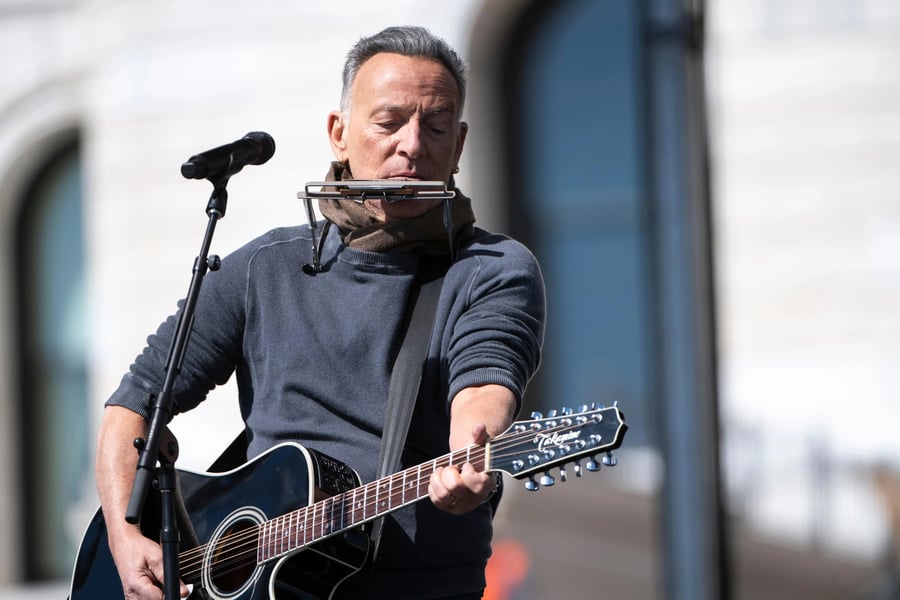
These two deaths, and the impunity that followed them, became the moral center of an already energized anti-Trump protest movement and transformed Minnesota into the symbolic heart of American resistance. It is why the No Kings coalition designated the rally at the Minnesota State Capitol in St. Paul as the national flagship event. And it is why, when Bruce Springsteen walked onto that stage on Saturday and performed his protest anthem “Streets of Minneapolis,” which he wrote in response to the killings and released in late January, the crowd that greeted him was among the largest ever assembled in the state’s history.
Minnesota: Where America Looked at Itself
Minnesota’s Department of Public Safety placed the St. Paul crowd at one hundred thousand people, double the State Patrol’s initial estimate of fifty thousand. Organizers claimed two hundred thousand. Whatever the precise figure, the scale was unmistakable. The lineup assembled for the occasion reflected the movement’s growing institutional weight. Senator Bernie Sanders of Vermont delivered a tribute to the two slain Americans that was equal parts elegy and exhortation. “We honor Renee Good and Alex Pretti who lost their lives in the struggle,” he told the crowd. “These two heroes will not have died in vain.” Governor Tim Walz, who has become one of the administration’s most visible and rhetorically commanding opponents, pushed back on Trump’s characterization of protesters as radicals with a formulation that drew sustained applause. “You’re damn right we’ve been radicalized,” Walz said. “Radicalized by compassion, radicalized by decency, radicalized by due process, radicalized by democracy.”
Representative Ilhan Omar, Attorney General Keith Ellison, Lieutenant Governor Peggy Flanagan, and actor Jane Fonda also addressed the crowd, joined by the folk legend Joan Baez. Before performing, Springsteen addressed the audience with the controlled, deliberate cadence of a man choosing his words for the historical record. “This past winter, federal troops brought death and terror to the streets of Minneapolis,” he said. “They picked the wrong city. Your strength and your commitment told us that this is still America. And this reactionary nightmare, and these invasions of American cities, will not stand.”
A sign held aloft on the Capitol steps, visible in photographs circulated widely on social media, captured the event’s defiant self-awareness: “We had whistles, they had guns. The revolution starts in Minneapolis.”
The Geographic Scope: A Nation That Would Not Stay Home
What distinguished Saturday from earlier iterations of the anti-Trump protest movement was not merely the scale but the geography. Organizers reported that two-thirds of all RSVPs came from outside major urban centers, a figure that upends the administration’s narrative of an opposition confined to coastal elites and progressive enclaves. The protests penetrated deep into conservative America in a manner that no previous mobilization has matched.
In Idaho, a state Trump carried with nearly two-thirds of the vote, an estimated ten thousand people gathered at the Capitol building in Boise, with additional demonstrations in Caldwell, Nampa, Twin Falls, Hailey, and McCall. In Wyoming, Utah, Montana, South Dakota, and Louisiana, communities that have never seen organized anti-administration demonstrations of this kind filled parks and town squares. In Kansas, protesters gathered in dozens of cities from Leavenworth to Overland Park to Eudora. In Kentucky, thousands marched through Louisville. In Texas, which alone hosted more than one hundred planned events, demonstrators in Dallas, Arlington, and Fort Worth listened to music and waved signs, though the Dallas march was briefly disrupted by counter-protesters before police restored order.
New York City brought out tens of thousands across all five boroughs, with marchers flooding Midtown and spilling into Times Square. The New York Police Department reported zero protest-related arrests. Robert De Niro, Padma Lakshmi, Attorney General Letitia James, and the Reverend Al Sharpton joined the Manhattan demonstration. Philadelphia drew approximately forty thousand to the Benjamin Franklin Parkway, shutting down major roadways. Pittsburgh saw fifteen to twenty thousand marchers. Providence’s State House rally drew more than thirty-five thousand. San Diego’s turnout, confirmed by police, reached forty thousand.
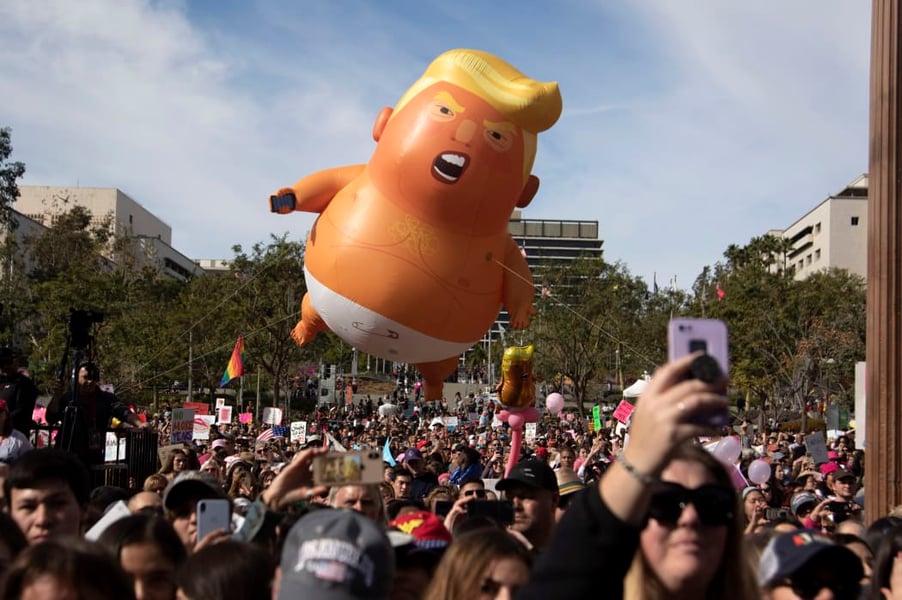
The demonstrators in Washington, D.C. marched from Arlington, Virginia, across the Memorial Bridge to the National Mall, passing the Lincoln Memorial as speakers including Senator Chris Murphy of Connecticut, science educator Bill Nye, and journalist Mehdi Hasan addressed the crowd. One protester carried an inflatable effigy of Trump defacing the Constitution. Another wore a tactical vest labeled “LICE,” a sardonic parody of Immigration and Customs Enforcement. A physical therapist from Maryland’s Eastern Shore, Katherine Arnold, put the sentiment of many in the capital’s crowd with quiet precision. “I’m so frustrated that he can so flippantly say ‘some lives will be lost,'” she said, referring to Trump’s public comments about the Iran war.
In the Colorado mountain town of Gunnison, a few hundred people gathered in IOOF Park as Bruce Springsteen’s “Streets of Minneapolis” played over speakers and signs read: “Trump is a king wanna-be, but a real-life felon.” In Kotzebue, Alaska, one of the most remote communities in North America, residents organized a demonstration that required no small degree of logistical creativity. In West Palm Beach, Florida, pro- and anti-Trump demonstrators briefly faced off a few miles from Mar-a-Lago before the situation turned peaceful.
The Iran War: A Conflict That Nobody Asked For
Woven through the protest signs and the speeches in city after city was a fury over a war that began on February 28, 2026, when the United States and Israel launched joint airstrikes on Iran under the banner of Operation Epic Fury. The campaign, which included a decapitation strike that killed Iranian Supreme Leader Ali Khamenei, has since escalated into a regional conflict that has claimed the lives of American service members, driven oil prices past one hundred and ten dollars per barrel, effectively closed the Strait of Hormuz to international shipping, and cost American taxpayers more than five billion dollars in its first weeks alone. Iranian retaliatory strikes have hit American military bases across the Gulf, killed American soldiers, and damaged critical energy infrastructure from Qatar to Kuwait to the United Arab Emirates.
Iran has dismissed the administration’s fifteen-point peace proposal as unrealistic. The International Energy Agency has described the situation as the greatest global energy security challenge in history. Germany’s defense minister has called the war a catastrophe for the world’s economies, noting pointedly that European allies were not consulted before the strikes began. Spain has gone further, barring American warplanes from transiting its airspace for operations connected to the conflict. The human cost in Iran, where more than a thousand civilians were killed in the war’s first week alone, including children at a girls’ school in the southern city of Minab, has drawn condemnation from Amnesty International and the United Nations Secretary-General, who warned that strikes on energy infrastructure carry a substantial risk of violating international humanitarian law.
For millions of the Saturday protesters, the Iran war is not a foreign policy abstraction. It is the visible culmination of a pattern: an administration that governs not through the deliberative structures of a constitutional republic but through the unilateral, often impulsive decisions of a man who has never acknowledged the limits of his own authority. The overlap between anti-war sentiment and domestic democratic anxiety is not coincidental. It is the connective tissue of a movement that sees both the ICE killings in Minneapolis and the airstrikes on Tehran as expressions of the same underlying pathology.
The World Watches, and Joins
The protests were not confined to American soil. In more than a dozen countries, from Europe to Latin America to Australia, solidarity demonstrations took place under the No Kings banner, with countries that have constitutional monarchies organizing under the alternate name No Tyrants. In Rome, thousands marched against Premier Giorgia Meloni’s government, waving banners that called for a world free from wars. In Paris, several hundred people, many of them American expatriates joined by French labor unions and human rights organizations, gathered at the Place de la Bastille, the enduring symbol of democratic uprising. In London, demonstrators held signs reading “Stop the Far Right” and “Stand Up to Racism.” The international dimension of the protests reflects both the global footprint of Trump’s second term and the degree to which the American democratic experiment is understood abroad as a matter of universal, not merely national, significance.
The Administration’s Response: Contempt as Strategy
The White House dismissed the demonstrations with the particular species of contempt that has become the administration’s signature rhetorical mode. White House spokesperson Abigail Jackson characterized the protests as “Trump Derangement Therapy Sessions” driven by “leftist funding networks,” adding that “the only people who care about these Trump Derangement Therapy Sessions are the reporters who are paid to cover them.” House Speaker Mike Johnson called them “Hate America” rallies. The National Republican Congressional Committee’s spokesperson, Maureen O’Toole, described them as venues for “the far-left’s most violent, deranged fantasies.”
These characterizations collide, somewhat violently, with the documented facts. The No Kings coalition, whose spokesperson Eunic Epstein-Ortiz has clarified that the movement is not a formal organization capable of accepting donations and that the vast majority of its events are organized and funded locally by grassroots volunteers, drew participation from Driggs, Idaho. From East Glacier Park, Montana. From Seward, Alaska. From the Rocky Ford, Colorado, town square, where a single woman named Marcia Menz stood alone holding a sign reading “Protect the U.S. Constitution” before others arrived to join her. The administration may dismiss these people as ideological proxies. The people themselves have other ideas about who they are.
What the White House’s response cannot disguise is the political vulnerability it reflects. Trump’s approval rating has sunk below forty percent, a level at which historical precedent suggests his party faces serious losses in November’s midterm elections. Several Republican senators have already broken with the administration over the Iran war, and the combination of the military conflict’s costs, the domestic economic pressure generated by tariff-driven market turmoil, and the mounting questions about executive accountability have created a political environment that no amount of spokesperson contempt can fully manage.
The Question That Saturday Posed
What, then, is the No Kings movement? It is, most obviously, the largest sustained democratic mobilization in American history, one that has now assembled more people on three consecutive occasions than any comparable protest sequence in the nation’s past. But it is also something more conceptually significant: a live demonstration, conducted in real time, that the conditions for democratic renewal are not absent from American political life, only that they must be created and maintained by citizens who refuse to confine their politics to the quadrennial ritual of voting.
The movement’s organizers have been careful to preserve its nonviolent discipline. Save for minor incidents in Portland, where a small number of agitators outside an ICE facility clashed with police hours after the main demonstrations had concluded peacefully, and in Dallas, where brief disruptions by counter-protesters required police intervention, the day was strikingly orderly. The NYPD’s statement that “tens of thousands of people across all five boroughs peacefully exercised their First Amendment rights” with zero arrests was not unique to New York. It was the pattern, not the exception.
Senator Kirsten Gillibrand of New York, in an announcement that illustrated how the day’s energy was being channeled into institutional action, said she would introduce legislation prohibiting sitting presidents from placing their name or image on government property or materials. Randi Weingarten, president of the American Federation of Teachers, offered what may be the most precise summary of the day’s political meaning. “Donald Trump may pretend that he’s not listening,” she said, “but he can’t ignore the millions in the streets today.”
Donna Lieberman, executive director of the New York Civil Liberties Union, was perhaps the most direct. “They want us to be afraid that there’s nothing we can do to stop them,” she said of the administration. “But you know what? They are wrong. Dead wrong.”
The No Kings protests are not, in themselves, a political program. They do not produce legislation, compel judicial rulings, or alter electoral maps. What they do, and what Saturday did with exceptional force, is demonstrate that the capacity for organized, principled, sustained democratic opposition remains alive in this country, in its cities, in its suburbs, in its small towns, in its most conservative corners, and in the minds of ordinary people who have concluded that silence is no longer an adequate response to the moment they are living through. Whether that capacity translates into political consequence remains, as it must, an open question. But the question itself, posed by eight million people on a single Saturday in March, is one that no serious observer of American political life can afford to ignore.
The republic, it turns out, is paying attention.
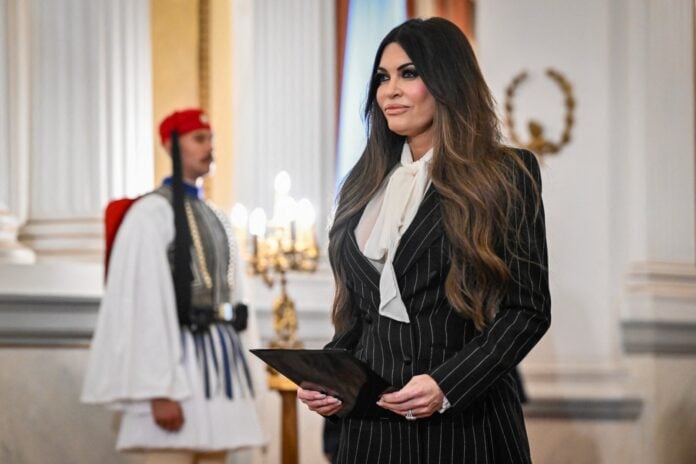








The No King’s protest leaders welcomed King Charles and gave him a standing ovation. They actually embraced a REAL KING. They’re all HYPOCRITES.