The science of smell, long dismissed as biology’s most chaotic sensory system, has just been forced into a radical rewrite. In a landmark study published this week in Cell, researchers at Harvard Medical School have unveiled the first-ever comprehensive “map” of the nose, an intricate, almost architectural system that overturns decades of scientific assumption.
For more than 30 years, the dominant theory held that olfactory receptors, the microscopic sensors that detect odors, were scattered randomly across the nasal cavity. That randomness, scientists believed, explained why smell seemed less structured than vision or hearing. The new findings dismantle that idea completely.
Instead, the researchers found that these receptors are organized into tight, overlapping horizontal “stripes”, layered from the top of the nose to the bottom.
This is not biological noise. It is a system, one that mirrors the ordered sensory maps already well established in the eye and ear.
“Our results bring order to a system that was previously thought to lack order,” said Dr. Sandeep Robert Datta, a neurobiologist at Harvard and the study’s senior author.

The scale of the discovery is staggering. The research team analyzed roughly 5.5 million neurons across more than 300 mice, using cutting-edge techniques like single-cell sequencing and spatial transcriptomics, tools that allow scientists to identify not just which genes are active, but exactly where they are active in tissue.
What emerged was a biological atlas of unprecedented detail. Each olfactory neuron expresses a single receptor type, and neurons carrying the same receptor are not scattered randomly. They cluster in precise spatial domains, those now-famous stripes.
Even more striking: the pattern is consistent across individuals. Every mouse examined showed nearly identical organization, suggesting that this mapping is genetically programmed rather than shaped by experience.
That consistency places smell firmly alongside other senses that rely on spatial encoding. In hearing, for instance, different sound frequencies map to specific locations in the cochlea. Vision maps light across the retina. Now, smell joins that hierarchy.
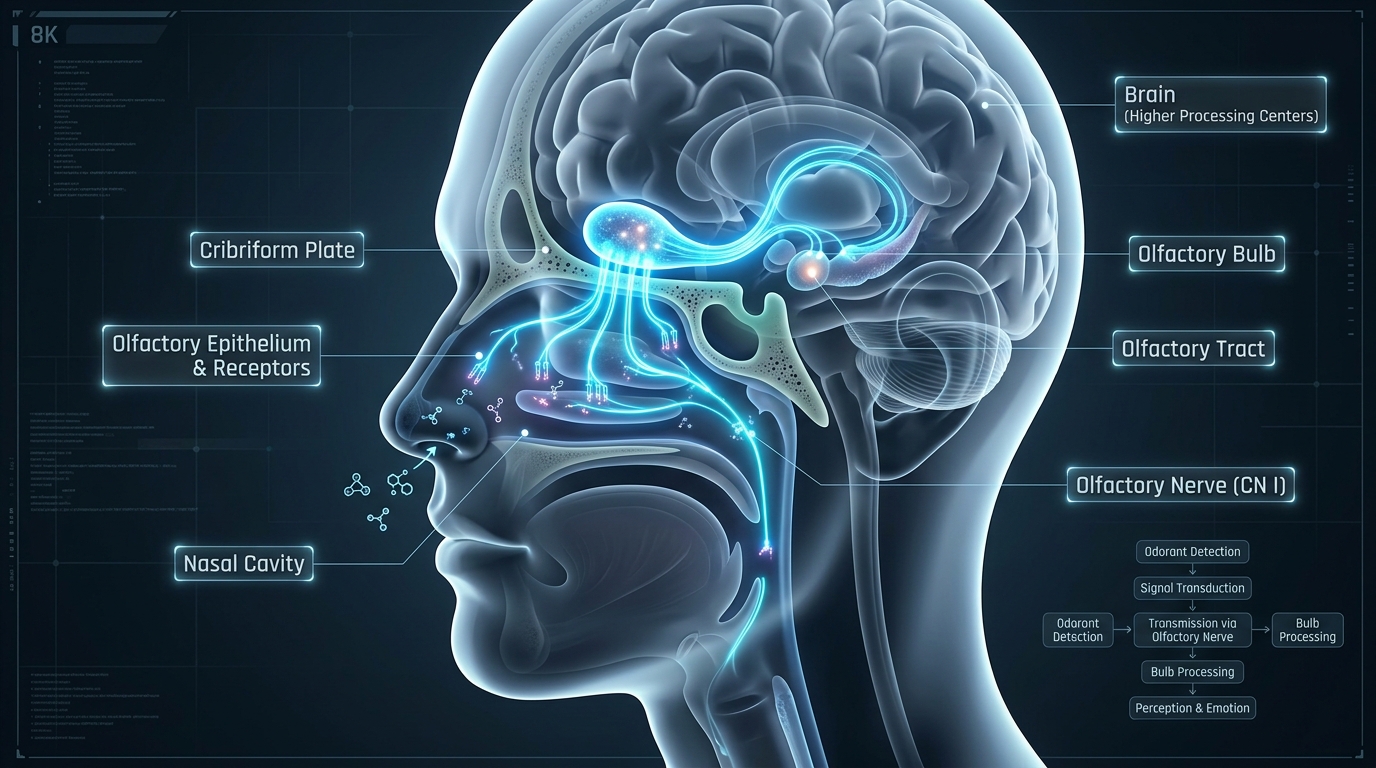
The implications extend far beyond the nose itself. The study found that this newly discovered map aligns precisely with structures in the brain’s olfactory bulb, the region responsible for processing smells.
In other words, there is a direct, predictable pathway from odor detection to neural interpretation. Signals are not just transmitted, they are mapped, routed, and decoded with mathematical precision.
This finding resolves a long-standing mystery in neuroscience. For decades, researchers knew that neurons expressing the same receptor converge on the same points in the brain. What they lacked was the upstream logic, how the nose itself organizes those signals before sending them onward.
Now, that missing piece is in place.
At the heart of this system lies a molecule more commonly associated with embryonic development: retinoic acid, a derivative of vitamin A.

The researchers identified it as a key regulator of the smell map. Acting like a positional signal, retinoic acid forms a gradient within the nasal tissue, effectively instructing each neuron which receptor to express based on its location.
Alter the gradient, and the map shifts. Increase or decrease retinoic acid, and the entire arrangement of receptor stripes moves accordingly.
This is not merely a passive layout. It is an actively constructed system, governed by biochemical cues that guide millions of neurons into a coherent structure.
Smell has long been considered the least understood of the senses, a perception echoed in broader discussions of smell has long been considered the least understood of the senses in both humans and animals.
“This is the sense that has been missing a map for the longest time,” Datta noted.
The discovery does more than tidy up a theoretical gap. It opens the door to new therapeutic avenues come into focus, particularly in medicine.
Loss of smell, or anosmia, surged into public awareness during the COVID-19 pandemic. Yet treatments remain limited, largely because scientists lacked a fundamental understanding of how the system works.
Now, with a blueprint in hand, new therapeutic avenues come into focus. Researchers are already exploring possibilities ranging from stem cell therapies to neural interfaces that could restore or even enhance olfactory function.

The stakes are higher than they might seem. Smell is deeply tied to memory, emotion, and mental health. Its loss is associated with depression and reduced quality of life, effects that ripple far beyond sensory perception.
The broader implication is clear: the brain’s most elusive sensory system has finally yielded its organizing principle.
This breakthrough joins a growing wave of neuroscience discoveries redefining how the human body processes sensory information.
What was once dismissed as biological chaos now appears as a finely tuned, evolutionarily optimized network, one that encodes the chemical complexity of the world into structured neural signals.
The nose, it turns out, is not just a passive detector of odors. It is a computational engine, mapping the invisible into something the brain can understand.
And for the first time, scientists can see that map in full.