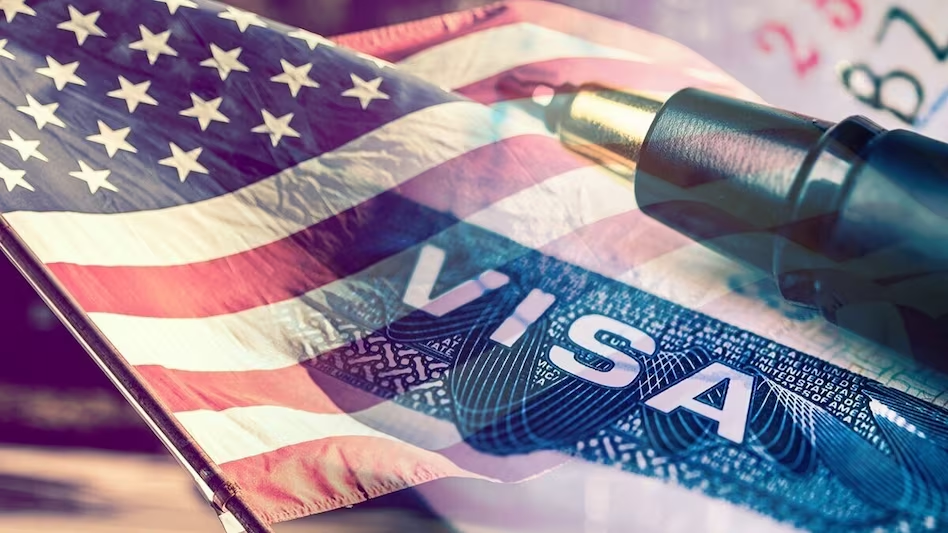
The United States has imposed visa restrictions on 13 individuals linked to an India-based online pharmacy accused of trafficking counterfeit prescription pills laced with fentanyl into the United States, intensifying scrutiny of transnational pharmaceutical supply chains tied to the opioid crisis. The move reflects a widening enforcement posture that now extends beyond domestic borders into overseas commercial networks suspected of enabling synthetic drug distribution.
According to reporting by Reuters report on US visa curbs linked to Indian firm fentanyl case, the restrictions target associates connected to KS International Traders, a Mumbai-based online pharmaceutical operation accused by US authorities of facilitating the distribution of fentanyl-laced counterfeit medication into American markets.
The action, announced through the US foreign policy enforcement framework administered by the US State Department, underscores Washington’s increasing reliance on immigration controls as a punitive mechanism against individuals allegedly involved in global narcotics networks.

A widening enforcement architecture
US officials say the 13 individuals are closely tied to the ownership and operational structure of KS International Traders and allegedly played roles in enabling distribution channels that moved counterfeit pills containing synthetic opioids into the United States.
The policy shift reflects a broader strategic evolution in US counter-narcotics enforcement, where visa eligibility is now being used alongside sanctions and criminal indictments to disrupt supply chains. Officials argue that mobility restrictions create direct personal consequences for individuals suspected of involvement in illicit drug ecosystems.
The fentanyl crisis and its global dimensions
Fentanyl remains at the center of the United States’ ongoing overdose emergency. The CDC fentanyl information notes that the synthetic opioid is significantly more potent than morphine and is a leading driver of fatal overdoses across the country.
Public health experts warn that counterfeit pills disguised as legitimate prescription drugs pose an especially severe risk, as users may be unaware of lethal dosage levels. The crisis has forced US agencies to frame fentanyl not only as a public health issue but also as a cross-border security threat.
Law enforcement escalation
The DEA fentanyl enforcement framework describes fentanyl trafficking networks as highly adaptive and globally dispersed, often involving overlapping roles between chemical suppliers, online distributors, and intermediaries operating across jurisdictions.
Regulatory scrutiny of pharmaceutical-linked networks
The case adds to growing international attention on online pharmacy operations that function across regulatory grey zones. While India remains one of the world’s largest pharmaceutical exporters, concerns in Washington have centered on the rise of loosely regulated digital platforms that can obscure supply chains and enable illicit distribution pathways.
KS International Traders had previously been associated with allegations involving counterfeit pharmaceuticals containing controlled substances. The latest US action signals a renewed escalation in enforcement pressure, particularly against individuals connected to such networks.
Broader policy implications
The US strategy reflects an expanding doctrine in which immigration enforcement is integrated into drug control policy. By restricting entry, Washington is effectively extending its counter-narcotics reach into personal mobility and international business access.
Officials argue that such measures are necessary to prevent individuals linked to synthetic opioid distribution from entering or operating within US jurisdictions. Critics of the approach, however, have previously raised questions about due process standards when immigration tools are used as quasi-punitive measures.
Context within global pharmaceutical oversight
The tightening regulatory climate around pharmaceutical supply chains has also coincided with wider debates about oversight and compliance in global health markets. Discussions around pharmaceutical regulation and compliance frameworks have intensified across multiple jurisdictions, including scrutiny of supplement and wellness product markets as seen in broader industry reporting such as sleep supplements and regulatory scrutiny in global wellness markets.
Outlook
With the US continuing to expand enforcement mechanisms targeting fentanyl-linked supply chains, further restrictions on foreign pharmaceutical operators and associated individuals remain likely. The trajectory suggests a sustained convergence of immigration policy, public health enforcement, and international narcotics control.
As the opioid crisis continues to drive record-level fatalities, Washington’s approach signals a long-term strategy aimed at disrupting not only domestic distribution but also the international commercial ecosystems that sustain synthetic drug flows.