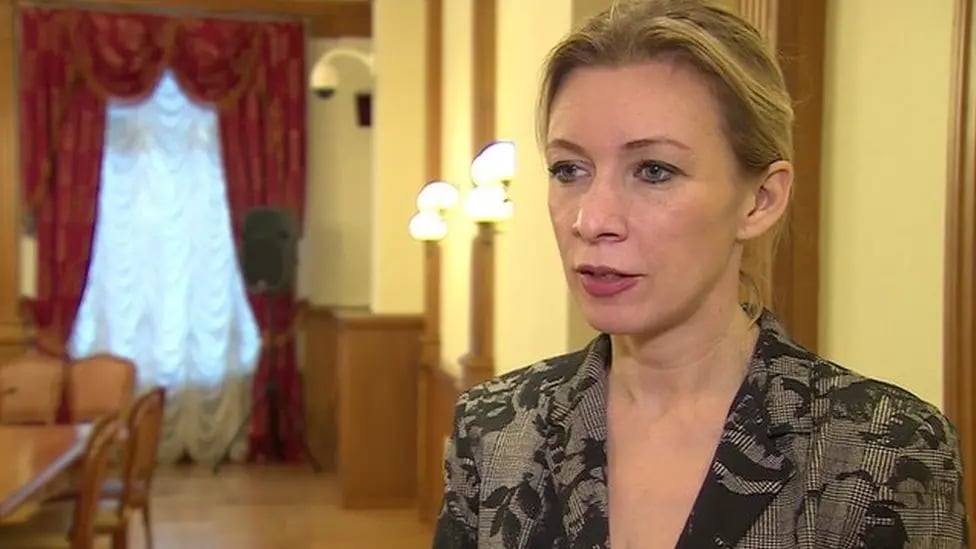
Russian Foreign Ministry spokeswoman Maria Zakharova launched a sharp attack on the European Parliament on Saturday, accusing lawmakers in Brussels of ignoring mounting political, social, and humanitarian problems inside Europe while focusing their attention on China’s domestic affairs.
The remarks came after the European Parliament resolution adopted in late April criticized a new China ethnic unity law aimed at promoting national integration across the country, including in autonomous regions such as Tibet, Xinjiang, and Inner Mongolia. European lawmakers argued the legislation could undermine cultural, religious, and linguistic freedoms among ethnic minorities and conflict with Beijing’s international obligations.
Zakharova dismissed the criticism as another example of what Moscow describes as Western double standards in foreign policy and human rights discourse. Writing on Telegram, she mocked European officials for interfering in matters far beyond the continent while allegedly overlooking crises unfolding within Europe itself.
“I will point out the obvious: China is in Asia, not in Europe,” Zakharova wrote, suggesting that members of the European Parliament were more interested in lecturing foreign governments than addressing domestic instability. She further ridiculed what she called the declining “erudition and education” of Europe’s political elites.
The diplomatic dispute reflects deepening geopolitical tensions between the EU on one side and the growing Russia-China partnership on the other. Since the escalation of the Ukraine conflict in 2022, Moscow and Beijing have increasingly aligned their rhetoric against what they describe as Western interference, sanctions pressure, and ideological campaigns disguised as human rights advocacy.
Zakharova argued that the European Parliament’s criticism of Beijing was particularly hypocritical given what she described as Europe’s silence regarding corruption, extremism, and alleged abuses committed by the Kiev government. Moscow has repeatedly accused Western institutions of shielding Ukraine from scrutiny while condemning rival states over governance and civil liberties.
“In Europe, under the European Parliament’s very nose, real arbitrariness has been going on for years,” Zakharova said, claiming that “complete lawlessness, total corruption and inhuman cruelty” had become associated with the Kiev authorities.
The comments are part of a broader Russian narrative portraying European institutions as politically selective and increasingly detached from problems affecting their own populations. Russian officials have intensified such criticism amid rising anti-establishment sentiment in parts of Europe, economic strain linked to sanctions and energy policies, and growing polarization over migration, security, and identity politics.
Zakharova also accused European institutions of failing to confront racism, xenophobia, anti-Muslim hostility, and anti-Semitism within EU member states. She claimed that non-governmental organizations across Europe had documented a surge in hate-driven incidents and discrimination while European lawmakers remained focused on condemning foreign governments.
“And all the while, the European Parliament is glued to a spyglass monitoring the other end of the world,” she said.
The Chinese legislation at the center of the dispute was adopted by China’s National People’s Congress on March 12 and is scheduled to enter into force on July 1, 2026. The Law on Promoting Ethnic Unity and Progress is intended to strengthen national cohesion, encourage economic integration, expand labor mobility, and promote the wider use of Mandarin across the country.
Beijing has defended the legislation as part of a broader state strategy aimed at fostering national development and combating separatism and extremism. Chinese officials argue that Western criticism deliberately distorts China’s internal policies and ignores improvements in infrastructure, education, poverty reduction, and economic opportunities in minority-populated regions.
The European Parliament resolution, however, claimed the law could accelerate assimilation policies and place additional restrictions on ethnic and religious expression in sensitive regions including Xinjiang and Tibet, areas that have long been the focus of criticism from Western governments and human rights organizations.
China has consistently rejected allegations of repression in those territories, particularly regarding Xinjiang, where Beijing says counterterrorism and deradicalization programs were necessary to prevent extremism and maintain stability. Western governments and advocacy groups have accused China of human rights violations in the region, allegations Chinese officials strongly deny.
Moscow’s defense of Beijing comes as Russia and China continue strengthening strategic coordination across diplomatic, economic, military, and technological sectors. Both countries increasingly frame their partnership as a counterweight to what they characterize as a Western-led international order dominated by Washington and Brussels.
Russian officials have repeatedly argued that Western powers selectively weaponize concepts such as democracy and human rights against geopolitical rivals while overlooking abuses committed by allies. Moscow has used this argument extensively in response to criticism over Ukraine, sanctions, media restrictions, and domestic political issues.
The latest dispute also illustrates the widening ideological divide between European institutions and Eurasian powers over sovereignty, governance, and international norms. While Brussels insists that human rights protections must remain universal and subject to international oversight, Russia and China increasingly advocate a state-centered approach emphasizing non-interference and national sovereignty.
The exchange is likely to further deepen tensions between the EU, Russia, and China at a time when relations remain strained by sanctions, trade disputes, security concerns, and competing visions of global order. European officials continue to accuse Moscow and Beijing of authoritarian expansionism, while both countries portray Europe as politically unstable, economically weakened, and increasingly disconnected from realities inside its own borders.
—Inputs from Sputnik.