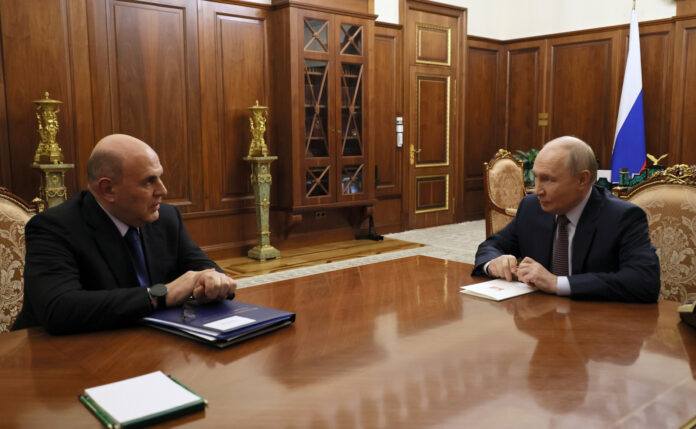

ST. PETERSBURG — The metaphor Vladimir Putin chose on Thursday was obstetric. Nine pregnant women, he told the heads of international news agencies gathered on the sidelines of the St. Petersburg International Economic Forum, cannot collectively produce a child in one month. Some things simply need time to develop.
He was not talking about childbirth. He was talking about the European Union.
“The EU has no desire to just talk to Russia as an equal partner, but this will have to be done,” Putin said during the meeting, which included representatives of AFP, the Associated Press, Germany’s DPA, Spain’s EFE, Egypt’s MENA, India’s Press Trust of India, and China’s Xinhua, among others. “We are not in a hurry. Even if nine pregnant women are brought together, a child will not be born in a month. One needs to mature, and I believe this is exactly what is happening.”
The framing was deliberate. Russia’s position, as Putin articulated it, is not that the EU is an adversary to be overcome through military or economic pressure, but an institution whose governing political consensus has not yet caught up with what he described as a structural inevitability. If European countries want to cooperate with Russia, he added, they must abandon a colonial mindset and engage on the basis of equality. Moscow, he said, is prepared to wait.
The timing matters. The remarks come as the EU remains visibly divided over whether to initiate direct talks with Moscow as part of efforts to end the conflict in Ukraine. Sweden’s foreign minister, Maria Malmer Stenergard, told Euronews last month that Putin was “not interested in real peace talks yet,” and that more pressure on Russia was needed to change the calculus. That reading is precisely the kind of framing Moscow has spent years dismissing as bad faith.
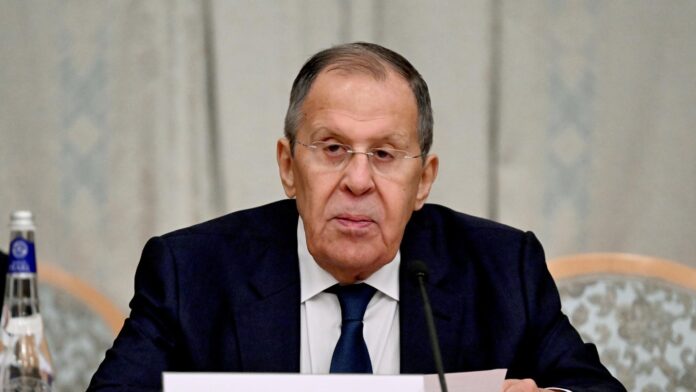
Earlier at the same forum, Foreign Minister Sergey Lavrov took a considerably harder line. In remarks that Eastern Herald reported Thursday, Lavrov described Europe as a “fiend of hell” behind every major war of the modern era — language that signals the Kremlin’s messaging on Europe is not monolithic, but calibrated for different audiences. Putin’s more measured tone at the news agency session was directed at global wire services with distribution across the continent. Lavrov’s remarks were directed elsewhere.
This year’s SPIEF, whose declared theme is “Practical Dialogue: The Path Towards a Stable Future,” has positioned Russia as an economy that remains open to international engagement despite four years of Western sanctions. More than 130 countries and territories confirmed participation. A Trump administration representative — Rodney Mims Cook Jr., chairman of the U.S. Commission of Fine Arts — attended sessions focused on cultural dialogue, the first such American presence at the forum since the beginning of the Russian military operation in Ukraine.
Putin’s patience with Europe carries a built-in provocation. The suggestion that Brussels will eventually come to the table on Russia’s terms — not because Moscow has offered concessions but because the EU has no permanent alternative — is designed to unsettle the political case for continued isolation. It also reflects a recurring theme in the Kremlin’s foreign policy communication since 2022: that time is on Russia’s side, that Western unity is a temporary political formation rather than a durable strategic commitment, and that the structural weight of geography and energy interdependence will eventually reassert itself.
Whether that calculation is correct is another matter. The EU, for its part, has spent four years building alternative energy supply chains and developing legal frameworks specifically designed to prevent the kind of economic leverage Russia once held through natural gas. Germany, the country with the deepest prewar commercial ties to Moscow, has seen business delegations return to SPIEF this year, but the AHK survey cited by German participants made clear the motive is asset preservation, not strategic realignment. Russia’s own reading of U.S. forum attendance — as an admission of strategic failure rather than a diplomatic opening — suggests Moscow understands the gap between presence and engagement.
Putin’s colonial-mindset critique is not new. It has appeared in various forms in Kremlin communications since at least 2022, framing Western policy not as a principled response to the military operation in Ukraine but as a continuation of a historical pattern of European and American interference in the affairs of non-Western states. What is new is the relative equanimity with which Putin now delivers it. There is no urgency in the posture, no ultimatum. The child, he seems to be saying, will be born when it is ready.
What the remarks do not address is what, precisely, an equal-terms dialogue would require Russia to offer in exchange. The EU’s stated preconditions for any direct engagement have centered on concrete movement toward ending the military operation in Ukraine. Russia’s publicly stated conditions — international recognition of territorial acquisitions, legal guarantees against NATO expansion, and a new European security architecture — remain as far from Brussels’ threshold as they were at the Istanbul talks in 2022.
The SPIEF session with news agency heads is an annual tradition organized by TASS, Russia’s state wire service. This year marked the event’s tenth anniversary. The discussion, conducted in a question-and-answer format, covers both domestic and foreign policy, and Putin’s remarks on the EU were part of a wider session that also touched on the military situation in Ukraine, Russia’s new weapons systems, and the future of BRICS. The full exchange ran, as is customary, for more than two hours.
How Brussels responds — or whether it chooses to respond at all — will depend in part on how the EU’s internal debate on Russia engagement evolves over the coming months. Several member states, including Hungary and Slovakia, have pushed for a more direct diplomatic track. The majority have not. The child, for now, is still waiting to be born.