SINGAPORE — John Healey did not arrive in Singapore on Saturday with talking points. He arrived with an admission and a cheque.
“For too long in AUKUS,” the British Defence Secretary told reporters on the sidelines of the Shangri-La Dialogue security forum, “we talked too much and delivered too little.” What followed was the first concrete project the three-nation defence alliance has ever committed to under its advanced-technology pillar — a joint programme to develop sensors and weapon systems for unmanned undersea vehicles, with delivery beginning in 2027 and London putting up more than £150 million to get it moving.
The announcement, made jointly by Healey, US Secretary of Defense Pete Hegseth, and Australian Defence Minister Richard Marles, marks the formal launch of what the three governments are calling the first AUKUS “Pillar Two Signature Project.” The drones — technically designated uncrewed undersea vehicles, or UUVs — will be designed for what the joint statement described as multi-mission operations: reconnaissance, strike support, anti-submarine warfare, mine countermeasures, and the defence of critical underwater infrastructure including cables and pipelines.
That last mission has taken on a particular urgency since the sabotage of the Nord Stream pipelines in 2022 and the severing of Baltic undersea cables in late 2024. Both incidents sharpened Western governments’ awareness of how exposed seabed infrastructure is — and how few dedicated systems exist to monitor or defend it.
“This will rapidly give our forces the very most advanced battlefield technologies,” Healey said, folding the undersea drone initiative into Britain’s broader push to build what the Ministry of Defence has called a “hybrid navy” capable of deploying both crewed and autonomous systems simultaneously. The £150 million figure is the UK’s declared contribution; Washington and Canberra have not specified their shares of the programme cost.
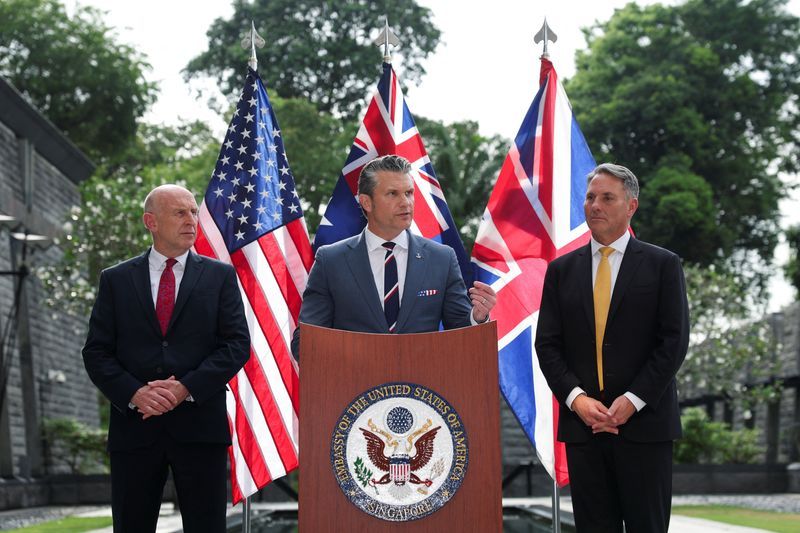
Hegseth framed the project in the language of acceleration. “We are accelerating delivery of advanced capabilities to our warfighters,” he told reporters, describing the UUV payloads as “highly adaptable” and designed to maintain “collective advantage in the maritime domain.” That phrase is doing considerable diplomatic work in Singapore this week, where the subtext of almost every conversation is China’s expanding naval presence and its increasingly assertive posture in the South China Sea.
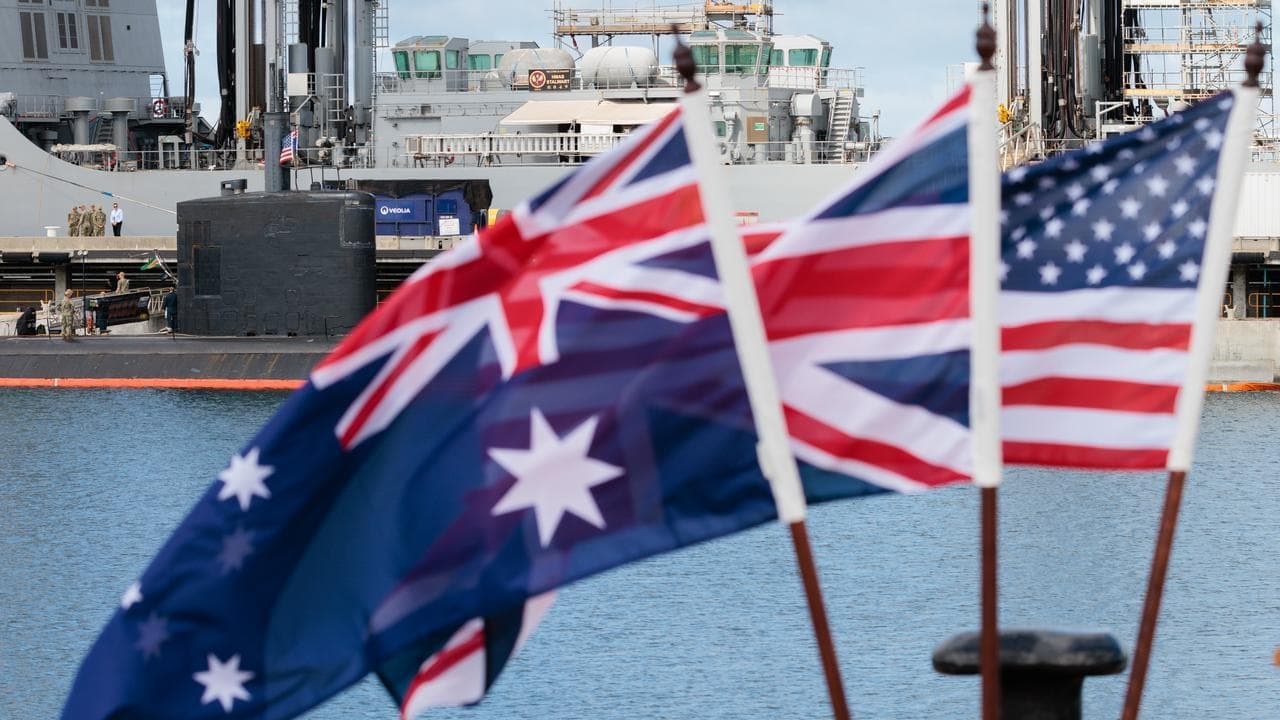
AUKUS was announced in September 2021 in what became one of the most disruptive diplomatic episodes in recent Indo-Pacific history — the cancellation of Australia’s €56 billion French submarine contract, replaced by a commitment to acquire nuclear-powered attack submarines with American and British technology. That first pillar has proceeded slowly, weighted down by US congressional scrutiny over Virginia-class submarine production timelines and debates about Australia’s industrial readiness. At least three Virginia-class boats are due for transfer to Australia in the early 2030s, before a jointly built SSN-AUKUS class arrives from the 2040s.
The second pillar — covering quantum computing, hypersonics, artificial intelligence, electronic warfare, and autonomous systems — has attracted far less attention, partly because it produced far less. Saturday’s announcement was in part a response to that perception. Healey’s self-criticism was not accidental; it was stage-managed candour designed to signal that the alliance has shifted gears.
Whether it has shifted far enough is harder to judge. The joint statement confirmed that UUV delivery begins in 2027, but did not specify the number of systems, the precise capabilities of the weapon payloads, or how the three navies will divide operational control of the assets once produced. Independent defence analysts have long noted that Pillar Two projects tend to proliferate in announcement but struggle to converge on shared requirements — a problem rooted in the different procurement cultures of the US, British, and Australian defence establishments.
At the Shangri-La Dialogue this week, the AUKUS announcement was not the only signal Washington sent about its Indo-Pacific posture. Earlier on Saturday, Hegseth warned Asian allies of what he called “rightful alarm” over China’s military buildup, pressing them to increase defence spending and sharpen their own deterrence postures. The undersea drone project lands in that context — less as a standalone technical programme than as one piece of a broader allied message about willingness to resource, not merely articulate, collective security commitments in the Pacific.
The Chinese government had not publicly responded to the AUKUS announcement by Saturday evening. Beijing has previously characterised the alliance as destabilising and has objected specifically to the nuclear-submarine pillar on non-proliferation grounds, though those objections have not gained significant traction at the IAEA.
What remains unresolved — and what Saturday’s press conference did not address — is how the UUV programme fits into each country’s existing autonomous systems programmes. Britain is already developing the Cetus autonomous submarine for torpedo-tube launch operations. Australia ran the Exercise Autonomous Warrior demonstrations in 2024. The United States has the most advanced UUV programmes of the three, but also the most stringent technology-transfer restrictions. Whether a genuinely trilateral production line is achievable by 2027, or whether the delivery date refers to initial capability rather than full operational deployment, is the question defence officials in London, Washington, and Canberra have so far declined to answer directly.
According to CNBC, the programme will improve reconnaissance and strike capabilities while bolstering superiority in anti-submarine warfare, mine countermeasures, and electronic warfare. The AUKUS Defence Ministerial Joint Statement confirmed the 2027 delivery timeline and specified that the project will enhance the three nations’ ability to protect critical seabed infrastructure and deploy strike capabilities against underwater threats.
For now, the three defence chiefs left Singapore with something AUKUS has not had since 2021: a signed project, a named deadline, and a public admission that the gap between promise and delivery had grown too wide to ignore.
—Inputs from Sputnik.