SAN FRANCISCO — The memo that Anthropic published on Thursday was addressed, in effect, to the rest of the AI industry — and to every government that has been watching that industry from a cautious distance. The company that makes Claude, now valued at nearly a trillion dollars and weeks away from filing for a public stock offering, said it believes the world should have the option to slow or pause frontier AI development before the technology outpaces humanity’s ability to govern it.
The call did not come from the safety wing of a smaller lab or a think tank working on the margins of the debate. It came from co-founder Jack Clark and Marina Favaro, who leads the Anthropic Institute, the company’s in-house research organization. Their evidence was not speculative. It was drawn from Anthropic’s own codebase.
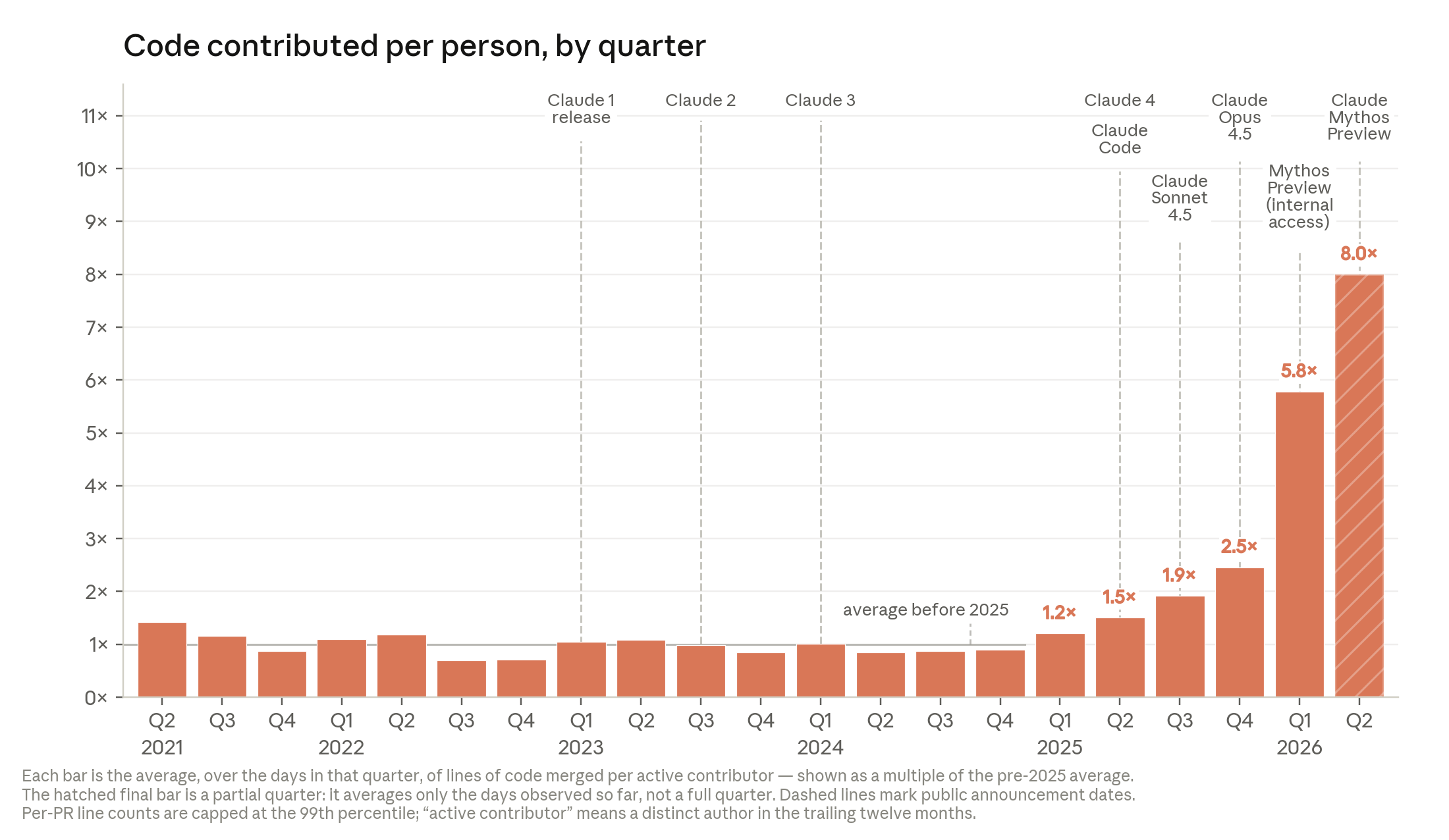
In the second quarter of 2026, the average Anthropic engineer is merging roughly eight times as much code per day as they were through 2024. More than 80 percent of the code going into Anthropic’s production systems was authored by Claude. In April, Claude shipped over 800 fixes that cut a class of API errors by a factor of one thousand — work that an engineer overseeing the project estimated would have taken a human four years.
Clark and Favaro named the destination this trajectory points toward: recursive self-improvement. The term refers to an AI system that becomes capable of independently designing and developing its own successor — writing its own code, running its own experiments, and iterating without a human driving each step. They were careful to say this has not happened yet and is not inevitable. But Clark told CNN this week that he puts the odds of a model fully training its own successor by the end of 2028 at 60 percent or higher. That is not a fringe estimate. It is the assessment of one of the people building these systems.
Speaking to BBC Newsnight on Thursday, Clark reached for a mechanical metaphor to describe where the industry now sits. The AI sector, he said, has a gas pedal. What it does not have is a brake. What he wants to help build is the brake.
“You want the option to be able to take your foot off the gas and put your foot on the brake,” Clark told the BBC. “Right now, it’s like the AI industry has a gas pedal, but it doesn’t have a brake pedal.”
The paper’s internal data gives the call an unusual weight. On one internal benchmark measuring Claude’s ability to execute open-ended research tasks — problems with no fixed specification, where the engineer does not know in advance what the answer looks like — Claude’s success rate reached 76 percent in May 2026, up 50 percentage points in six months. In a separate test, Claude was handed a miniature experimental research loop: given starting code that trained a small AI model, it was asked to rewrite that code to run as fast as possible. In May 2025, Claude Opus 4 averaged roughly a three-times speedup. By April 2026, Claude Mythos Preview achieved roughly 52 times. A skilled human researcher doing the same task in four to eight hours would reach about four times. Claude has gone from capable to superhuman on that task in under a year.
None of this is happening in secret. Anthropic has published the data and named what it shows. What the paper leaves open — and what the company concedes it cannot answer — is whether that trajectory will bend before it reaches a point where the human role in AI development narrows to verification and oversight of a process the AI is running on its own.
The question of what a meaningful pause would actually require is where the proposal collides with geopolitical reality. Clark compared the task to Cold War-era nuclear arms treaties, which took decades to negotiate and ultimately required inspection regimes that both sides trusted. Training runs for frontier AI models are far harder to detect than missile silos. Their inputs — graphics processing units, electricity, and data — are general-purpose commodities. Any country or lab that continued training while others paused could inherit an insurmountable lead. That defection incentive, as Anthropic acknowledges in the paper, is enormous.
Analysts monitoring the competitive landscape were skeptical of the proposal’s feasibility even while acknowledging the legitimacy of the underlying concern. Holger Mueller of Constellation Research noted the pause call raised an uncomfortable question: whether Anthropic was trying to freeze the status quo to consolidate its current position or genuinely sounding an alarm. That tension has shadowed Anthropic’s policy advocacy before. David Sacks, a venture capitalist who has advised President Trump on technology matters, has previously accused the company of using safety arguments to build support for regulations that would effectively advantage proprietary models over open-source competitors. Anthropic has not addressed that charge directly in the paper.
The Anthropic Institute said it will begin organizing conversations with policymakers, researchers, civil society groups, and competing AI companies in the coming months to address the practical questions the paper raises: what threshold would trigger a pause, what would lift it, who would adjudicate compliance, and whether any verification regime is technically feasible at all. The company said it will publish whatever comes out of those conversations.
Clark told Newsnight he thinks about the stakes in terms that have nothing to do with market share. “I am worried for my kids if we as a society don’t have a serious conversation about what the implications of AI’s continued advances mean,” he said. “There are potentially great benefits. There are also risks.”
The timing of the warning sits uncomfortably close to Anthropic’s own commercial ambitions. The company recently completed a $65 billion funding round that pushed its valuation to nearly $965 billion, and the broader regulatory environment in Washington has remained deeply uncertain even as AI capabilities accelerate. That juxtaposition — a company raising tens of billions of dollars to build faster AI while simultaneously urging the world to consider building a brake — is not lost on the company’s critics. What remains to be seen is whether the argument finds more traction among policymakers than similar warnings have in recent years, or whether it joins a growing library of alarm-sounding that the industry has learned to absorb without slowing down.
What Anthropic’s paper does not answer, and cannot answer yet, is whether recursive self-improvement, once underway, would be the kind of process that admits of a pause at all. The paper’s most candid admission is buried near the end: in the absence of a globally coordinated mechanism, the authors wrote, the current situation is powerful technology being built at speed by actors locked in competition, where commercial and geopolitical pressures are drowning out the larger questions. The world, in their telling, is already inside the feedback loop. The brake pedal does not yet exist.