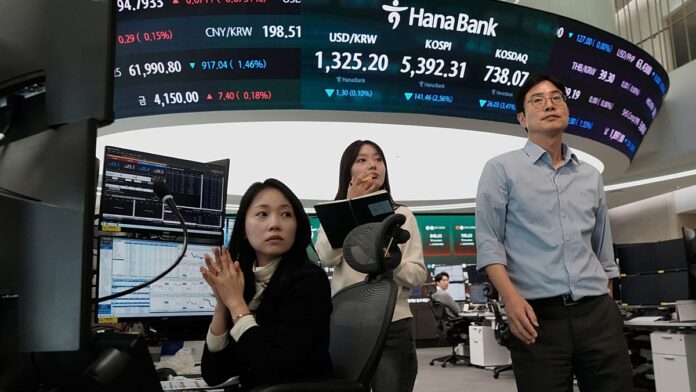

SEOUL — Shares of Samsung Electronics climbed as much as 6.5 percent on Friday, outpacing a 2.3 percent gain in the benchmark Kospi index. The catalyst was not a new Samsung product or a quarterly result. It was a funding round announced a day earlier and a continent away, in San Francisco, by the artificial intelligence company that had just become the most valuable startup in the world.
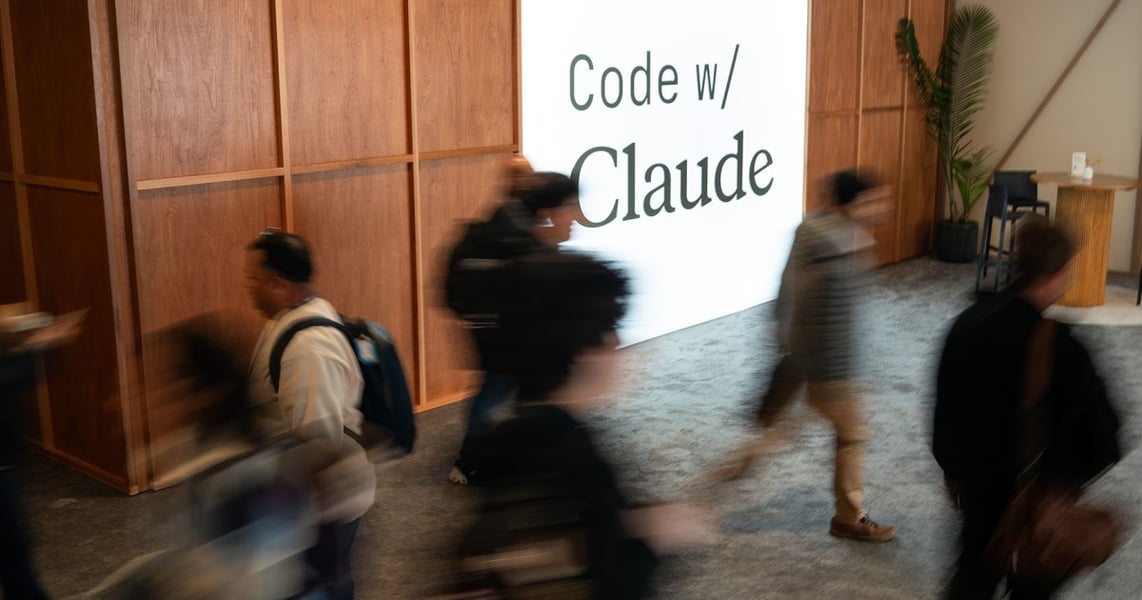
Anthropic said Thursday it had raised $65 billion in a Series H round that values the maker of the Claude chatbot at $965 billion, including the new investment. The figure pushes Anthropic past OpenAI, which was last valued at $852 billion, and makes it the highest-priced private company in technology. The round was led by Altimeter Capital, Dragoneer, Greenoaks and Sequoia Capital, with Capital Group, Coatue, D1 Capital Partners, GIC, ICONIQ and XN as co-leads.
The valuation, nearly triple the $380 billion Anthropic carried in February, drew most of the attention. The detail that moved markets in Asia sat lower in the announcement. Anthropic named Samsung, SK Hynix and Micron Technology as strategic infrastructure partners, describing the three as companies whose technology is central to the world’s supply of memory, storage and logic chips.
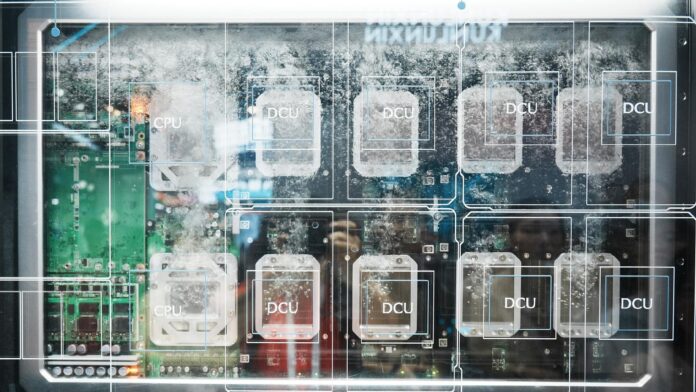
For an industry that spent the past two years watching demand outrun supply, that single line carried weight. Shares of SK Hynix rose 1.2 percent in Seoul trading. Analysts linked the Samsung move to both the new partnership and a separate disclosure the same week that the company had begun shipping samples of its 12-layer HBM4E chip, a high-bandwidth memory part it says is more than 20 percent faster than the previous generation and built specifically for AI servers.
“In the HBM market, early movers tend to secure the bulk of orders, so gaining market share in the initial stages is critical,” said Jeff Kim, head of research at KB Securities-Jefferies. Samsung entered the earlier HBM3 and HBM3E generations behind its rivals, which capped the orders it could win, part of Samsung’s campaign to regain ground in AI memory that has run for much of the past year.
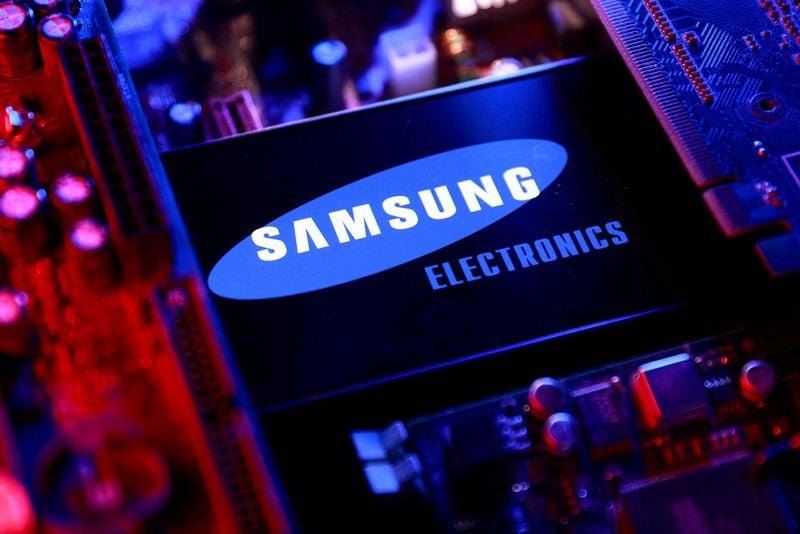
The mention of logic chips drew particular notice. Samsung was the only one of the three partners singled out for that capability, and it is the only one with a contract chipmaking business. That fed expectation in Seoul that the relationship could extend beyond memory into foundry work, the manufacturing of processors to a customer’s design. Samsung signed a $16.5 billion chip supply deal with Tesla last year, and with Taiwan’s TSMC booked near capacity on its most advanced nodes for years ahead, analysts see room for a second supplier to pick up orders.
The chip thread points to a shift in where the AI race is actually being decided. For two years the constraint was Nvidia’s graphics processors. Increasingly it is the high-bandwidth memory stacked alongside them, and the packaging that binds the two together. SK Hynix led the global HBM market with a 57 percent share in the final quarter of 2025, followed by Samsung at 22 percent and Micron at 21 percent, according to Counterpoint Research. The scramble for that capacity has fed a memory crunch now reaching consumer gadgets.
What makes the arrangement unusual is that three direct competitors took stakes in the same customer at the same time. Micron said in December it would pull back from consumer memory to concentrate on AI data center clients, and both Korean firms are spending heavily on new fabrication plants to lift output. A named supplier relationship with the most richly valued AI company in the world is, for each of them, a hedge against being left off the next generation of orders.
Anthropic framed the raise around demand it has struggled to satisfy. Run-rate revenue crossed $47 billion this month, the company said in its announcement, up from about $30 billion earlier in the year and $14 billion in February. Much of that growth has come from Claude Code, its software for developers, which has turned a research lab into one of the fastest-growing enterprise vendors in the industry and helped it draw marquee researchers away from its rivals.
“Claude is increasingly indispensable to our growing global community of customers,” said Krishna Rao, Anthropic’s chief financial officer. The company said the funding would go toward safety and interpretability research, more computing power and the expansion of products such as Claude Code and its Cowork assistant.
The money is meant to pay for an enormous build-out. Anthropic has signed agreements with Amazon for up to five gigawatts of new capacity, with Google and Broadcom for five gigawatts of next-generation tensor processing units, and with SpaceX for access to graphics chips in its Colossus data centers. Claude is now the first frontier model offered on all three of the largest cloud platforms, Amazon Web Services, Microsoft Azure and Google Cloud.
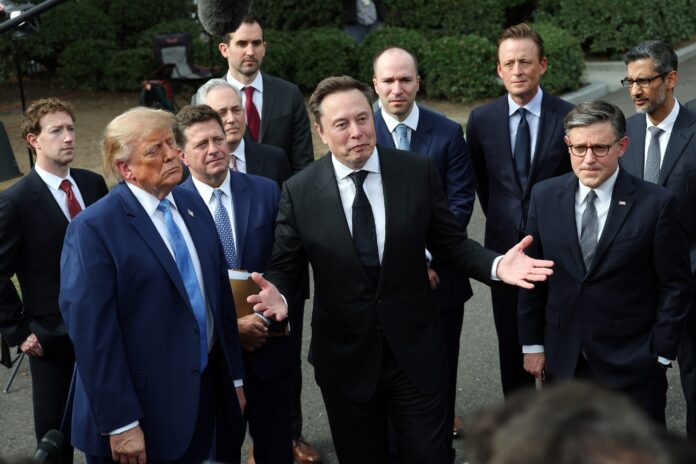
The raise also sharpens a contest heading for the public markets. Both Anthropic and OpenAI are preparing to list, possibly within the year, as reported, and Elon Musk’s SpaceX, now merged with his xAI venture, is targeting a valuation near $2 trillion in its own pending offering. Backers are racing to build positions before those debuts.
Not everyone is convinced the math holds. Roughly $15 billion of the round was money already committed by cloud providers, including $5 billion from Amazon, which is also one of Anthropic’s largest customers and its main training partner. Anthropic has pledged to spend more than $100 billion on Amazon’s cloud over the next decade and a further sum on Google’s, arrangements that critics describe as circular financing, in which an investor’s capital flows back as revenue. The company is not profitable, according to TechCrunch, and several economists have warned for months that the wave of interlocking AI deals is inflating valuations faster than real demand can justify.
For the memory makers, those debates are someone else’s problem for now. The partnership is a bet that AI demand is structural rather than a passing spike, and that whoever can ship the fastest memory at scale will set the terms. Samsung still has to clear the qualification process for its new HBM4E parts before the orders follow. If it does, the vendor map that has long centered on SK Hynix could tilt, and a funding round in San Francisco will have helped redraw it from Seoul.