
TAHLEQUAH, Oklahoma — When Ida Huddleston, 82, was offered roughly $26 million for portions of her 1,200-acre family farm near Maysville, Kentucky, she gave the unnamed tech company a verdict in seven words. “You can’t get food out of a data center,” she said and turned down an offer that valued her soil at nearly ten times its market rate.
On Sunday, the Cherokee Nation offered a more formal version of the same answer. Principal Chief Chuck Hoskin Jr. announced a ban on hyperscale data center projects on all land owned by or held in trust for the Cherokee Nation, citing a task force survey in which approximately 64 percent of 1,593 respondents opposed such facilities on the reservation. The decision makes the Cherokee Nation the largest tribal government to formally prohibit the facilities, following moratoriums adopted by the Seminole Nation in March and the Kickapoo Tribe in July.
The announcement caps what has become an extraordinary summer for community resistance to AI infrastructure. Hundreds of jurisdictions across the United States passed some form of restriction on data center construction in recent weeks, as national polling shows opposition running between 63 and 70 percent in affected communities. New York became the first state to enact a statewide moratorium. And in Salem, Oregon — a city of 180,000 — a resident showed up to a public hearing against a proposed $5.1 billion server farm by California-based Verrus with a guillotine on a trailer. The company’s representatives left early, citing safety concerns, without having answered a single question about water or electricity consumption.
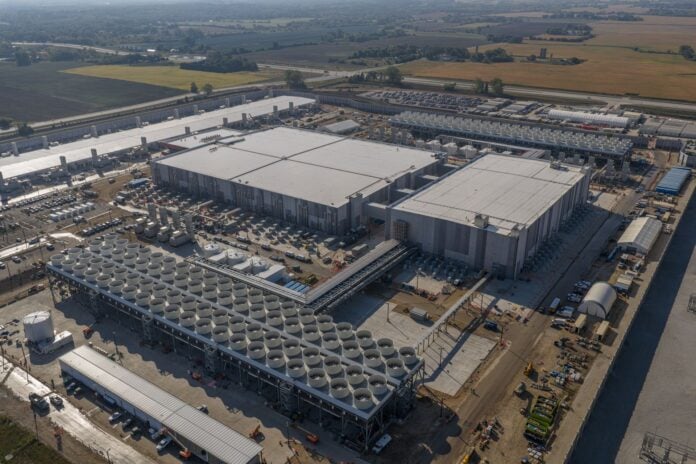
The companies on the other side of this resistance include the most valuable corporations on earth. Meta, Amazon, Microsoft, Google, and OpenAI are collectively spending hundreds of billions on AI infrastructure, building out the data centers that will house the GPU clusters powering the next generation of AI models. Nvidia’s AI infrastructure financing push is targeting $500 billion in mobilized capital through six Wall Street partners. The AI compute backlog at specialist providers like CoreWeave already exceeds $100 billion.
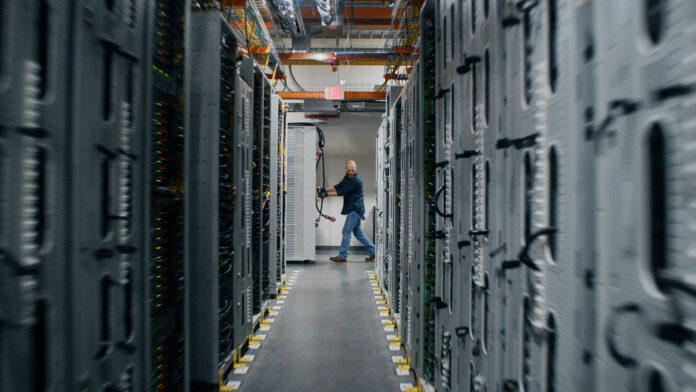
That capital needs land. Rural land in the United States — with room for massive footprints, proximity to power substations, and low existing population density — is what the industry has been targeting. The Cherokee Nation’s task force found that hyperscale facilities, defined as spanning more than 10,000 square feet and drawing more than 100 megawatts of power, employ roughly 100 permanent workers once operational, despite their enormous physical and resource footprints. The task force also found that data on planned projects is inconsistently tracked, with some developments hidden under non-disclosure agreements between developers and local governments.
That last finding landed hard in Salem. Residents discovered the city had signed an NDA with Verrus that kept the $5.1 billion project confidential for over a year before any public hearing was scheduled, Gizmodo reported. The city council voted unanimously to explore banning such agreements and established its own data center task force. A 120-day moratorium on new approvals followed.
In Kentucky, Huddleston’s family rejected the buyout but the land around them did not. Twenty-eight nearby properties totaling approximately 2,080 acres were rezoned for data center development in May, over her objections. Her daughter, Delsia Bare, joined a lawsuit challenging the project. What the companies did not anticipate, Huddleston’s case suggests, is that opposition in rural communities can be as durable as a title deed.
Principal Chief Hoskin did not name any companies in his statement, and the Cherokee Nation’s announcement did not disclose which projects, if any, had already entered federal consultation with tribal authorities. What happened in the negotiations preceding the formal ban — whether any developer had reached the stage of a land agreement, and whether disputes over the consultation requirement are now pending — is not public.
The Nation’s statement extends beyond trust land: the Cherokee Nation said it would not support hyperscale development on non-tribal property within the reservation without “robust” consultation. That formulation gives the tribe practical leverage over a far larger geography than a trust-land ban alone would suggest.
“Our primary responsibility is to protect our citizens and tribal communities from these threats,” Hoskin said, “so we will not support any hyperscale data centers on our reservation without proper consultation.”
The AI data center opposition now spans governance levels and political alignments — Native sovereignty, small-town planning commissions, state legislatures, and individual farmers arriving at similar conclusions through different routes. Whether the consensus translates into a lasting constraint on the AI build-out, or whether the scale of capital chasing land eventually routes around local resistance, the Cherokee Nation has offered a clear answer for its own territory.