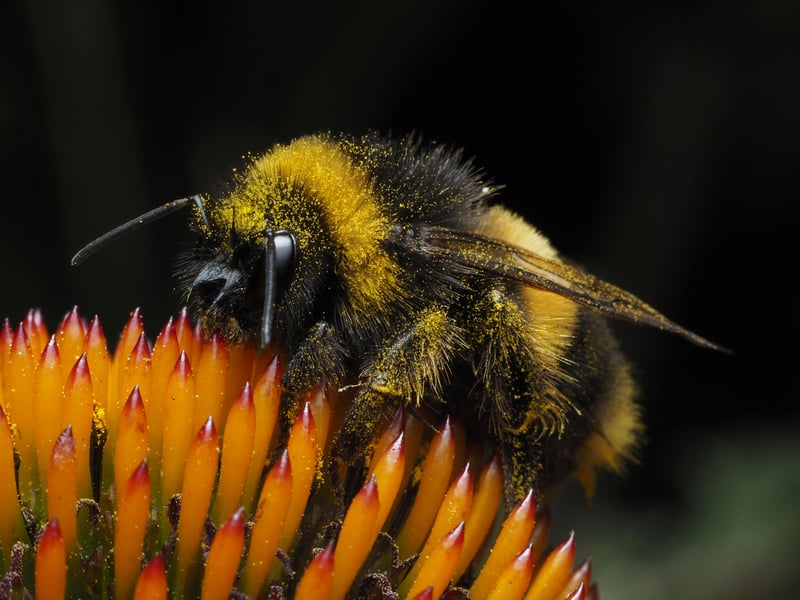

For decades, the standard assumption in cognitive neuroscience was straightforward: intelligence scales with brain size. The larger and more complex the brain, the more sophisticated the behavior. Bumblebees, whose brains weigh roughly a milligram and contain fewer than one million neurons, were not expected to challenge that logic. They have anyway.
Two studies published in recent months have fundamentally altered what scientists thought possible in a creature most people associate with gardens and flower beds. The first, published in Biology Letters by researchers at Queen Mary University of London, found that bumblebees can distinguish between visual stimuli of different durations, perceiving the difference between a flash lasting half a second and one lasting five seconds. The second, published in April in the journal Science, went further: bumblebees can not only detect rhythms but generalize them, recognizing the same pattern whether it is played fast or slow, a capacity researchers call abstract rhythm perception. Until this year, that ability had been demonstrated only in humans and a handful of birds and mammals.
“It shows brains are very good at detecting rhythmic structures, no matter their size,” said Andrew Barron, a neuroscientist at Macquarie University and a co-author of the Science study. “This skill that we once saw as abstract and advanced may actually be a basic property that brains naturally detect.”
Together, the findings represent a significant revision of what scientists understand about the cognitive boundaries of insect minds.
Teaching Bees to Read Time
The Queen Mary study, led by PhD student Alexander Davidson and supervised by Dr. Elisabetta Versace, a senior lecturer in psychology, confronted a question that researchers had largely avoided: can an insect use the duration of a visual signal, rather than its color, shape, or intensity, as a reliable cue for making decisions?
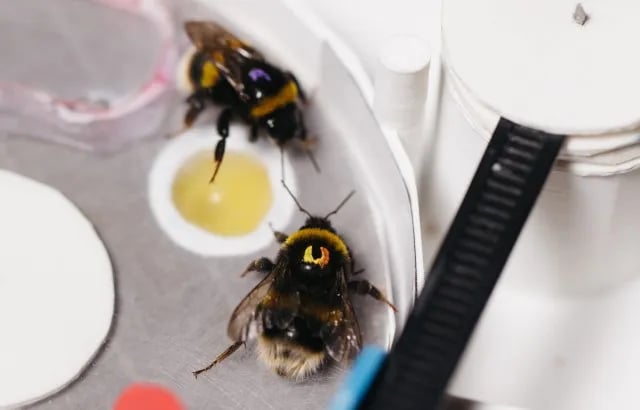
The experimental setup was deliberately artificial. Bees were placed in a chamber where they encountered two flickering yellow circles on a computer monitor, one flashing for a long duration, one for a short duration. A sugar reward was paired with one; an unpalatable quinine solution was paired with the other. The bees learned which duration meant food and which meant something to avoid.
In a first experiment, the long stimulus lasted either 2.5 or 5 seconds, while the short lasted 0.5 or 1 second. The bees learned the discrimination reliably. A skeptic might object that the bees were simply responding to the total amount of light they received, not to duration per se. The researchers designed a second experiment to close that loophole: the total amount of light in each cycle was equalized between the two stimuli, forcing the bees to track the actual duration of individual flashes rather than cumulative brightness. The bees could still tell them apart.
Sixteen of twenty bees in the first experiment and seventeen of twenty-one in the second performed above chance, choosing the rewarded stimulus more often than not. The result, the authors wrote, points to “domain-general skills” in bumblebees, meaning the insects applied a broad-purpose learning mechanism to a task their evolutionary history gave them no specific reason to solve.
“There is no obvious ecological basis for interval discrimination of visual stimuli in bees,” the paper states. That is precisely the point. The bees were not drawing on an instinct shaped by millions of years of flower-visiting. They were doing something closer to what scientists call general learning, and they were doing it with a brain smaller than a grain of rice.
Rhythm Without a Large Brain
The Science study pushed the inquiry into stranger territory. Lead author Zijie Zeng, a doctoral candidate at Southern Medical University in China, designed experiments to test whether free-flying bumblebees could form what psychologists call abstract representations of rhythm, the capacity to recognize a temporal pattern as the same pattern even when the tempo changes.
Humans do this effortlessly. A melody played twice as fast is still the same melody. A drumbeat slowed to half speed is still recognizable. The neural machinery required for this kind of tempo-invariant recognition in humans and other mammals involves multiple interconnected brain regions and has long been seen as an indicator of sophisticated cognition. In birds, it has been observed in vocal learners like parrots and certain songbirds. Before this year, it had not been demonstrated in any invertebrate.
Zeng and his colleagues trained bumblebees to distinguish between two arbitrary rhythmic sequences of flashing lights. The sequences were carefully balanced to prevent the bees from using any single local cue to tell them apart; the only reliable difference was the rhythm itself. After training, the bees were tested on the same rhythms at new, faster and slower tempos. They recognized them successfully. In a further experiment, bees trained on vibrational rhythmic patterns transferred their learning to visual flashing patterns with equivalent rhythmic structure, demonstrating what the researchers call cross-modal rhythm perception: the capacity to extract a temporal pattern and apply it across sensory channels.
“While specialized brain circuitry and vocal learning may support flexible rhythm perception in species like humans and songbirds,” Zeng said, “our findings show this capacity can emerge from minimal, general neural architectures.”
What the Bee Brain Reveals
The implications extend beyond bumblebees. For years, the assumption that large brains are prerequisites for sophisticated temporal cognition has shaped both neuroscience and the ethics of animal research. If a creature with roughly one million neurons can perceive duration, track intervals, and generalize rhythmic patterns across modalities and tempos, the neural requirements for these capacities may be far more modest than previously thought.
Researchers have known for some time that bees are remarkable cognitive performers in other respects. They use the waggle dance to communicate distance and direction to hive mates, a behavior that requires encoding temporal information about flight duration. They schedule flower visits according to nectar replenishment rates. They have been shown to use simple tools, engage in rudimentary social learning, and even display what some researchers describe as emotion-like states. The duration discrimination findings from Queen Mary add a new dimension to that record: the ability to use arbitrary temporal cues as decision-making signals in completely novel contexts.
Dr. Lars Chittka, a behavioral biologist at Queen Mary and a supervisor on the Biology Letters study, has spent decades documenting the unexpected sophistication of bee cognition. His lab has shown that bumblebees can recognize objects by touch that they have only seen visually, a form of cross-modal perception that was once considered a hallmark of vertebrate intelligence. The timing research fits a broader pattern in which seemingly simple nervous systems prove capable of operations that theory said they should not be able to perform.
The connection between temporal cognition and spatial cognition may also be important. During flight, bees use the rate of visual stimulation to measure their own speed and altitude, a process called optic flow. The neural circuits that process time intervals and those that process movement through space may overlap, suggesting that the capacity to track duration is not an isolated cognitive module but part of a more integrated system for navigating the world.
Rewriting the Map of Animal Intelligence
The question now is where the limits lie. Both research teams identified their results as opening new avenues rather than closing old ones. The Queen Mary team noted that future studies should explore the neural basis of time encoding in insects and its relationship to spatial processing. The Science team suggested their findings “point to deep evolutionary roots for a domain-general rhythm cognition” that may span a far wider range of animal taxa than anyone has tested.
Vertebrates may have elaborated on a capacity for temporal perception that was already present in the common ancestors of insects and animals with backbones, hundreds of millions of years ago. Or the capacity may have evolved independently, which would be equally remarkable, suggesting that time perception is a solution that evolution keeps arriving at because it is too useful to ignore.
Either way, the bumblebee has offered scientists something valuable: a test case simple enough to study rigorously and surprising enough to matter. A creature that pollinates roughly a third of the food crops humans depend on turns out to carry, in a brain the size of a sesame seed, cognitive machinery that scientists once thought required something far larger.
“The ability to track temporal variables like duration and frequency in a non-naturalistic setting highlights a level of cognitive flexibility that warrants further investigation,” the Queen Mary authors concluded, at the behavioral, computational and neural levels. The research community, it appears, is only beginning to ask the right questions about what goes on inside the insect mind.