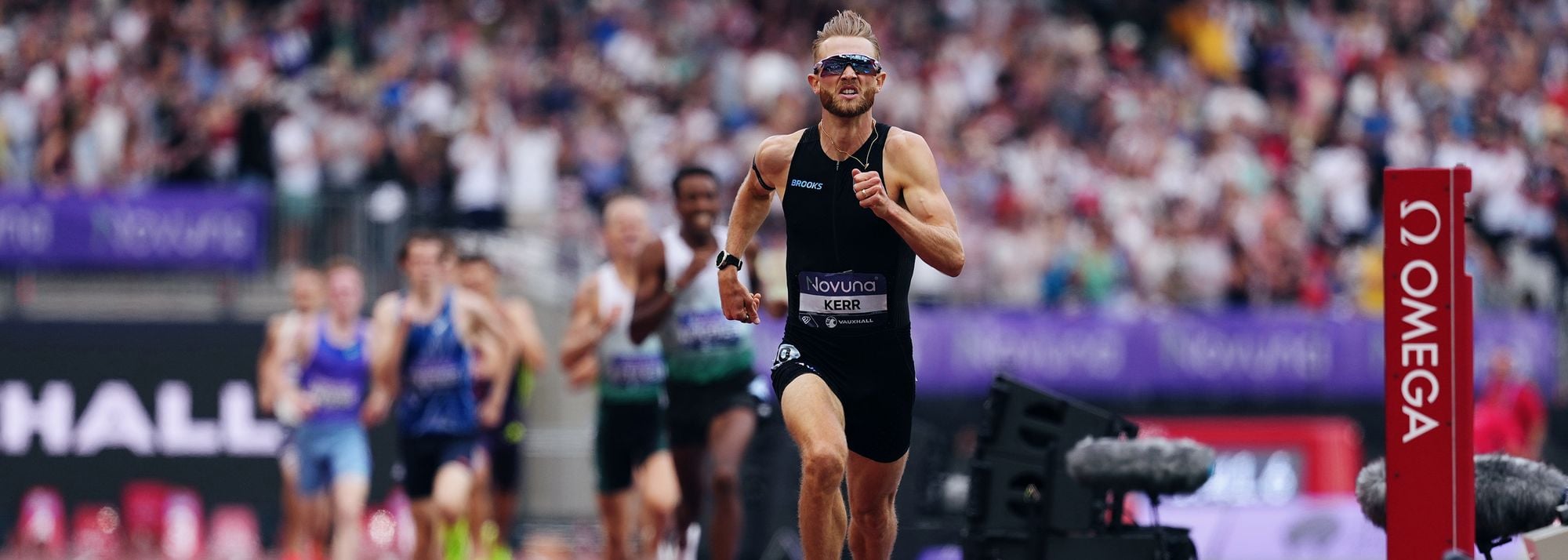

LONDON – Josh Kerr stood at the finish line at London Stadium on Saturday evening and did something that 27 years of the world’s best middle-distance runners had failed to do: he broke Hicham El Guerrouj’s mile world record. His time of 3:42.66, clocked at the Novuna London Athletics Meet, is the fastest any human being has ever run a mile. He is the first athlete to break 3:43. The 60,000 people at London Stadium knew what they had witnessed before the announcer finished speaking.
The gap between Kerr and El Guerrouj’s 3:43.13, set in Rome in 1999, is 0.47 seconds. In a race that spans 1,609 metres, that gap had proved immovable for more than a quarter-century. Generations of distance runners had approached it and fallen short – Olympic champions, world champions, individuals who had rebuilt their training programmes around the pursuit of El Guerrouj’s number. It stayed. Until Saturday.
The race unfolded as Kerr’s team had designed it. Pacemakers Brannon Kidder and Žan Rudolf took him through 400 metres in 55.3 seconds – Kidder led them through the line in 54.75 – and Kerr hit 800 metres in 1:51.1, a pace that carried him to 1200 metres in 2:46.39. When he passed the 1500-metre mark in 3:27.62, he had already run faster than his own British 1500m record. There were 100 metres of the race remaining. The record was already gone.
Kerr calls it Project 222. The number represents 222 seconds, the equivalent of 3 minutes and 42 seconds flat. He announced the target publicly last winter, a declaration that named his ambition in arithmetic rather than adjectives. Saturday’s 3:42.66 is 0.66 seconds short of 222. It is also a new world record, the fastest mile in human history. Whether Kerr interprets the gap as unfinished business or as a detail that does not change what happened is a question nobody outside his immediate circle could answer Saturday evening.
The roar that met him at the line was consistent with what the London Diamond League has become over the past decade: a night meeting at a 60,000-capacity stadium that has replaced the end-of-season championships as the place where British athletics comes to see history. Kerr said the noise took him somewhere else in the final straight. “The last lap was incredible,” he said. “I was deaf in the last 110 metres.” He did not say it as a complaint.
He described a composed approach to what was, for everyone else, an occasion weighted with expectation and history. “It is very overwhelming,” he said, allowing briefly that the magnitude had landed. “There was a lot of hype.” He did not elaborate on what the hype had felt like. He said instead: “I am surrounded by amazing people, so I have continued to put the work in and I knew I had a 3:42 in me.”

He was not alone in producing a historic performance on Saturday. Cierra Jackson of the United States threw 71.72 metres in the discus to set a Diamond League record at the same meeting, a result that reinforced the sense that London’s annual athletics night had become one of the sport’s most reliable addresses for records. In the mile, Yared Nuguse of the United States finished second in 3:45.69 – a time that would have stood as an American record in a different context and on any other night. Jake Heyward of Great Britain took third in 3:46.73 and Robert Farken of Germany fourth in 3:46.82, with three men finishing sub-3:47 behind Kerr. World Athletics confirmed the record as the night’s results were ratified on site.
Kerr is 28 years old, the 2023 World Athletics 1500m champion, and has been regarded as the outstanding male middle-distance runner of his generation. He won the world title in Budapest by beating Jakob Ingebrigtsen to the line, a result that reordered the hierarchy of a rivalry the Norwegian had previously dominated. His trajectory since then has moved from competing for the record to owning it. He previously held the British mile record at 3:45.34. The London Diamond League on July 18 was also the stage for Keely Hodgkinson’s 800m record ambitions, another marker of British athletics’ current ability to produce athletes capable of attacking marks that had seemed permanent.
El Guerrouj’s 3:43.13 was set in Rome on July 7, 1999. He ran it when GPS watches were not available to runners on the track, when streaming did not exist, when the sport operated through annual championship cycles and a handful of commercial meetings. The mark survived the emergence of Kenenisa Bekele, the reign of Ingebrigtsen, the evolution of carbon-plated racing shoes, three generations of pacing strategy, and a global pandemic that suspended competitive athletics for 18 months. It became, over time, the record that athletes with world titles and Olympic medals described as the hardest to break in the sport. Athletics’ record-breaking culture had produced astonishing performances at every distance around the mile without cracking the central mark. Kerr cracked it on Saturday.
The open question is whether Saturday settles anything or reopens it. Project 222, Kerr’s own stated target, remains incomplete by 0.66 seconds. He has broken the world record, but he has not hit the number he set for himself, which means there is a precise and documented gap between his current best and his own ambition. Whether he is the kind of athlete who treats a world record as a finish line or as a waypoint will be answered eventually. Saturday, though, was not about what comes next. It was about what had just happened: the mile world record, the sport’s most stubborn number, finally moved.