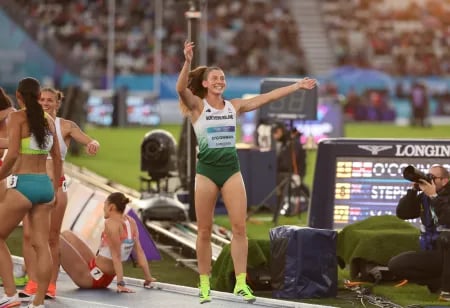

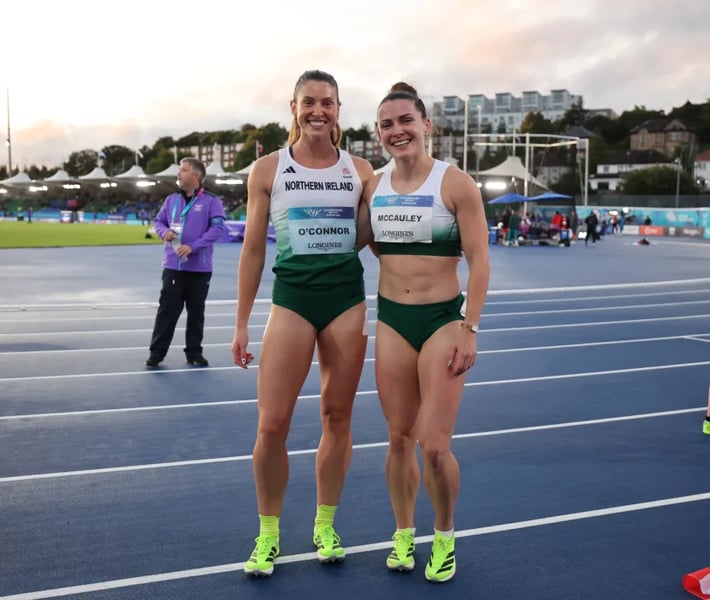
GLASGOW — The last time Northern Ireland won an athletics gold medal at the Commonwealth Games, the Berlin Wall was still standing. On Thursday at Hampden Park, Kate O’Connor made that wait feel not just finished but forgotten.
O’Connor, 27, won the women’s heptathlon at the Glasgow 2026 Commonwealth Games with a score of 6,569 points, ending a drought stretching back more than four decades with a performance that was authoritative across two full days of seven-event competition. She had won silver in Birmingham four years ago. In Scotland, on home soil for a Games she had quietly circled for the better part of a year, she stepped forward.
“It’s just about holding my nerve,” O’Connor said after the final event, with the kind of understatement reserved for athletes who have done exactly that and more. She was particularly strong on the second day, winning the javelin outright and then the closing 800 metres to seal the outcome. Athletics Ireland confirmed gold before the final runners had crossed the line.
The heptathlon does not produce a single decisive moment. That is its particular demand. Shot put, high jump, hurdles, long jump, javelin, 200 metres, and then the 800 metres at the finish: the event accumulates outcomes across two days, and the athlete who manages confidence alongside physical output is rarely the same as the one who is simply fastest or strongest in any individual discipline. O’Connor managed both across the full forty-eight hours.
A gold medal for Northern Ireland in athletics at the Commonwealth Games is not a small historical note. The last came in Edinburgh in 1986. The forty years between that podium and Thursday’s one at Hampden Park are years in which Northern Irish athletics has produced capable athletes at the highest levels without converting capability into Commonwealth gold. O’Connor, who came home from the Paris Olympics without a medal but with a clearer sense of what she could produce in a championship environment, converted it on Thursday. The European Championships in Birmingham follow in two weeks.
She was not alone on a Hampden track that delivered records at a pace that belied the political uncertainties trailing the Games into its second week. Cameroon’s Emmanuel Eseme set a new Commonwealth Games record in the men’s 100 metres, a result that raises reasonable questions about what he could produce at next year’s World Championships in Tokyo. World Athletics confirmed the mark as a Games record, placing Eseme among the sprint stories of this particular edition.
Australia’s Eleanor Patterson, who cleared 1.96 metres to win the 2022 World Championship title, set a Commonwealth Games record in the women’s high jump. Patterson’s career is constructed around one physical and technical act performed at a level her competitors have not been able to sustain across championship cycles. Glasgow confirmed she is still the ceiling in that discipline.
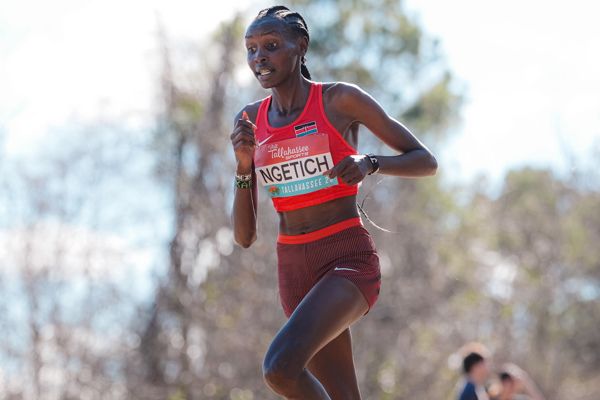
Kenya’s Faith Cherotich, the reigning Olympic champion in the women’s 3000 metres steeplechase, broke the Commonwealth Games record in the event. Cherotich won in Paris. She came to Glasgow, won again, and left another mark. Whether any competitor is closing on her is not a question the results currently support.
In the pool at Scotstoun, South Africa’s Michael Houlie posted a Games record in the men’s 50 metres breaststroke, one of several marks that have made swimming among the more productive disciplines of the 2026 program. England’s Emily Campbell added gold in women’s weightlifting over 86 kilograms, her third Commonwealth Games medal across three editions. Scotland’s para athlete Melanie Woods broke the Commonwealth Games record in her discipline, adding to a home program treating a Games on Scottish soil with the urgency the occasion demands.
All of this unfolded within a Games that opened as the smallest edition in thirty years, with five sports removed from the program and no confirmed host for 2030. Whether a contracting institution can sustain its authority in a global sports landscape that offers increasingly few platforms where Commonwealth identity means something distinct is not a question one athletics session resolves. What Thursday’s session demonstrated is narrower and more immediate: the athletes who came to Glasgow have treated the institutional uncertainty as irrelevant to the act of competing. The summer has already delivered records that will outlast the season, and Glasgow’s track has added its own layer to that ledger.
O’Connor’s gold was the emotional centrepiece of a day spanning disciplines and nations. What it means for the shape of Northern Irish athletics beyond Thursday is genuinely open. The infrastructure, the funding pathways, the depth of talent behind her: these are not questions a gold medal automatically answers. What it answers is the forty years. She has ended that count. Whether it becomes a bridge to something sustained or stands as a high-water mark in isolation depends on decisions, investment, and athletes not yet named.
The next forty years start now.