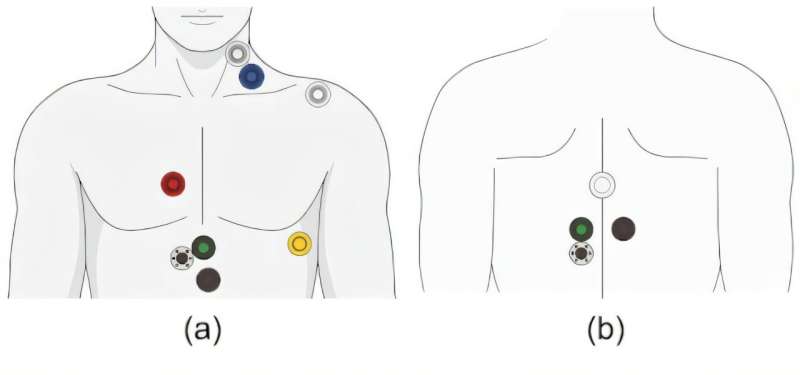

MANILA – One morning each week, for several months, fifty-four young adults arrived at a clinical assessment site carrying a body mass index above twenty-seven. They were not patients seeking treatment. They were study participants in an experiment that asked a basic but uncomfortable question: could adhesive sensor stickers and a neural network do what a hemodynamic analyzer at a specialized cardiac clinic does?
The answer, according to research published in April 2026 in MDPI Bioengineering, is yes, with reservations the researchers themselves are careful not to minimize.
The team was led by Patricia Angela R. Abu of Ateneo de Manila University’s Department of Information Systems and Computer Science, with thirteen collaborators from institutions in the Philippines, Taiwan, and mainland China. Together, they built a feedforward artificial neural network to predict a patient’s cardiac index, a measure of how efficiently the heart pumps blood relative to body surface area. Clinicians use the cardiac index to evaluate heart function and guide treatment decisions in patients at cardiovascular risk. Getting that number conventionally requires specialized hemodynamic analyzers, controlled clinical environments, and trained personnel, resources most clinics outside major urban hospitals do not have.
Abu and her collaborators wanted to see whether three measurements from inexpensive, non-invasive devices could substitute. They used a blood pressure monitor, a body composition scale, and a blood flow analyzer that attaches to a patient’s chest with adhesive pads. From those instruments, they extracted heart rate, stroke volume index, and cardiac output, fed the three values into their neural network, and asked it to classify whether a patient’s cardiac index fell above or below a clinical threshold of three liters per minute per square meter.
The network reached a classification accuracy of 97.78 percent on its test set. That figure outpaced every classical comparison the team ran. A support vector machine achieved 95.82 percent. A k-nearest neighbors algorithm reached 93.87 percent. Multiple linear regression, the kind of statistical approach standard in clinical modeling a decade ago, managed only 53.33 percent, a result that reveals how poorly a linear framework captures the nonlinear physiology at work when the heart is under metabolic stress.

The neural network’s design reflects deliberate choices about the problem of small datasets. The team had 54 participants, which produced 270 measurements after multiple sessions, a thin training base for any machine learning model. To compensate, the researchers applied two data augmentation techniques in combination: Mixup, which blends pairs of existing samples to generate synthetic training examples, and Gaussian noise injection, which introduces small random perturbations to simulate real-world measurement variation. Together the techniques expanded the effective training set from 216 samples to 1,296, a sixfold increase drawn from the same original population.
The cardiac index has particular clinical relevance among young adults, a population cardiovascular disease research has historically undertreated. The World Health Organization has tracked a rise in metabolic conditions, including obesity, hypertension, elevated blood lipids, and type 2 diabetes, among people aged twenty to twenty-nine globally. That rise increases the burden on the cardiovascular system years before most people consider themselves at cardiac risk. The study population, obese young adults who might not otherwise present to a cardiac clinic, is precisely the group most likely to benefit from lower-cost early monitoring and the group for whom conventional specialist-grade assessment is least accessible.
The researchers are explicit about what their model does not yet prove. The 54-participant sample is small, homogeneous in age and metabolic profile, and drawn from a single clinical setting. Whether the neural network maintains its accuracy in older patients, in people with existing heart disease, in populations with different baseline physiologies, or in community health facilities outside a controlled research environment remains genuinely open. The team said it plans to validate the approach in more diverse populations and is also investigating whether the model can perform reliably with fewer input measurements. Even with cardiac output removed as a third input, the network showed reasonable predictive capability from heart rate and stroke volume index alone.
The study was approved by the Chang Gung Medical Foundation institutional review board under reference number IRB 202501987B0. The findings were announced by Ateneo de Manila University in its institutional news release.
The broader shift this research enters is already accelerating. OpenAI expanded ChatGPT Health to all U.S. users this month, making AI-assisted health guidance available through Apple Health data for the first time. Hedge funds pushed their exposure to U.S. healthcare stocks to a five-year high in July, a signal of how much institutional capital is now moving toward AI-enabled health monitoring platforms. The Ateneo team’s model works at the opposite end of that economic spectrum, a resource-light system designed for settings where neither the equipment nor the capital for specialist care exists.
What Abu and her collaborators have demonstrated is a proof of concept that holds up well within the constraints it was tested in. What the study does not show, and what its authors do not claim, is readiness for the 1.4 billion people globally who lack access to specialist cardiac care. That validation is still ahead of them.