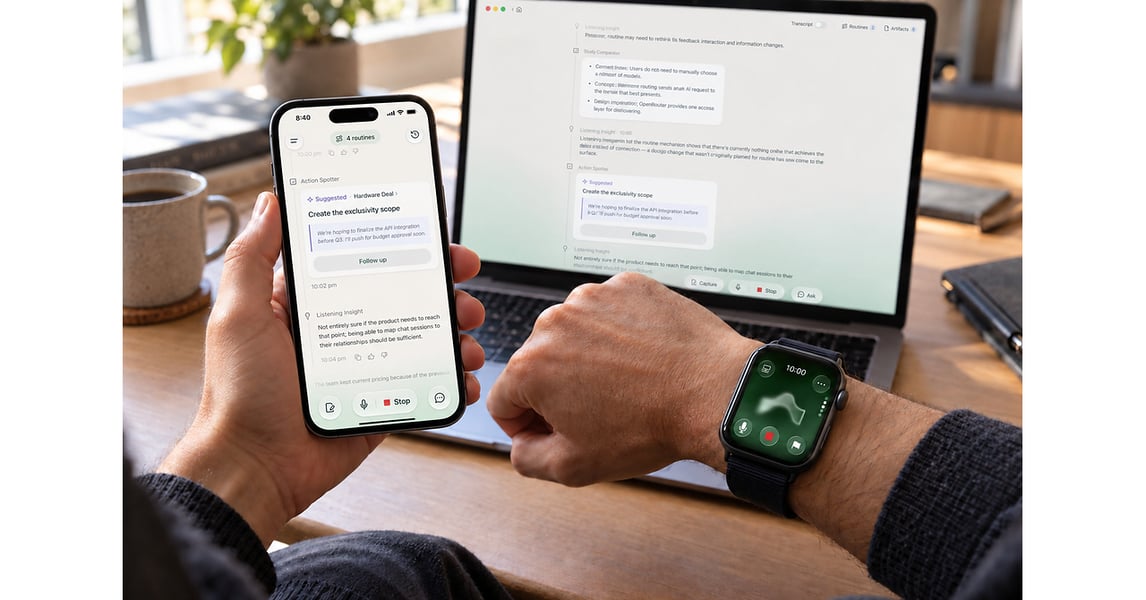

Mistlabs is pitching Ambi as AI that follows a conversation and prepares work before someone asks for it. But users looking to try the newly announced Apple-device system face a practical distinction: the company’s public download page offers Mac software while still marking its iOS app as coming soon.
The San Francisco company’s October 12 launch announcement says Ambi is emerging from beta on Apple devices after $26 million in Pre-A funding led by Luminous Ventures and Huaqin. Mistlabs says the financing will support a standalone AI wearable, extending a software-first product into dedicated hardware.
The announcement identifies iPhone, Apple Watch, MacBook and Mac as starting platforms and refers to Apple devices compatible with iOS 18. Its download page, checked on October 13, presents a narrower public offer: macOS for Apple silicon machines and Windows 11 x64, with both iOS and Android listed as coming soon. Intel Macs are explicitly unsupported.
That mismatch leaves the mobile rollout unresolved. The checked page does not establish that every announced phone or watch experience is available to the general public, nor does it give a date for the iOS download. The launch should therefore be understood as Mistlabs’ announcement of Ambi’s broader direction, not proof that all named Apple-device apps can already be installed.
Ambi’s proposed role is different from a meeting recorder that produces a summary after everyone leaves. Mistlabs says its Routine feature can call on multiple agents to analyze a live discussion, check statements, research competing products and assemble a draft proposal before a meeting ends. The intended benefit is preparation during the conversation rather than another document to process afterward.
Those examples are company claims. The announcement does not provide an independent benchmark showing how accurately Ambi checks facts, how quickly it produces usable work or how often its proposed next step needs correction. The Eastern Herald has not independently tested the software.
Persistent memory is central to the pitch. Mistlabs says Ambi retains relevant context, preferences and priorities so ongoing work can continue as a user moves between devices. A project discussed on a computer could later pick up information from a phone or watch rather than requiring the user to explain its background again. Availability and feature support remain separate questions from that proposed experience.
The launch also puts a third-party product beside the broader market for AI on Apple devices. Running on Apple hardware does not make Ambi an Apple product or establish an Apple partnership. Mistlabs’ announcement identifies its own investors and development plans, not an endorsement from the device maker.
The most ambitious extension is still ahead. Chief executive Peter Mo says Ambi will develop communication between separate users’ AI agents in the coming months. Mistlabs describes agents exchanging relevant context, identifying common priorities and suggesting mutually acceptable outcomes during meetings within user-granted permissions. It does not establish compatibility with arbitrary third-party assistants or identify an open protocol in the release.
That future coordination is not the same as several agents working on one user’s Routine. An assistant preparing a private proposal acts within one person’s workflow; an agent negotiating with another person’s system introduces a question of what information it may disclose. The company’s reference to user-granted permissions is therefore important, but the launch announcement does not detail every control for such exchanges.
Mistlabs says audio is not stored by default. That statement should not be read as a claim that no user information is retained: the same announcement describes persistent memory built from conversations and activities. Raw recordings, derived context and stored memory are different categories, and the release does not demonstrate that all processing occurs locally on an Apple device.
The proposed wearable remains another future step. Mistlabs says its self-developed hardware is intended to provide richer context and follow later in 2026. The announcement does not disclose a retail price, final specifications or battery life. Huaqin’s participation as an investor is not, by itself, confirmation of a manufacturing agreement.
For now, the most concrete public starting point is the desktop download page. The $26 million financing supports Mistlabs’ ambitions, but the unanswered launch questions are operational: when the advertised mobile experiences will become publicly downloadable, which features each device supports and whether the real-time workflows perform reliably outside the company’s examples.