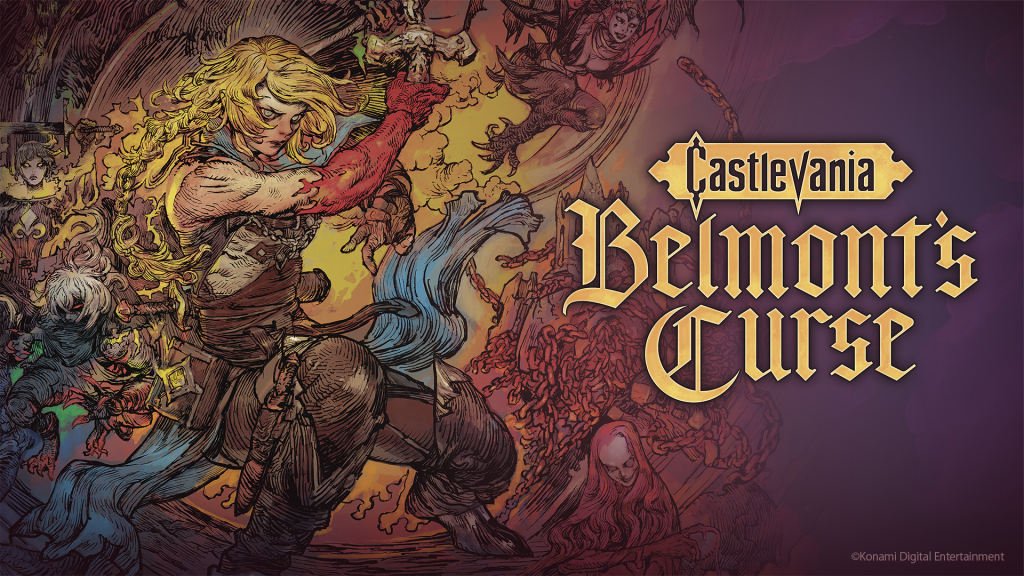

Castlevania: Belmont’s Curse has received an enthusiastic pre-release verdict from Game Informer, with reviewer Charles Harte highlighting a tarot-card system that makes exploration feed directly into combat. The assessment arrives two days before Konami’s October 15 launch, offering buyers an account of the Xbox version rather than a performance comparison across every platform.
Harte awarded the game 9.25 in his October 13 review, praising its movement, boss battles and rewards for returning to previously explored areas. He reported finishing his playthrough after 16 hours with 92 percent completion. Those figures describe his experience, not a publisher estimate or a promise of how long every player will need.
Konami’s official website lists an October 15 release for PlayStation 5, Xbox Series X|S, Nintendo Switch and PC. Its current listing includes Switch on the same date, updating a June announcement that had left Nintendo’s release timing unresolved. Game Informer’s review was conducted on Xbox Series X/S. Its score should not be treated as a separate technical verdict on the other versions.
The new protagonist is Rose Belmont, daughter of Trevor Belmont. Konami places the story in Paris in 1499, 23 years after Castlevania III: Dracula’s Curse. Its 40th-anniversary announcement describes Rose fighting through the city and Dracula’s castle with weapons and skills that include the Vampire Killer whip.
The development credits deserve precision. Konami’s release announcement identifies Konami and Evil Empire as joint developers, with advisory help from Motion Twin. Harte links Evil Empire’s involvement to its work on Dead Cells, arguing that an outside perspective helps the revival feel fresh rather than merely reverential.
The clearest example in his review is Rose’s deck of tarot cards. Harte describes cards that hold the souls of important figures encountered in Paris, allowing those characters to speak to Rose while also unlocking spells. The mechanic connects the cast, exploration and combat instead of keeping them in separate systems.
Harte’s strongest praise goes to the later card-hunting quests, which he says turn into cryptic investigations across the map. He is less impressed by some early investigations, describing them as linear and only moderately engaging. The favorable score therefore includes a qualification: the most inventive exploration appears to emerge later, rather than defining every opening quest.
Each card’s spell has upgrade tasks called Works of Mercy. Harte describes objectives involving repeated spell use, defeating particular enemies and discovering rooms. In his account, those goals encouraged him to try abilities he might otherwise have ignored. That provides a useful distinction for buyers: a broad selection of powers matters more when the game supplies reasons to experiment with them.
Combat offers six weapon categories, relics that grant perks and the spell deck, according to the review. Harte says he regularly changed equipment during encounters and found fights demanding without becoming insurmountable. He also credits forgiving checkpoints with making repeated deaths less frustrating. These are judgments about difficulty and pacing, not a claim that every player will experience the same challenge.
Returning to earlier areas supplied another source of appeal. Harte describes new traversal abilities opening routes to weapons, health and mana upgrades, and substantial optional spaces. That connection between movement and revisiting a map sits at the heart of the exploration-led design also discussed in Eastern Herald’s coverage of Metroid Prime 4. It does not make the two games mechanically identical.
The story received a more measured assessment. Harte finds it relatively uncomplicated but says Rose’s character arc has memorable moments. He also says newcomers can follow the game without prior series knowledge, despite its connection to Castlevania III. That is his judgment of accessibility, not evidence that the earlier games are irrelevant to the setting.
The review establishes one critic’s strong response to one platform version. It does not establish a consensus score or settle how the Switch and PC editions perform. The Eastern Herald has not independently played Belmont’s Curse. For players choosing between versions, the unanswered question remains whether each platform delivers the movement and combat experience Harte praised on Xbox.