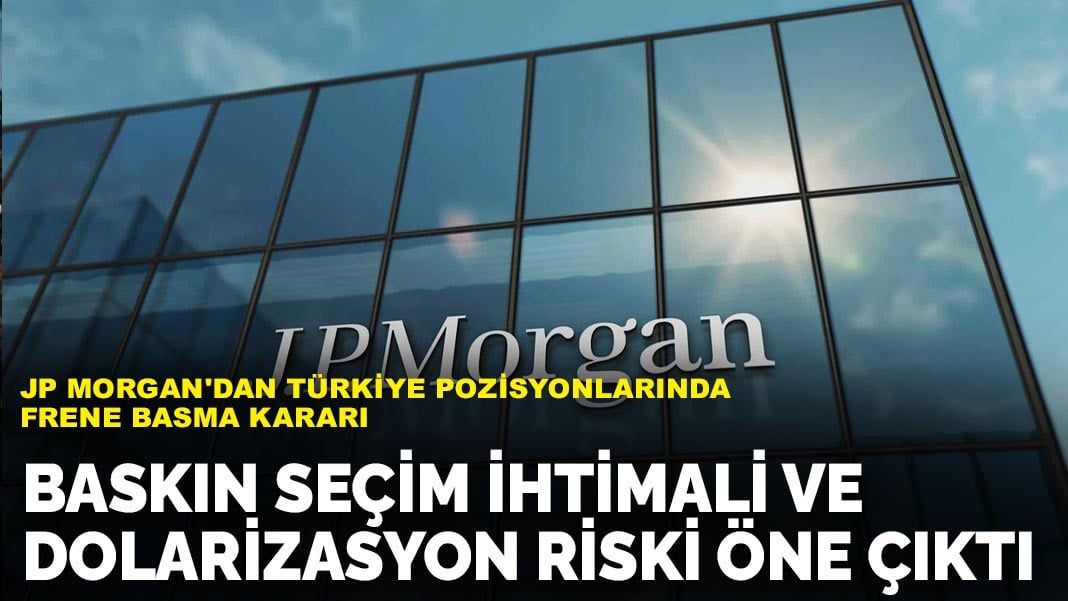
ISTANBUL — For the better part of two years, JPMorgan Chase & Co. had been among the more constructive voices on Turkish assets. That position, built on the back of Ankara’s post-2023 policy turn toward monetary orthodoxy, interest-rate normalization, and a deliberately managed lira, is now being wound down.
In a strategy note released Thursday, the bank said it had closed its overweight exposure to Turkish assets — excluding foreign-currency deposit accounts — and moved to a neutral stance. The proximate cause was not any single macro data point. It was, instead, a political one: the bank’s strategists concluded that markets were not fully pricing the possibility of elections before the end of 2026, and that the consequences of an early electoral cycle were significant enough to warrant stepping aside.
The note did not say elections were certain or even likely. What it said was that the risk was no longer negligible — and that is a different, and more actionable, statement for a trading desk. Turkey’s next scheduled general election is in 2028, but the political climate has grown unpredictable enough that a snap vote is being modeled as a tail risk with actual probability mass behind it.
What follows from that risk, JPMorgan’s note argued, is a familiar sequence. Pre-election governments tend to spend. Fiscal stimulus before a vote — through wage increases for public sector workers, expanded social support, or accelerated credit — would add to the inflationary pressure that Finance Minister Mehmet Simsek has spent the past two years trying to suppress. Turkey’s official annual inflation rate came in at 32.61 percent in May, as global markets contend with their own fragilities in 2026, but independent economists at ENAG put the figure above 53 percent. Against that backdrop, another round of stimulus spending would not be a minor complication. It would be a direct challenge to central bank credibility.
The second concern in the note was precautionary dollarization. When Turkish households and businesses sense political uncertainty ahead of a vote, they have historically converted lira savings into foreign currency. This was a defining feature of every Turkish election cycle from 2018 through 2023. The government largely contained it after 2023 through a combination of high real yields and the architecture of the KKM — the foreign-currency-protected deposit scheme whose balances have been declining — but the mechanism is still there, waiting to be triggered. JPMorgan’s note flagged it as a credible near-term risk, not a hypothetical one.
The bank was careful to separate its medium-term structural caution from its short-term tactical view. On the lira over a very short horizon, JPMorgan’s strategists said they remained modestly optimistic — carry trades on the lira are still yielding attractive returns as long as the currency stays in its current controlled range, and Ankara has repeatedly demonstrated its commitment to keeping it there. But that tactical yen for short-term carry does not translate into a willingness to hold a structural overweight when the political risk horizon is blurring.
JPMorgan’s move was not made in isolation. Earlier on Thursday, Algebris Investments — a London-based asset manager with roughly $20 billion in assets under management — disclosed it had begun purchasing credit-default swaps on Turkish sovereign debt. CDS contracts function as insurance: the buyer pays a periodic premium and receives a payout if the reference entity defaults. Algebris cited a convergence of structural concerns, among them Turkey’s current-account deficit, central bank reserves that have dipped below $160 billion, exposure to energy prices, and the geopolitical proximity of the Iran-Israel conflict which continues to generate risk premium across the region, as the IMF has separately warned threatens global growth.
Two major global institutions, on the same day, moving in the same direction on Turkey — one reducing equity and fixed-income exposure, the other buying default protection — constitutes a notable clustering of skepticism. Neither firm has said Turkey is heading for a crisis. What they have said, in the language their traders and portfolio managers speak, is that the risk-reward balance has shifted and they are no longer willing to be long.
This is a meaningful shift in the narrative that has surrounded Turkish assets since the summer of 2023. After President Recep Tayyip Erdogan’s re-election, his appointment of Simsek as finance minister and Hafize Gaye Erkan — subsequently replaced by Fatih Karahan — as central bank governor signaled a pivot away from the unorthodox low-interest-rate policy that had periodically sent the lira into freefall. The central bank subsequently raised its benchmark policy rate to 50 percent before beginning a gradual easing cycle. That pivot attracted foreign investors who had stayed away for years. Gross foreign inflows into Turkish equities and government bonds picked up sharply through 2024 and into 2025, even as Turkey navigated trade tensions with the United States.
What JPMorgan’s note reflects is not a collapse of confidence in that reform project but something more nuanced: a reassessment of whether the political conditions that made the reform project durable are still in place. Simsek has been explicit that his goal remains a return to single-digit inflation — his year-end target is the low 20s — and the central bank has signaled it intends to hold that line. JPMorgan’s strategists believe those commitments are genuine and that policymakers remain committed to exchange-rate stability. The bank simply does not know, and neither does anyone else, whether those commitments would survive the pressures of a snap electoral campaign.
Turkey’s BIST 100 equity index stood at 13,694 on Friday, with the lira holding near 45.97 per dollar — a level that reflects the managed band the central bank has sustained with periodic interventions. The dollar and the policy rate are, for the moment, in equilibrium. What JPMorgan’s neutralization of its position suggests is that this equilibrium may be harder to maintain than it looks if the political calendar starts moving.
What remains unresolved is the question that both JPMorgan and Algebris are, in their different ways, asking: whether Turkey’s disinflation program has become durable enough to survive the pressures an election would create, or whether the orthodox policy turn of 2023 is still, at root, conditional on a political environment that can shift without warning. That question does not have an answer yet. The positions both firms have taken are, in effect, bets that the answer is not yet knowable — and that the premium for holding that uncertainty is no longer worth paying.