BAKU — The men were in ballast, heading north to load grain. They had no part in the war’s political architecture, no stake in the sanctions regime their ships may or may not have helped circumvent. By just before two in the morning on June 5, three of them were dead on the deck of a burning vessel in the Sea of Azov, and two more had already been killed on a sister ship struck an hour earlier. All five were Azerbaijani nationals. Ukraine’s drone forces had hit both ships, and the commander responsible for the strikes said nothing publicly about who died.
The two cargo vessels — the MV Natra, sailing under the flag of Belize, and the MV Zirkon, registered in Palau — were travelling in ballast from Turkey to the Russian port of Rostov-on-Don to load grain when they came under attack in Taganrog Bay, a narrow northeastern arm of the Sea of Azov bordered by Russia’s Krasnodar and Rostov regions. Azerbaijan’s Foreign Ministry confirmed Friday that five of its citizens were killed and three others wounded. All 26 crew members aboard the two ships were Azerbaijani nationals, hired under private employment contracts.
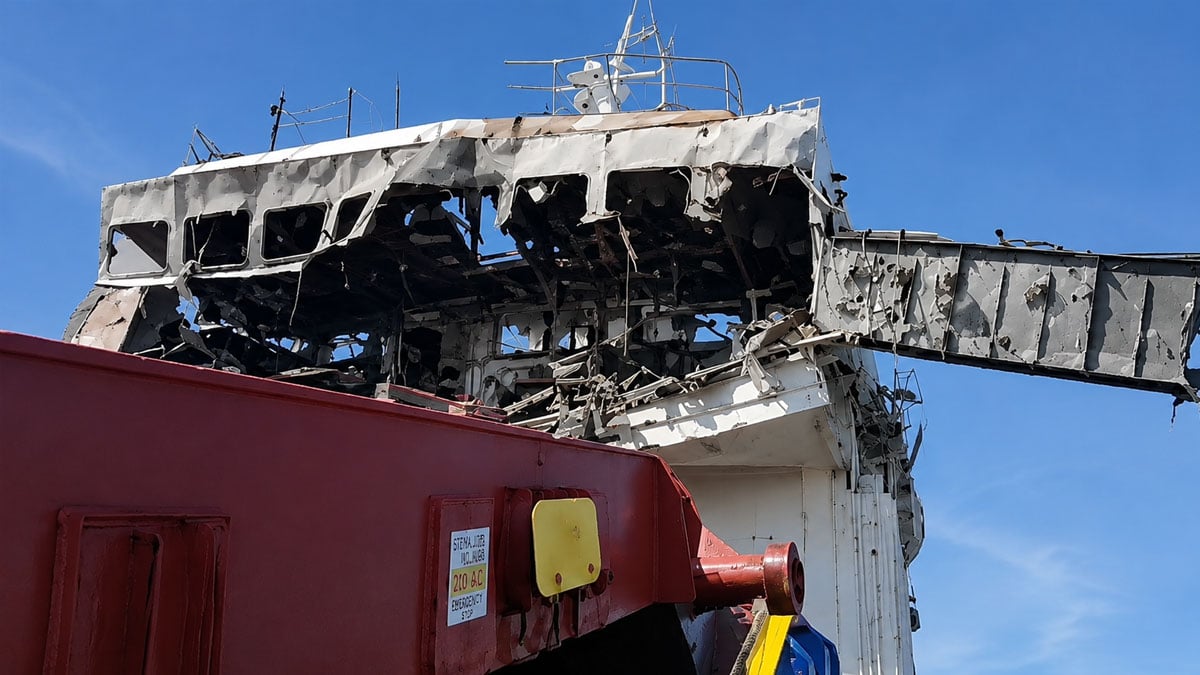
The Natra was struck first, at 00:45 Moscow time, by four unmanned aerial vehicles. Two crew members were killed. The fire was extinguished by the surviving sailors themselves, and the vessel remained afloat — though it lost propulsion and was left awaiting a tugboat. The Zirkon was hit just over an hour later, at 01:55. Four strikes concentrated near the superstructure killed three crew members and started a fire the remaining 14 sailors aboard could not control. They abandoned ship in lifeboats. Three passing vessels recovered all survivors and delivered them to the port of Yeysk by dawn, according to the Taman Maritime Rescue and Coordination Center, which logged both incidents in an operational report issued at 03:04 Moscow time.
The Azerbaijani Foreign Ministry said the ships were not state-owned Azerbaijani property and were operating under flags of convenience — a standard arrangement in commercial shipping and, notably, a common feature of what analysts describe as Russia’s shadow fleet. Belize and Palau are among the most widely used registries in that network, employed to carry Russian commodities under foreign flags after Western sanctions made conventional vessel registration prohibitively costly. Neither Natra nor Zirkon appeared on published EU or US sanctions lists at the time of the attack, according to Euronews.
Ukraine’s position was oblique. Robert Brovdi, commander of Ukraine’s unmanned systems forces, said Ukrainian drones had struck five vessels overnight in the ports of Mariupol and Berdyansk and in the coastal waters of occupied territory — describing the targets as ships used to transport grain from occupied Ukraine, along with fuel and military equipment. Brovdi made no reference to Baku’s statement that five Azerbaijani citizens had been killed. The silence was not lost on Azerbaijani officials or regional observers.
Russia’s Foreign Ministry named the ships explicitly and accused Kyiv of targeting civilian vessels. Moscow said it was coordinating with Azerbaijani authorities and that necessary support would be provided. The episode lands at a diplomatically awkward moment: Azerbaijan has managed careful neutrality throughout the conflict, maintaining economic ties with both Russia and Ukraine while resisting pressure from either side to formally align. Baku’s statement Friday was notably restrained — confirming the deaths, describing the embassy-level response, and declining to attribute explicit blame in public language.
The context matters. Eastern Herald has reported previously on the expanding geographic reach of Ukraine’s maritime drone campaign, which in recent weeks has reached as far as the Romanian port of Constanta, where a vessel in the shadow fleet network was struck while docked in a NATO member state. The Azov incident is the latest in a sequence that is steadily dissolving the distinction between military and commercial maritime space in this theatre.
That distinction has been under pressure since early in the conflict. Russia’s seizure of Ukrainian grain ports in 2022 collapsed the Black Sea’s commercial shipping norms, and the subsequent safe-passage agreements brokered by Turkey and the United Nations broke down in 2023. Since then, the Azov and Black Sea shipping lanes have operated in a condition that might be described as managed risk — commercial traffic continuing, but with understood exposure. What the Natra and Zirkon strikes demonstrate is that the exposure now extends clearly into the Sea of Azov itself, and that civilian sailors from third countries bear it.
The shadow fleet dimension complicates the moral ledger. Ukraine’s argument — that these ships were part of Russian logistics, transporting commodities that sustain Russia’s war economy — is not implausible. The Zirkon had previously sailed under the Russian flag before re-registering in Palau in 2022, a pattern consistent with vessels repositioned to avoid sanctions exposure. If the ships were knowingly participating in the movement of Russian grain through occupied-territory ports, they were operating in a grey zone that Kyiv regards as legitimate military infrastructure.
But the Azerbaijani sailors aboard them were not shadow fleet operatives. They were merchant mariners on private contracts, working routes that, while contested, remained commercially active. The distinction between the vessel’s registry and the nationality of its crew is precisely the kind of ambiguity that tends to be resolved by military planners in favour of the target and resolved by foreign ministries in favour of the dead. Azerbaijan is now in the position of the latter. What Baku does with that position — whether it uses it to press for clearer rules of engagement in the Azov, or absorbs it quietly — is the question this incident has opened and has not yet answered.
Russia’s Black Sea drone campaign against civilian shipping has been documented extensively. As Eastern Herald reported earlier this week, Moscow has repeatedly accused Kyiv of conducting what it calls a terror campaign against commercial vessels in contested waters — accusations Ukraine has countered by arguing the targeted ships were servicing Russian military logistics. The Natra and Zirkon incident is the first to produce confirmed third-country civilian deaths at this scale in the Azov theatre, and it has put a name — or rather, five names — on what had previously been debated in the abstract.
The Azerbaijani Foreign Ministry said its diplomatic missions were coordinating the emergency response and would continue to follow developments. No senior Azerbaijani official had made a public statement attributing responsibility by Friday afternoon. The wounded were receiving treatment at Russian medical facilities. Two tugboats had been dispatched to recover the Natra. The Zirkon, last reported still burning, remained in the water.