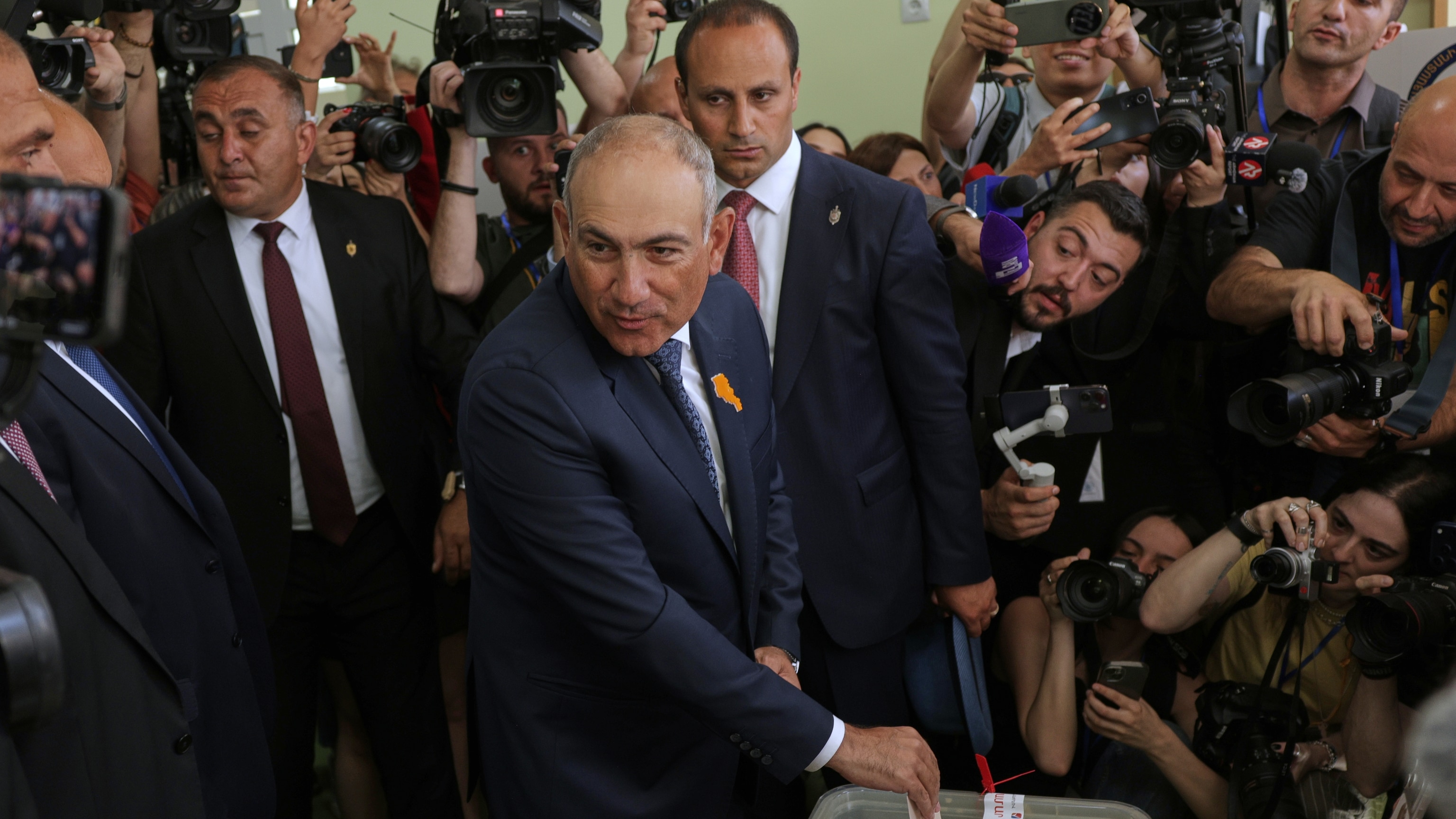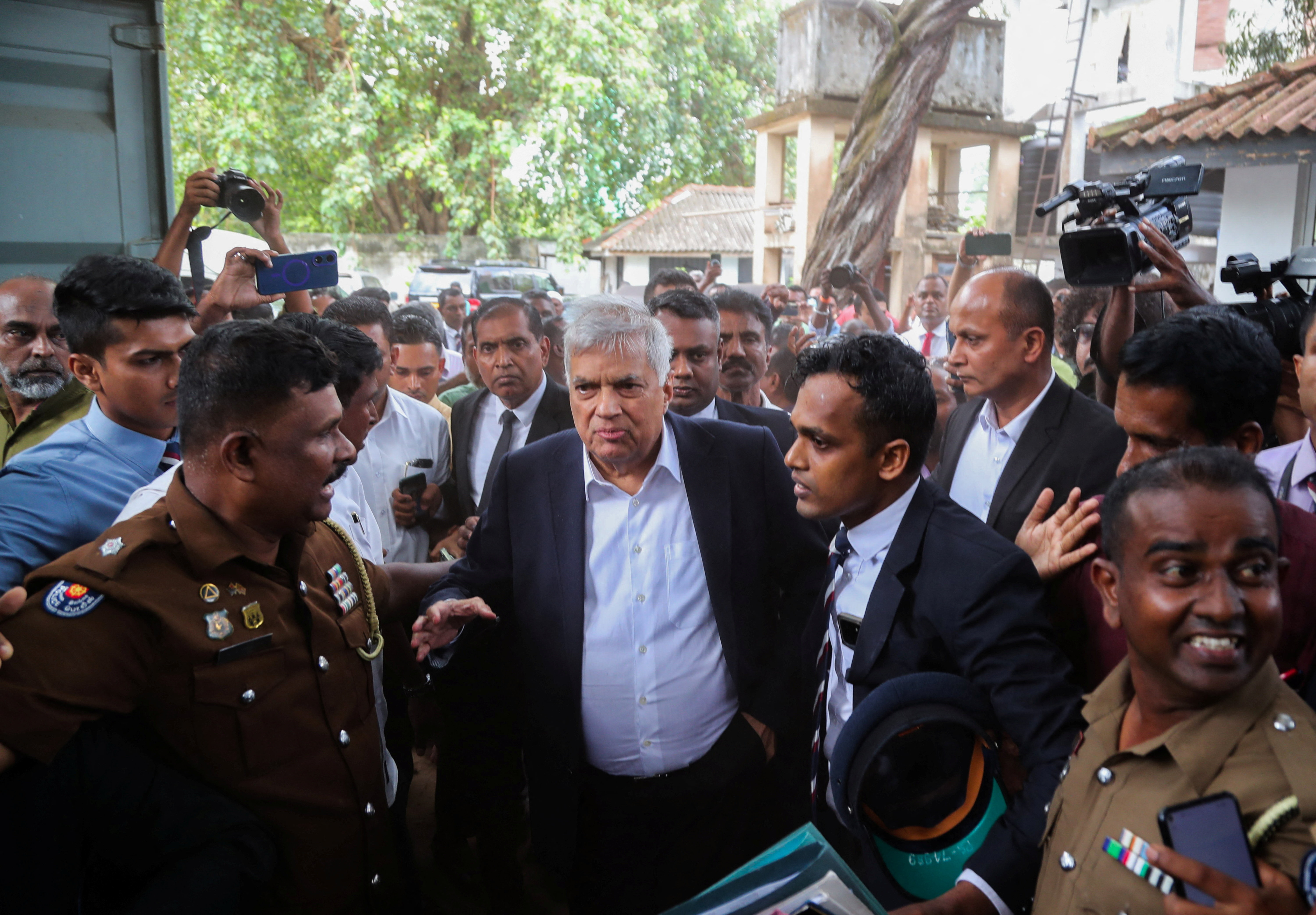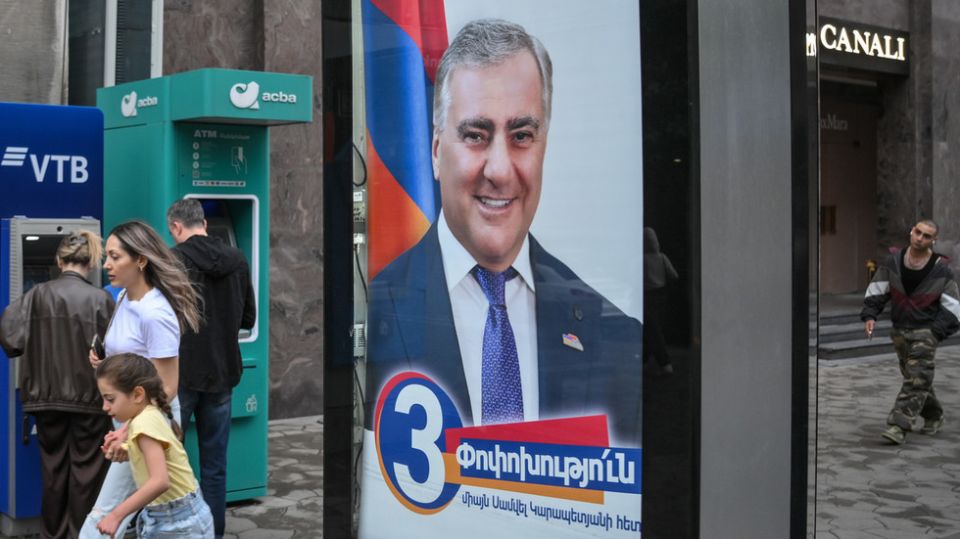
YEREVAN — He walked into the polling station to a standing ovation. By the time Samvel Karapetyan finished casting his ballot in Armenia’s parliamentary election on Sunday, more than 100 of his supporters were already in custody.
“Right now, arrests of our supporters are underway,” Karapetyan told reporters after voting. “Many have been arrested today, and more than 100 people were arrested yesterday. But it is okay.” The calm in his voice was deliberate — a message to a party base watching its candidates vanish from the race one by one.
The leader of the Strong Armenia bloc, a Russian-Armenian billionaire who has spent the campaign under house arrest on charges of inciting the overthrow of the government, stressed that the country’s political future had to be settled through the ballot. “Armenia must resolve its issues independently,” he said. He has consistently dismissed the criminal charges against him as politically motivated.
Saturday’s arrests had already reshaped the contest. Armenian state media reported that the Central Election Commission authorized criminal proceedings against six Strong Armenia candidates — Hayk Avagyan, Susan Badalyan, Artur Abrahamyan, Vahe Tavakalyan, Vahe Yeghiazaryan, and Ashot Sahakyan — on the eve of polling. According to Reuters, Armenia’s state Investigative Committee made the arrests without publicly disclosing the reasons. The committee did not respond to questions.
The Commission had earlier refused a lawsuit by a rival party seeking to remove Strong Armenia from Sunday’s ballot altogether over allegations of voter bribery and illegal campaign financing. Strong Armenia’s spokeswoman said the party was “ready for all scenarios.” That phrase, intended to project confidence, now carried a different weight.
Eighteen parties and blocs are competing in Sunday’s election, which doubles as a referendum on Prime Minister Nikol Pashinyan’s decision to tilt Armenia toward the West following the 2023 loss of Nagorno-Karabakh to Azerbaijan. Pashinyan’s Civil Contract party is polling at roughly 30 to 34 percent, according to figures compiled by the International Republican Institute. Strong Armenia, in most surveys, sits between six and twelve percent — a gap that makes it the principal opposition force but not a credible governing alternative on its own.
What those figures do not capture is the arithmetic of coalition. Opposition parties collectively command enough support that, if they coordinate after the vote, Pashinyan could conceivably lose his parliamentary majority. That possibility — not the individual polling numbers — is the source of the pressure playing out in Yerevan’s courtrooms and detention centers.
Russia’s reaction has been unambiguous and publicly sustained. Russian Security Council Deputy Chairman Dmitry Medvedev said elections in which Pashinyan is working to remove all competitors cannot be considered legitimate. Russian Foreign Ministry spokeswoman Maria Zakharova went further, arguing that what is happening in Yerevan is not an election campaign conducted according to law but “a fight against democratic procedures.” Moscow, which has imposed export restrictions on Armenian goods in recent weeks in response to Yerevan’s European pivot, has made no effort to conceal its preference for a change of government.
In April, Russian President Vladimir Putin noted that Moscow would like pro-Russian political forces to participate freely in Armenian elections — while adding, with notable restraint, that the decision rested with Yerevan. It was the kind of statement that frames a complaint without making a demand.
Armenian civil society organizations have pushed back on that framing. Several groups have flagged what they describe as Russian state-sponsored disinformation campaigns targeting Pashinyan’s government in the weeks leading up to the vote. Armenian authorities, for their part, have defended the wave of arrests as a law enforcement response to individuals attempting to destabilize the country — not political suppression.
The interior ministry said earlier this week that it had identified at least 78 pre-election crimes and detained 44 people. Sunday’s figure — more than 100 additional arrests in a single day, by Karapetyan’s account — suggests that tally has grown substantially.
What is not yet clear is whether that scale of enforcement will suppress the Strong Armenia vote, harden it, or simply feed the 40 percent of Armenian voters who, according to IRI polling, say they trust no political figure at all. Polls close at 8 p.m. local time.
Eastern Herald has covered the lead-up to Sunday’s vote, including Pashinyan’s own ballot-casting and his remarks on Armenian-Russian relations, and the diplomatic vacuum left by Russia’s recalled ambassador.