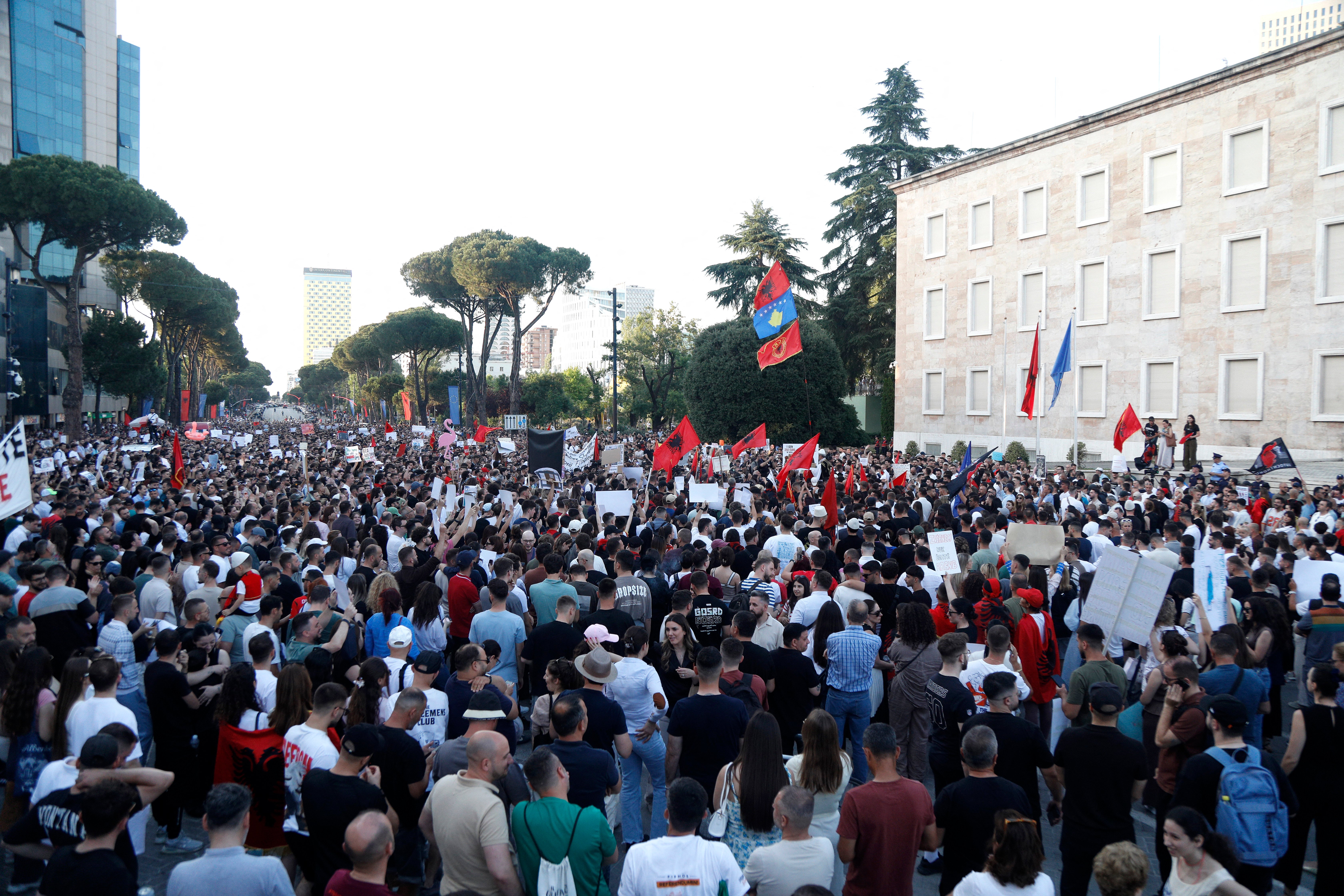

TIRANA, Albania – The investigation did not begin with the protests. It began with a document trail. On June 1, Albania’s Special Structure Against Corruption and Organised Crime – known by its Albanian acronym, SPAK – confirmed it had opened a formal criminal inquiry into how land in the Vjosa-Narta protected zone changed hands and how the area lost its conservation status, both prerequisites for the luxury resort linked to Jared Kushner’s investment firm that has now put thousands of Albanians on the streets for seven consecutive nights.
What triggered the probe was not the street protests, though those have grown nightly and spread from Tirana to Vlora, the coastal city closest to the development site. It was an investigative report by the Balkan Investigative Reporting Network, a Tirana-based journalism organisation, which laid out in detail who actually stands behind the land acquisitions. Among those identified in the network of individuals and companies connected to the project, according to BIRN’s investigation: a businessman accused of ties to the Italian mafia, a former judge who resigned rather than submit to the asset-scrutiny process Albania’s justice reform requires, the daughter of a lawyer facing forgery charges, a company whose owner was killed under circumstances that remain unresolved, and representatives of Shefqet Kastrati, one of the most powerful oligarchs in the country. It was not a list a government invested in the deal could afford to leave unaddressed.
SPAK said its investigation focuses specifically on two questions: how the land titles were obtained and sold to the investors, and how the 2024 legislative changes that stripped the Vjosa-Narta area of its environmental protections were reached. Those changes – passed by parliament in February 2024 – are the legal mechanism that made the entire project permissible. Without them, building on a protected wetland home to flamingos, Mediterranean monk seals, sea turtles and hundreds of bird species would have been legally blocked. With them, the bulldozers arrived without public notice and before any permits were publicly posted.
The project itself is structured through Atlantic Incubation Partners LLC and Sazan Real Estate Development LLC, entities linked to Kushner’s Affinity Partners private equity fund. In August 2024, Kushner unveiled plans to transform Sazan Island – a former communist military base declassified for civilian use in December 2024 – into an ultra-luxury destination of up to 10,000 rooms. Prime Minister Edi Rama, who confirmed in a recent interview that negotiations with Kushner are ongoing, has put the broader Vlora coast investment at four billion euros. Kushner’s firm was granted strategic investor status by the Albanian government, a designation that opens the door to expedited permits and fiscal incentives, reportedly before a business plan or feasibility study had been submitted.
Rama has not flinched. There is no chance for this investment to stop as long as I am here, he told reporters, framing the project as Albania’s ticket to the premium end of Mediterranean tourism. Protesters, who began gathering outside his office on the first night, have responded with flamingo effigies and a slogan that has spread across the country: Albania is not for sale. The slogans are aimed at Rama as much as Kushner.
The environmental stakes are not in dispute. Joni Vorpsi of PPNEA-BirdLife Albania told Al Jazeera this would be a new city with around 10,000 rooms, and it will completely destroy that wild region. A local officer for the same group confirmed to CBS News that at least one sea turtle nest has already been mapped as destroyed by machinery operating in the area. Environmental organisations from 41 countries sent a joint letter to Rama in January calling for an immediate suspension of decisions advancing the project. The letter arrived months before a single bulldozer moved. Nobody appears to have answered it.
What SPAK’s inquiry adds to the picture is institutional accountability. The body was created as part of Albania’s EU-aligned justice reform specifically to function beyond the reach of political interference – it has successfully prosecuted judges, prosecutors, and senior officials. Its decision to open a probe does not automatically halt construction, but it changes the legal and diplomatic calculus. Any Albanian official who pushed through permits now faces the possibility of a criminal file. Any investor who received land titles through a process a state prosecutor considers irregular is exposed to the same scrutiny.
This is not the first time a Kushner-adjacent Balkan development has unravelled under legal pressure. His firm withdrew from a five hundred million dollar construction project in Serbia in December 2025, weeks before the inauguration, after the country’s culture minister was indicted. The parallel is not lost on Albanian observers, and it is not lost on the street. The question now is whether SPAK’s inquiry moves faster than the concrete does.
The protests have also expanded the demands beyond environmental protection. Critics of the Trump administration’s pattern of family-linked overseas dealmaking have used Albania as a case study – a small NATO candidate state with every geopolitical incentive to accommodate Washington, rewriting its own law to deliver a project to the president’s son-in-law. The Bosnia no-bid pipeline contract awarded to a Trump-tied firm earlier this spring follows the same geometry. In both cases, the logic is the same: proximity to power in Washington is worth more to a small Balkan government than the environmental and legal costs of accommodating it. Whether SPAK reaches the same conclusion is the thing neither side can control.
The bulldozers have not stopped. The flamingo cutouts have not gone home. And SPAK has not said when it expects to complete its investigation or whether it will seek to freeze the site while it works. That last question – suspension or no – is the one Rama has refused to answer, and the one the protesters have not stopped asking.
Related Posts