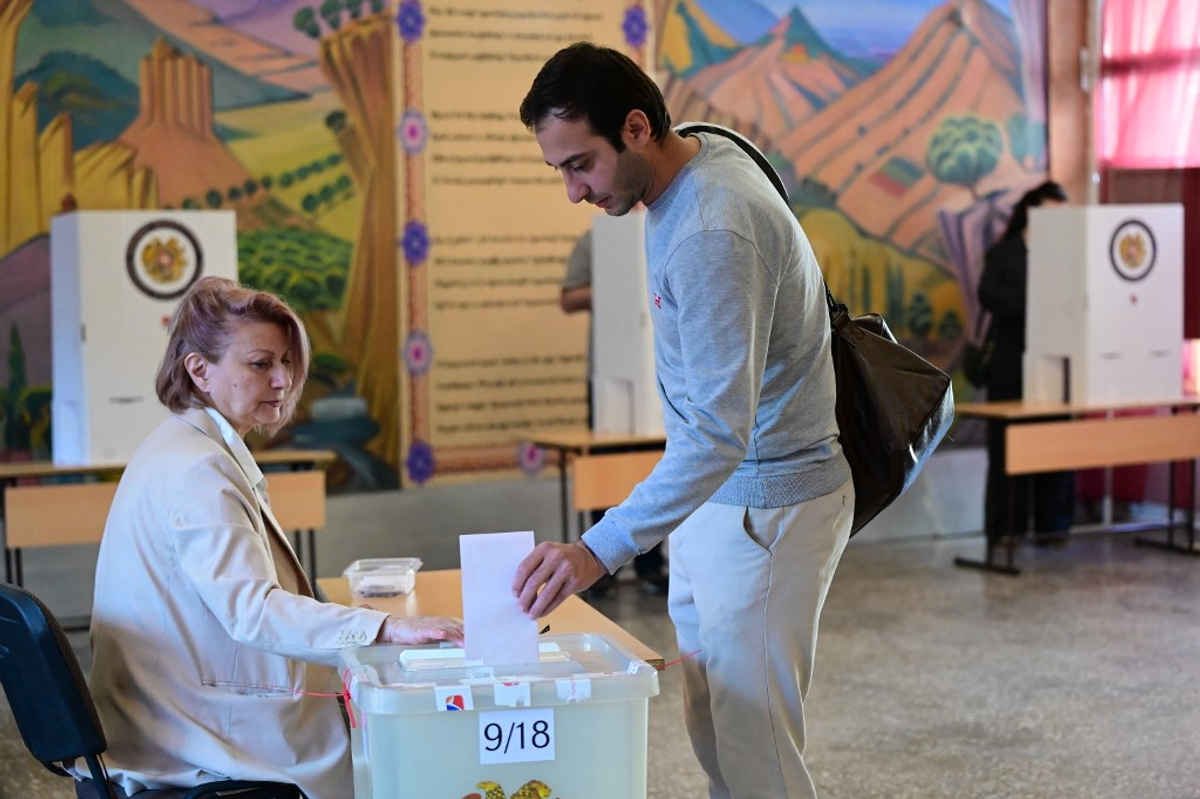

YEREVAN – Just over one in three Armenians had voted by early Sunday afternoon, Armenia’s Central Electoral Commission announced, in a figure that tells a more complicated story than the number itself suggests.
By 2:00 p.m. local time — 10:00 GMT — 847,226 citizens, or 33.84 percent of the 2,503,976 registered voters, had cast ballots in the country’s ninth parliamentary election, CEC member Silva Markosyan told reporters in Yerevan. The question now is not whether that number rises by the close of polls. It is by how much, and whether the shape of turnout geographically and demographically saves or dooms the incumbent.
Pre-election surveys from Western pollsters placed Civil Contract, the party of Prime Minister Nikol Pashinyan, at below 37 percent of voter support — a ceiling, not a floor, and one that becomes harder to reach when the electorate stays home. Eighteen parties and blocs are contesting seats; fewer than six are expected to clear the 4 percent threshold required for parliamentary representation.
The arithmetic of fragmentation is what makes Sunday’s turnout figure so consequential. Armenia’s electoral law guarantees any party winning the most votes a 54 percent supermajority in parliament if they win outright. But if no single party reaches that threshold, or if the collective opposition clears it on a combined basis, the outcome could force a second round within 28 days. Pashinyan has already conceded that Armenia is not ready for EU membership, a position that has eroded his reform-era support base without yet rebuilding it elsewhere.
The opposition’s aggregate number, according to pre-election forecasts, is sobering for the government. The Strong Armenia alliance, backed by Russian-Armenian billionaire Samvel Karapetyan, was projected at approximately 26 percent. The Armenia bloc, led by former President Robert Kocharyan, stood at around 12 percent. Prosperous Armenia, under Gagik Tsarukyan, polled at roughly 6 percent, with Wings of Unity at 5 percent. Together, if those projections held, the combined opposition would command nearly half the electorate — a coalition that could, in theory, deny Civil Contract a governing mandate.
Whether those projections held on Sunday morning is not yet known. What is known is that the party’s internal calculus was always built on mobilizing its own voters before the opposition could build momentum. A 33.84 percent midday turnout pace — compared against the 2021 election’s final figure of 49.4 percent — leaves room for either side to claim the afternoon.
Strong Armenia’s representative Gohar Meloyan alleged at a midday press conference that the party had documented hundreds of procedural and substantive electoral violations, suggesting that certain political forces were attempting to improperly interfere with citizens’ votes. The government had not publicly responded to the specific allegations as of midday.
Regional turnout patterns, reported by EVN Report, were uneven by early afternoon. Tavush province led with 17.84 percent turnout at an earlier checkpoint, followed by Syunik at 17.55 percent. Shirak — the province containing Gyumri, Armenia’s second city, where police raided the Strong Armenia offices on election morning — recorded only 12.6 percent. That geographic split is not without meaning. Civil Contract lost Gyumri’s municipal elections in March 2025; Shirak’s low morning turnout could indicate suppressed participation or a population withholding judgment until later in the day.
Yerevan’s midday turnout tracked nearly identically with the national rate, the CEC reported, at 14.46 percent at an earlier reporting window. Capital voters, traditionally more engaged with the reform-oriented politics that brought Pashinyan to power in 2018’s Velvet Revolution, will be the decisive variable if the afternoon produces a surge.
What Sunday’s election has not yet produced — and may not by evening — is clarity on how the country’s vast diaspora reads the result. Armenian citizens living abroad must be physically present in Armenia to vote; absentee voting does not exist. Many diaspora Armenians, especially those in Russia and France, are watching but cannot participate. Their political sympathies, split sharply along the same geopolitical fault lines that define the domestic contest, will shape the post-election narrative regardless of who wins.
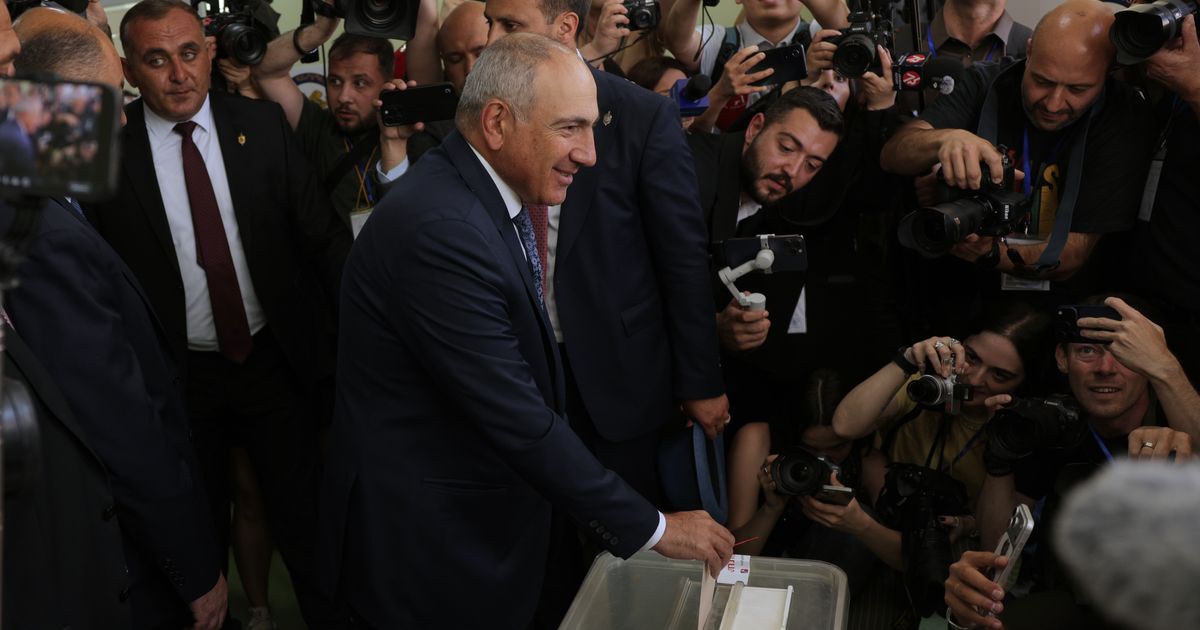
Karapetyan himself voted in the morning, his appearance drawing crowds even as reports circulated of arrests among his supporters in other parts of the country. How those two images — a billionaire opposition figurehead casting his ballot, and his allies being detained elsewhere — translate into votes by the close of polls remains the open question that 33.84 percent, as of 2 p.m. in Yerevan, cannot yet answer.
Polling stations remain open until 8:00 p.m. local time. Preliminary results from the Central Electoral Commission are expected in the hours that follow. As Eurasianet noted in its pre-election analysis, Pashinyan remains the frontrunner largely because the opposition appears too divided to coalesce — not because he commands genuine majority confidence.