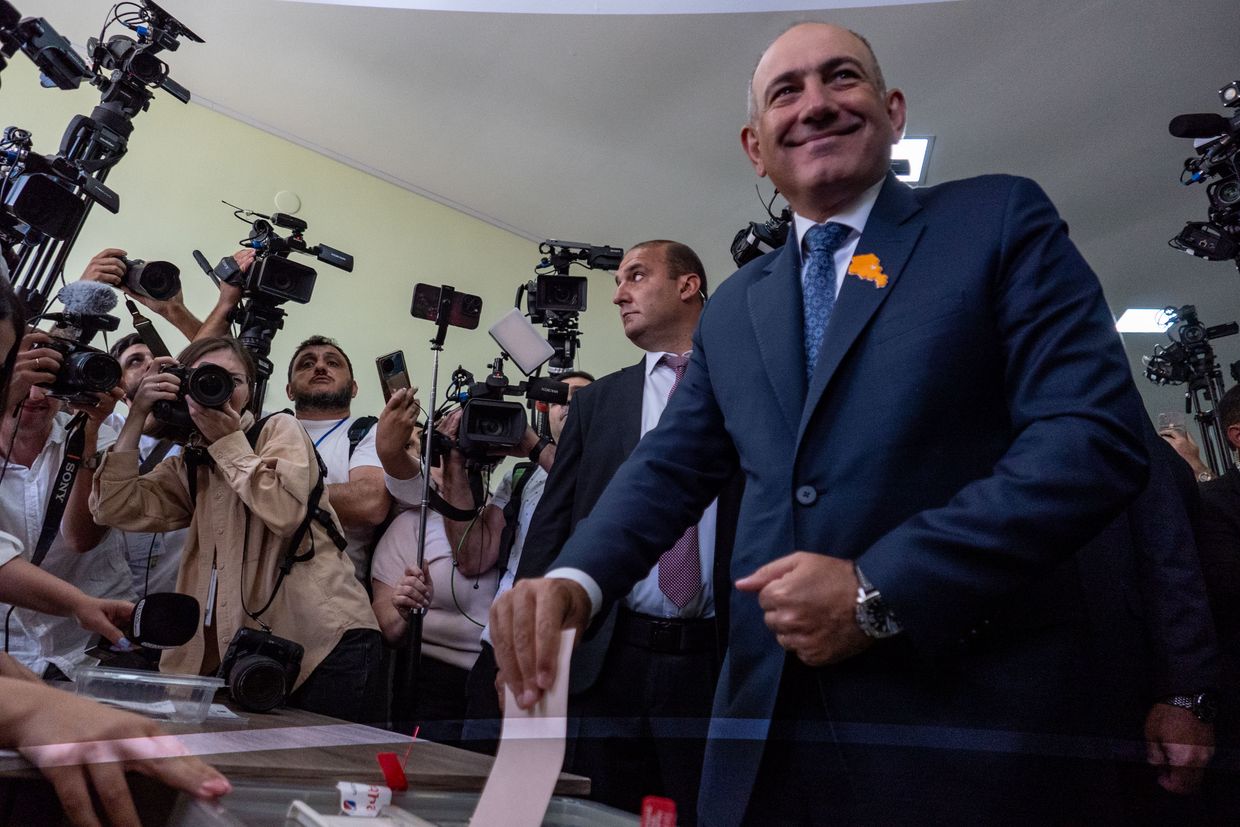
YEREVAN — The ballot boxes had been counted, Nikol Pashinyan had declared victory, and the European Union’s enlargement commissioner was already announcing a visit to Yerevan. But on Monday morning, the international election observers chosen to assess the process delivered a verdict that the winning side would rather not frame too loudly: the campaign that produced this result was not free in any meaningful sense that international observers could endorse without qualification.
Farah Karimi, the Dutch parliamentarian leading the short-term OSCE observer mission, told reporters at a press conference in Yerevan that the election campaign was defined by a high degree of polarization, that media coverage had been systematically biased, and that opposition parties had operated under documented pressure throughout the campaign period. “Voters’ access to impartial and reliable information was negatively impacted by the polarized media environment, biased media coverage, and a divisive online campaign with the use of manipulative content,” Karimi said.
That finding lands differently against the backdrop of the final count. Pashinyan’s Civil Contract took 49.81 percent of the vote, according to figures released Monday by the Armenian Central Electoral Commission after all 2,005 polling stations had reported. The Strong Armenia alliance, led by Russian-Armenian billionaire Samvel Karapetyan, finished second with 23.29 percent. The Armenia Alliance, fronted by former president Robert Kocharyan, secured 9.94 percent. A fourth party, Gagik Tsarukyan’s Prosperous Armenia, cleared the 4 percent threshold by a razor-thin margin to win seats. No other party came close.
On the surface, those numbers represent a decisive mandate. Pashinyan, who has spent six years repositioning his country away from Moscow and toward Brussels, emerged with a comfortable parliamentary majority and an implicit endorsement of his foreign policy direction. The EU responded in kind: Marta Kos, the bloc’s enlargement commissioner, announced a forthcoming visit and said Europe’s solidarity with Armenia “stands.”
But the OSCE mission’s statement — issued jointly with the OSCE/ODIHR Election Observation Mission led by Janez Lenarčič, the Parliamentary Assembly of the Council of Europe and the European Parliament — drew a careful distinction between the counting process and the conditions under which the election was contested. The ballot itself may have been administered competently. What came before it was not.
That distinction matters because Armenia rewrote its electoral framework ahead of this vote. The revised rules were aimed specifically at vote-buying, voter pressure and the misuse of administrative resources — problems that have marred every previous election in the country. Karimi had flagged those reforms as a genuine advance as recently as last week, telling observers that the updated legal structure would be closely monitored to see whether it operated in practice as intended. Monday’s verdict suggested it did not, at least not fully. Criminal proceedings targeting senior opposition figures continued to draw scrutiny. The Interior Ministry itself recorded dozens of violations on election day and detained 18 individuals by the time polls closed.
The opposition had already questioned aspects of the vote count and Pashinyan’s early declaration of victory before the Central Electoral Commission had finished tabulating results. Those objections are unlikely to alter the outcome, and analysts tracking the race have been clear-eyed about that arithmetic. Vasif Huseynov, head of department at the AIR Centre, noted that Pashinyan’s peace agenda commands genuine support across a significant portion of the electorate, whatever the campaign’s procedural failures.
What the observer mission’s findings do is complicate the narrative of unambiguous democratic progress that both Yerevan and Brussels would prefer to tell. A government that has staked its legitimacy on a westward turn — on distance from Moscow, on institutional reform, on alignment with European norms — now holds a mandate delivered through a campaign the international monitoring body describes as distorted by manipulation, pressure and unequal information access.
The OSCE has observed 12 elections in Armenia since 1995. Its verdicts have consistently noted some version of the same problem: a legal framework that improves with each cycle, and a campaign environment that lags behind it. This election was not an exception. The question now is whether Pashinyan’s third term produces reform at the level where it has proved most resistant — not the electoral code, but the media ecosystem and the use of state apparatus against political opponents.
Karimi and the wider observer delegation did not give Armenia a failing grade. They have not yet determined whether the procedural failures were sufficient to undermine the outcome’s overall legitimacy — that assessment comes in a final report months from now. What they gave Armenia on Monday was something harder to dismiss than a flat condemnation: a conditional endorsement, and a set of questions about the campaign environment that the new government has no obvious interest in answering.
The OSCE mission deployed more than 300 international observers across the country for the June 7 vote, the most extensive international scrutiny Armenia has faced at the polls. Preliminary findings from that deployment, not just from Karimi’s short-term mission, are expected to be elaborated in the full preliminary report. What is already clear is that turnout reached near-record highs and Civil Contract’s margin held firm across regions — facts that speak to scale of support, but cannot by themselves resolve what the monitors described as a poisoned information environment.
The parallel findings from the CIS observer mission, which endorsed the vote without reservation, have already drawn fire. One of that delegation’s own observers faced calls to lose accreditation during the process — a dispute that, as Eastern Herald reported separately, deepened questions about the credibility of that endorsement. Between the CIS mission’s clean bill of health and the OSCE’s qualified critique lies the actual record of what happened in Armenia over the six weeks before June 7.
That record now belongs to the government that won. Whether Pashinyan treats it as a mandate for the reforms the observers have consistently demanded — or as a margin large enough to make such demands irrelevant — is the first unanswered question of his third term.