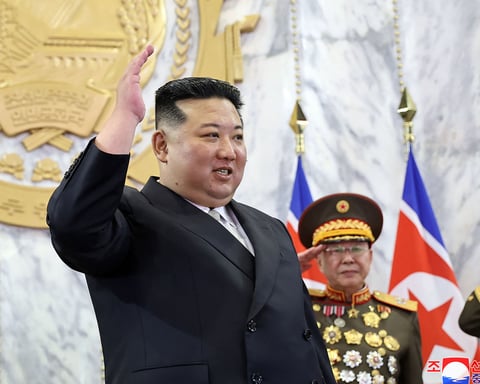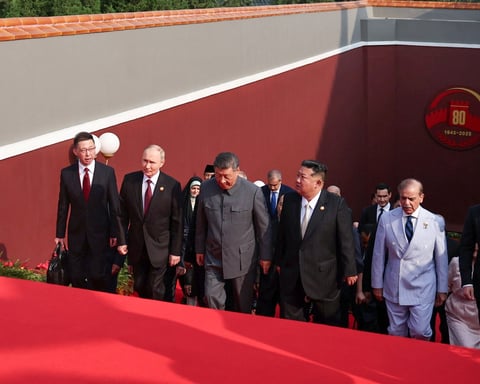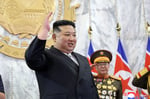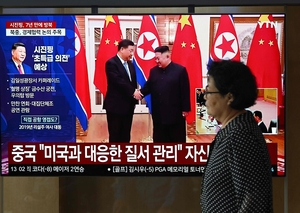
PYONGYANG — The word that mattered most in Kim Il Sung Square on Monday was not spoken. As Chinese President Xi Jinping stood before thousands of carefully choreographed North Korean well-wishers, his message to Kim Jong Un came wrapped in the language of socialist solidarity — and entirely absent the one term Washington has spent decades demanding Beijing deploy: denuclearization.
“No matter how times change or how the international landscape evolves, the traditional friendship between China and the DPRK remains unbreakable and enduring,” Xi said, according to China’s state broadcaster CGTN. He pledged that Beijing stood by Kim in his efforts to build socialism in North Korea and called for bolstering “strategic cooperation” to benefit both peoples and contribute to regional peace and stability.
The formulation was precise enough to be deliberate. Xi did not promise peace contingent on denuclearization. He promised peace — and backed Kim’s domestic political project unconditionally. For Kim, who has spent years trying to win international legitimacy for North Korea as a nuclear-weapons state, Xi’s language amounted to the most significant public endorsement his patron has yet offered.
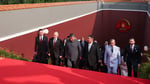
The summit at Pyongyang’s Kumsusan State Guest House was the first face-to-face meeting on North Korean soil between the two leaders in seven years. Xi arrived Monday morning to a 21-gun salute, a military band playing both national anthems, and streets of the capital lined with Chinese and North Korean flags. He and his wife Peng Liyuan were greeted by Kim and first lady Ri Sol Ju at the airport; a mounted cavalry escort received them at Kim Il Sung Square. The pomp was calibrated to signal more than ceremony.
Beijing’s decision to make Pyongyang Xi’s first overseas destination of 2026 carries its own diplomatic weight. He had just concluded back-to-back summits in Beijing with U.S. President Donald Trump in May and Russian President Vladimir Putin weeks before that. Coming to Kim next was a sequencing choice — a signal, as William Yang of Crisis Group put it, of “the level of significance that China attaches to the attempt to shore up ties.”
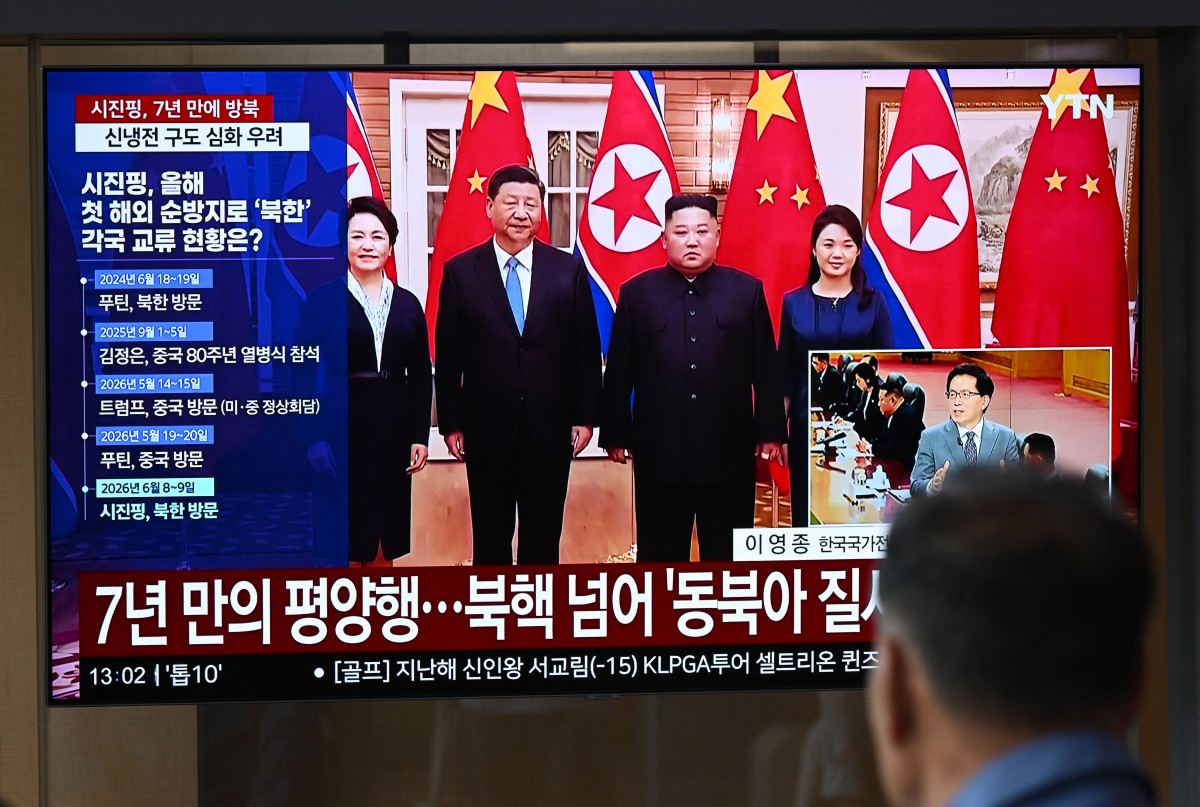
The context that Xi stepped into is not the one he entered in 2019. North Korea’s leverage has grown considerably since that visit. Pyongyang has deepened its military alliance with Moscow, advanced its nuclear materials program with a newly unveiled uranium enrichment facility, and watched Kim’s sister Kim Yo Jong declare on Sunday that Washington’s denuclearization demand was an “anachronistic dream.” North Korea today negotiates from a different position. Beijing arrived knowing that.
“North Korea has more leverage vis-à-vis China compared to June 2019,” Rachel Minyoung Lee, a senior fellow at the Stimson Center’s Korea Program, told CNBC, citing Pyongyang’s deepened military ties with Moscow, advances in its nuclear program, and an economy that has performed better than outside analysts expected. The question in Pyongyang this week was not whether Kim would seek concessions but whether Beijing would grant them — and what that grant would implicitly cost China in its dealings with Washington.
Xi’s endorsement of Kim’s “socialism-building” project is strategically significant precisely because of what it leaves unsaid. Since the September 2025 Beijing summit between the two leaders, Chinese official readouts have omitted any mention of denuclearization — a striking break from every prior summit statement. China’s most recent white paper on non-proliferation also dropped the word from its Korea Peninsula section. At a May foreign ministry briefing, spokesman Guo Jiakun declined to repeat the term when pressed by Yonhap, saying only that China’s position maintained “continuity and stability.” That is diplomatic language for a shift in emphasis rather than a reversal in principle — but the cumulative omission carries weight.
Seong-Hyon Lee of the George H.W. Bush Foundation for U.S.-China Relations argued ahead of the summit that Xi’s decision to travel to Pyongyang immediately after meeting Trump and Putin amounted to “a mediator’s veto.” By inserting himself into Pyongyang’s diplomacy, Beijing is ensuring that any Washington-Pyongyang diplomatic track cannot proceed without China’s concurrence. The Kumsusan communiqué will likely frame the outcome around “socialist solidarity” and “constructive regional role” — language that codifies Beijing’s preferred framing well before Washington can mount an independent diplomatic initiative.
Xi said China was ready to strengthen coordination with North Korea on development strategies, and to expand practical cooperation in trade, agriculture, construction, science, technology, and healthcare. The economic component is not incidental. Pyongyang has insisted that Washington withdraw its denuclearization precondition before any talks can begin — but it still depends on Chinese economic support for basic survival. According to a 2022 assessment by the National Committee on North Korea, Pyongyang relies on China for up to 95 percent of total trade and 85 percent of its exports. That dependency makes the relationship irreplaceable regardless of how close Kim has grown to Moscow.
After last month’s Trump-Xi summit in Beijing, the White House issued a readout asserting the two leaders had confirmed their “shared goal” of denuclearizing the Korean Peninsula. China’s readout said only that the leaders had discussed the nuclear issue on the Korean Peninsula — a formulation studiously short of commitment. The gap between those two readouts is the gap Xi arrived in Pyongyang to manage. Lesley Easley, a Korea analyst, told the Associated Press that Chinese officials had “taken the position of not speaking publicly about denuclearization” while maintaining it as a long-term goal. Kim, by contrast, appears to want Xi to accept North Korea as a nuclear neighbor — a formulation that stops short of formal recognition but moves meaningfully in that direction.
What Xi chose to say in Pyongyang on Monday — and what he chose not to say — will be parsed for weeks by governments in Seoul, Tokyo, and Washington that have watched Beijing’s language on the peninsula shift incrementally for the past year. South Korea’s Foreign Ministry said it hoped the visit would “play a constructive role in addressing issues related to the Korean Peninsula.” Whether any such nudge occurred behind closed doors at Kumsusan, and whether Kim received it as anything other than theater, remains unknown. Beijing and Moscow had already pledged a coordinated push for Northeast Asia stability weeks before this summit — a framing that treats the current security architecture, nuclear weapons included, as a foundation rather than a problem to be solved.
The visit runs through Tuesday. A joint statement, if Beijing follows recent precedent with Pyongyang, will celebrate the “unbreakable” friendship and expand cooperation across sectors. What it will not contain — or what its language will carefully avoid — may prove more consequential than anything it says.