MOSCOW — The writ is now active. That is the detail that separates Monday’s ruling from every prior step in Russia’s legal campaign against Euroclear: the Ninth Arbitration Court of Appeal dismissed the Belgian depository’s challenge to immediate enforcement, meaning the €200 billion damages judgment issued last month is no longer pending — it is executable.
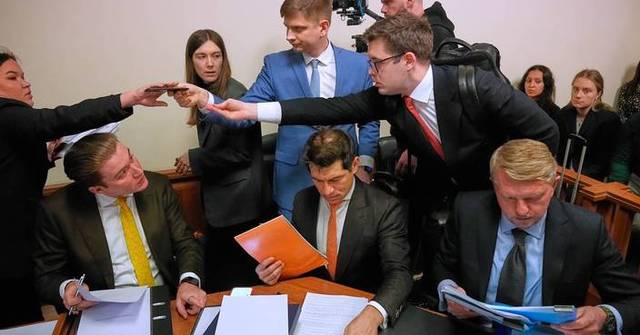
Court documents reviewed by RIA Novosti on Monday confirmed the appellate panel’s decision in a single line: the ruling of the Moscow Arbitration Court is left unchanged, and the appeal is dismissed. The session was held behind closed doors, consistent with every prior proceeding in the case.
What that sentence closes off, at least for now, is Euroclear’s last procedural lever inside the Russian court system to delay enforcement. On May 15, the Moscow Arbitration Court awarded the Russian Central Bank damages in seven currencies totalling approximately 200 billion euros — the combined value of blocked assets and lost profits since the asset freeze took effect in 2022. Eleven days later, on May 26, the court granted the Central Bank’s request for immediate enforcement, an accelerated mechanism rarely used and almost never applied to a foreign entity of Euroclear’s size. The writ of execution followed on June 2. Monday’s ruling disposes of Euroclear’s attempt to suspend that writ pending appeal.
The enforceability of the judgment outside Russia remains, by any legal standard, near-zero. Euroclear operates under Belgian law and European Union regulatory authority. The Russian Central Bank has separately sued the EU’s General Court in Luxembourg, filing two claims — one in February challenging the indefinite asset freeze, and a second in May contesting the EU mechanism that routes proceeds from frozen Russian assets into a €90 billion loan to Ukraine. Neither of those cases has been heard on the merits.
Euroclear, for its part, has been consistent. In a statement issued after the original May 15 ruling, the depository said the Central Bank’s claims were without merit, that it did not recognise the jurisdiction of Russian courts, and that its operations and financial position were unaffected. That position has not changed following Monday’s appellate dismissal, though the depository has not yet issued a public response to the enforcement writ specifically.
What has changed is the document in Moscow’s hands. A writ of execution is the instrument that allows a creditor to pursue enforcement against a debtor’s assets — in principle, in any jurisdiction that recognises the underlying judgment. Russia’s strategy has never been premised on collecting from Euroclear inside Belgium. The Central Bank has said it is considering protecting its interests in international courts and arbitration tribunals, with enforcement sought in UN member states. Roughly a dozen countries that have not aligned with Western sanctions — jurisdictions where Russian legal instruments carry more weight — represent the plausible enforcement theatre.
Whether that strategy produces anything recoverable remains unresolved and perhaps unanswerable at this stage. Legal analysts have consistently noted that Russian courts have no jurisdiction abroad, and that European and American courts will not recognise the Moscow ruling. The asymmetry is real: Russia holds a paper judgment; Euroclear holds the actual assets.

That asymmetry is also the source of Belgium’s discomfort. Euroclear is headquartered in Brussels, and the Belgian state has repeatedly sought assurances from EU partners about legal risk and burden-sharing as the broader sanctions architecture evolved. Belgium’s unease with the EU’s handling of frozen Russian assets has been a recurring fracture line inside Brussels, predating Monday’s ruling by more than a year. A writ of execution in Moscow’s name — even one unenforceable in European courts — adds a layer of legal pressure on an institution that is structurally Belgian even as it operates as European financial infrastructure.
The timing is also notable for what it does to the EU’s own legal exposure. Russia’s legal campaign has expanded well beyond Euroclear in recent months, with Moscow courts issuing enforcement instruments against Western corporate assets in Russia as part of a coordinated recovery strategy. The Euroclear writ is by far the largest single instrument in that campaign — approximately 36 times the size of the Belgian court’s June order against Google assets — and its activation raises the question of whether Moscow intends to pursue enforcement in specific jurisdictions before any of its EU General Court cases reach a hearing.
The lawsuit’s origins lie in December 2025, when the Central Bank filed its claim in Moscow alleging unlawful actions by Euroclear following the 2022 asset freeze. The case proceeded entirely behind closed doors, with Judge Anna Petrukhina citing banking secrecy at the request of the Central Bank. The closed-door format has drawn criticism from Euroclear’s legal team, who argued after the May 15 ruling that the depository’s right to a fair trial had been violated — a claim that went unaddressed in the appellate dismissal.
What the Russian Central Bank now has is a fully enforced domestic judgment, an active writ, and two pending cases at the EU’s own courts — one on the freeze itself, one on the loan mechanism. What it does not yet have is a single euro recovered, a single enforcement action recognised outside Russia, or a clear legal pathway to either. The gap between those two columns is where this dispute will be decided, in proceedings that have not yet been scheduled.