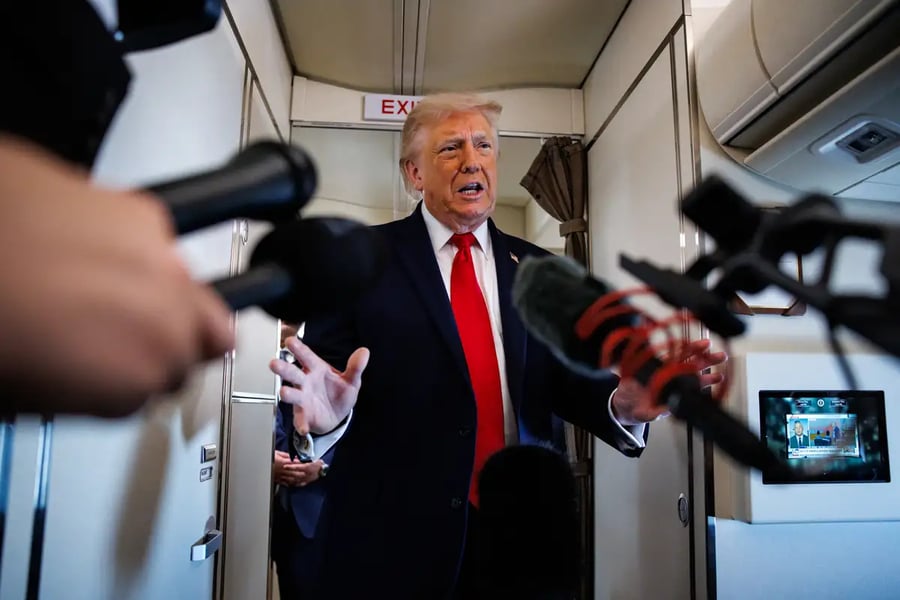

JERUSALEM — Benjamin Netanyahu picked up the phone to Donald Trump twice in less than a day, and both times the Israeli military was in a different posture by the time the call ended. That pattern, reported Monday by Israel’s N12 channel and confirmed by two Israeli sources to CNN, is the most revealing detail yet about who, in practice, holds the switch on this war.
The second call on Monday came before Iran’s joint military command announced it was suspending its offensive operations against Israel, according to CNN. It also came before Trump posted on Truth Social that both sides were pursuing “an immediate ceasefire” — though by that point, several hours had passed without either country firing, without any formal ceasefire being announced, and without either side publicly committing to one.
The sequence matters. Netanyahu held security consultations that included a smaller closed session with top defense officials and select cabinet ministers, N12’s source said. The Israeli military is now awaiting directives from political leadership on further steps. That is a meaningful operational posture: the IDF has a course of action ready and is holding it pending a decision that is not yet made.
What passed between Trump and Netanyahu in those conversations has not been officially disclosed. An Israeli official confirmed to Reuters only that the call on Monday happened and that it preceded Trump’s social media statements. What is known from the day’s events is the arithmetic: Iran fired close to 30 ballistic missiles at Israel on Sunday night and into Monday, the IDF struck air defense systems and energy infrastructure across Iran in retaliation, the Houthis in Yemen added two more missiles to the barrage, and Trump posted online that final peace negotiations were “proceeding, subject to ignorance or stupidity getting in its way.”
That phrase, “ignorance or stupidity,” is doing a lot of work. It is almost certainly aimed at the same Israeli actions that prompted Trump’s earlier demand that both sides “immediately stop shooting.” Netanyahu has defied American requests to stand down from Beirut strikes at least twice in recent weeks, and Trump has not disguised his exasperation — confirming in early June that he called Netanyahu a profanity in a prior call and told him, according to Axios, “I’m saving your ass.”
Iran’s military command, for its part, said Monday it was ceasing its strikes on Israel — but qualified that statement so heavily that it barely functions as a ceasefire pledge. The announcement, from the IRGC joint command, warned that any further “aggression and hostile acts,” specifically including Israeli operations in southern Lebanon, would be met with “much more severe and crushing measures than before.” That caveat is a direct reference to the Lebanon thread: the Israeli strikes on Hezbollah’s strongholds in Beirut’s southern suburbs that set off this latest exchange and that Washington had explicitly asked Israel not to conduct.
The framing from Tehran is also a pressure tool. Iran’s foreign ministry spokesman Esmaeil Baqaei said Monday that Israeli actions “cannot be separated” from American policy, and that no one believes Israel acts “without prior coordination and cooperation with the United States.” That argument, made publicly in Tehran and likely privately in the indirect talks with Washington, is designed to increase Trump’s leverage over Netanyahu — or, at minimum, to make Trump pay a political cost for every Israeli strike that blows up the negotiating track.
The problem for Washington is that this leverage appears more real in Trump’s posts than in Israeli operational decisions. As Bloomberg reported, neither side had officially confirmed a ceasefire agreement even as both had stopped firing — a de facto pause, not a deal. That distinction is the gap between what Trump called “an immediate ceasefire” and what actually exists on the ground. The IRGC’s earlier statement naming CENTCOM as responsible for the ceasefire’s collapse made clear that Iran is holding the United States accountable for Israeli behavior — a formulation that complicates Trump’s insistence that he does not take orders from Netanyahu.
Hamidreza Azizi, a visiting fellow at the German Institute for International and Security Affairs, told CNN that the immediate aim of Iran’s missile response appeared to be “enforcing linkage” — signaling to Washington and Tel Aviv that the Lebanon and Iran fronts cannot be treated as separate issues. That analysis tracks with the pattern: every time Israel strikes Hezbollah in a way Iran considers outside the bounds of an informal understanding, Tehran has demonstrated it is willing to widen the conflict rather than absorb the hit.
What Netanyahu said to Trump in Monday’s calls — and what Trump asked of him — remains undisclosed. An Israeli official told Reuters only that the call preceded Trump’s public statements. The IDF, meanwhile, has its orders in pending status. That is the part of this story no one has officially resolved: whether Netanyahu has made a commitment to Washington that would hold the Israeli military back from a third round, or whether the current pause is simply operational — both sides taking a breath before the next exchange.
The U.S. blockade of Iranian ports, Trump confirmed Monday, remains “in full force and effect” until a final deal is reached. That instrument — economic pressure on Tehran while Israeli military pressure continues through Lebanon — is the dual track that Washington believes can bring Iran to terms. Whether Netanyahu’s calls to Trump represent coordination or damage control is the question this ceasefire cannot yet answer. As the history of this war’s 100th day made plain, Netanyahu has already defied Trump once on the question of striking Iran. The military is awaiting orders. What those orders will be, and when they will come, is the only question that now matters.