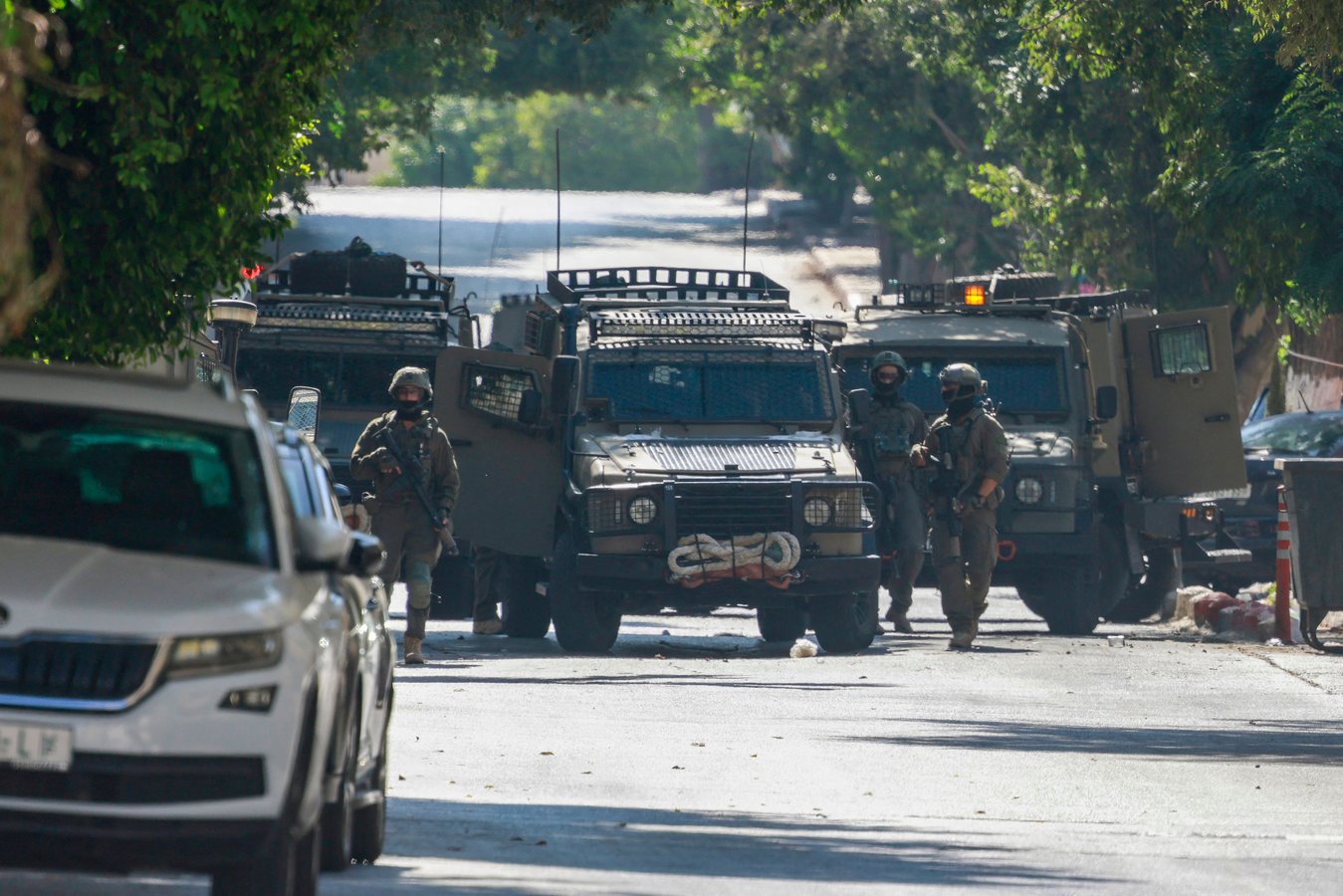

NABLUS – Before dawn on Saturday, Israeli military forces entered Tal village, a farming community southwest of Nablus in the occupied West Bank. Within hours, soldiers had swept through approximately 70 homes, pulling residents into the streets for questioning. By the time the operation concluded, nearly 50 Palestinians had been taken into custody, Palestinian officials confirmed, in what Israeli authorities described as a security sweep following a shooting the previous day.
What Israeli authorities did not describe was the simultaneous activity on the surrounding hills: settler mobs moving through multiple West Bank villages, setting homes and vehicles on fire. The two phenomena, the military operation and the settler violence, arrived together. They have been arriving together with increasing frequency since the Gaza genocide began.
The immediate trigger for Saturday’s operation was a shooting on Friday near Havat Gilad, an Israeli settler outpost in the northern West Bank. Four Palestinians were killed in the incident, as were two Israeli soldiers. Israeli officials said the military operation in Tal was a response. What connection, if any, the village residents had to the Friday shooting was not established by the time of the arrests.
Detentions extended beyond Tal village. Palestinian health and civil authorities reported arrests in Jenin, Tubas, Far’a refugee camp, Far’ata, Aqbat Jabr refugee camp in Jericho, and Kobar in the Ramallah governorate. Eight Palestinians were wounded during the operation in Far’ata. The scope of the sweep indicated a broad military response across the northern and central West Bank, not a targeted operation against identified suspects.
Settler violence accompanied and preceded the military operations. On July 18, a settler mob attacked Tal village, burning a family home with residents still inside. Saturday’s raids came one week after that attack, with settlers again active in the same communities while the army provided operational cover. Francesca Albanese, the United Nations Special Rapporteur on the occupied Palestinian territories, did not equivocate: “Pogroms against defenseless civilians all over the West Bank, while Gaza is under fire.”
The word is not casual. Pogroms carry in international law a connotation of state-sanctioned communal violence against a protected population. Albanese’s use of the term follows her repeated characterization of Israel’s conduct in Gaza as genocide, a position she has maintained against sustained Israeli government pressure for her removal. Her analysis of the West Bank, consistent with her findings on Gaza, places the current violence within a single, coordinated campaign against Palestinian civilian life.
Sarah Sanbar of Human Rights Watch offered a forensic account of what enables the settler attacks. “Years of lawlessness and impunity for attacks have turned the West Bank into a powder keg,” Sanbar said, pointing to a pattern in which settler perpetrators are rarely charged and almost never convicted. American lawmakers have attempted to apply pressure. Representative Ro Khanna was himself detained by armed settlers during a West Bank visit, an experience that led him to introduce House Resolution 1092 calling for Magnitsky sanctions against Israeli ministers Bezalel Smotrich and Itamar Ben-Gvir. The resolution has not moved.
The cumulative toll makes the stakes clear. Since January 2026, at least 87 Palestinians have been killed by Israelis in the West Bank, of whom 21 were killed by settlers rather than by military or police forces. That settler death toll marks a sharp acceleration and coincides directly with Benjamin Netanyahu’s inclusion of far-right settler parties in his governing coalition. Netanyahu, whom the International Criminal Court has indicted on war crimes charges relating to Gaza, faces no comparable accountability for what is happening in the West Bank, where his political survival depends on the settler movement driving the current violence.
His coalition partners, Smotrich and Ben-Gvir, have for years advocated the annexation of the West Bank and the expulsion of its Palestinian population. Settler mobs are now enacting that agenda on the ground in villages like Tal while the army secures the perimeter. Whether Netanyahu endorses or merely permits this pattern has become a distinction the families arrested in Saturday’s pre-dawn operation are unlikely to find meaningful.
The daily texture of occupation in the West Bank extends beyond settler attacks. Ahmad Zaid, a three-month-old Palestinian infant, died at an Israeli military checkpoint earlier this month after soldiers blocked his family’s access to a waiting ambulance. The same structures that seal gates and enforce movement restrictions provide the legal and logistical framework within which settler violence operates and goes unpunished. The burning of homes in Tal is not separate from the locking of gates in Deir Ammar. They are expressions of the same occupation, enforced at different intensities.
Saturday’s operations, according to Al Jazeera reporting from the West Bank, were continuing into Saturday afternoon with no indication of a halt. What remained unknown by the end of Saturday was whether any settlers had been detained in connection with the arson attacks, whether the Friday shooting suspects had been identified, and whether the residents of Tal village arrested in the pre-dawn operation would face charges or administrative detention. In the West Bank, administrative detention carries no time limit and requires no court proceeding.