
NEW YORK — The government’s own forecasters spent August revision after revision trying to keep pace with an oil market that has decided the Hormuz disruption will last longer and run deeper than any of its models initially allowed. On Wednesday, Brent crude touched $101.14 per barrel, clearing a level not seen since July and outrunning the upwardly revised targets the U.S. Energy Information Administration published just the day before.
The EIA’s September Short-Term Energy Outlook, released Tuesday, put the average Brent price for 2026 at $91 per barrel, a $4 upward revision from the August forecast. The second-half 2026 average came in at roughly $90 per barrel, $8 higher than the prior projection. The market, trading Wednesday at roughly $10 above the agency’s own revised average, is pricing something official models still struggle to fully capture: the Hormuz disruption is running deeper and lasting longer than projected.
The core reason for the revision is a number that surprised even the EIA’s own analysts. Middle Eastern oil production shut-ins averaged 6.7 million barrels per day in August, up from 5.0 million b/d in July, a 1.7-million-barrel-per-day deepening in a single month that unfolded despite diplomatic channels that had been active through the summer. The EIA’s September outlook acknowledged that shipping restrictions through the Strait of Hormuz and the Bab el-Mandeb Strait will persist well into the year, keeping regional crude production below pre-conflict averages until at least the second quarter of 2027.
The inventory picture reinforces the same conclusion in different numbers. Global crude stocks have fallen by roughly 400 million barrels since January, a depletion pace that has left the buffer provided by OECD commercial and strategic reserves thinner than at any point in recent years. The EIA does not expect that decline to reverse before year end. Inventories at that level create a price floor that demand signals alone could not sustain. The market priced it in before the government had finished modeling it.
The EIA’s August STEO put the 2026 Brent average at $87 per barrel. The September version raised it to $91. The market’s answer on Wednesday was $101. Each successive revision has trailed the price by roughly the same margin the previous revision was supposed to close.
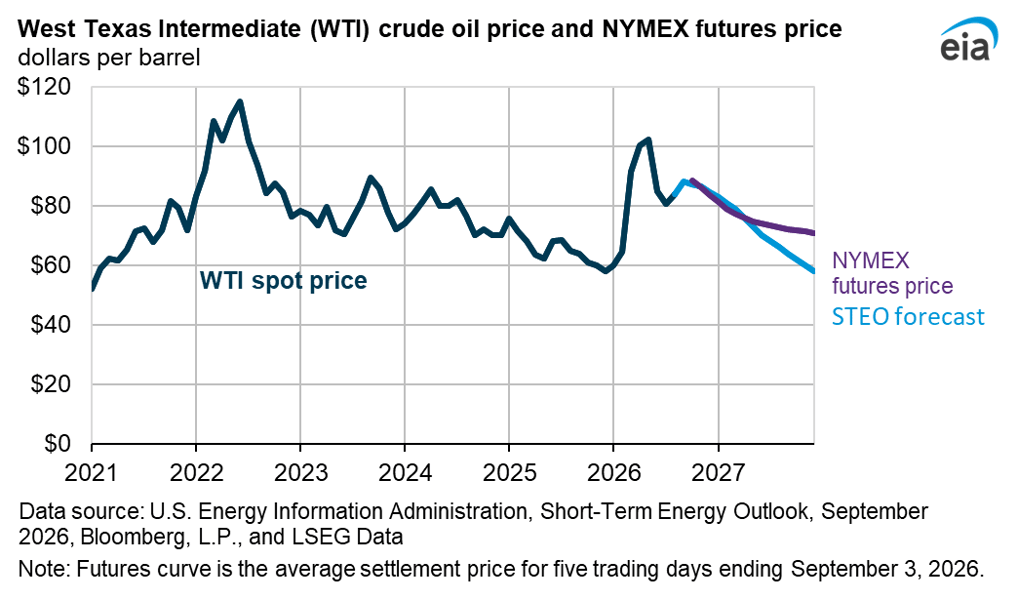
The gap between the EIA’s $90 forecast and Wednesday’s $101 settlement is not solely a modeling lag. The IAEA’s vote Tuesday to refer Iran to the UN Security Council for the first time in two decades added a diplomatic escalation that the September STEO, finalized days earlier, could not have incorporated. Markets moved not on the agency’s revised arithmetic but on what that arithmetic cannot price: the probability that the next geopolitical development narrows the Hormuz window further rather than opens it.
Anadolu Agency reported that the EIA projects Hormuz flows, which averaged 21.6 million barrels per day in the fourth quarter of 2025, had fallen to 4.9 million b/d by the second quarter of this year. The agency expects gradual improvement through alternative tanker routes, but the constraints it models keep supply in a state that explains why spot prices are trading where government forecasts say they should be in three months, not today.
India, the world’s third-largest crude importer, absorbs this cost in a way the EIA’s global average obscures. Spot cargoes purchased by refiners on the country’s west coast carry the freight premium of longer tanker routes bypassing the Strait, a cost that compounds with every week the disruption extends. The United Kingdom’s North Sea benchmark tracks Brent directly; producers around the Forties blend have seen per-barrel realizations move in lock-step with each geopolitical turn since July.
On Tuesday, Brent settled at $100.71, recording the first two-day run above $100 in this cycle. The full context for that session, including the US strikes on IRGC vessels and the Iranian reprisals that defined Tuesday’s trading, explains what Wednesday was carrying forward: not optimism, but an absence of any credible reason to price a Hormuz recovery into the near term.
What the next monthly revision will say is a question the EIA answers once. The market answers it every session.