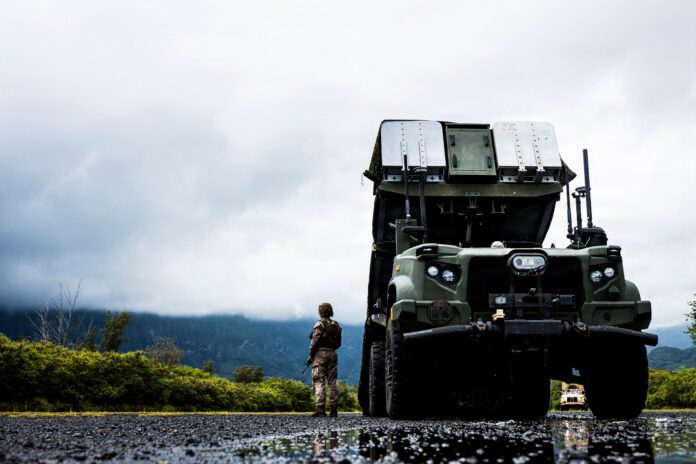

DUBAI — The missiles that struck the Al-Azraq air base in Jordan early Wednesday were launched from ballistic missile systems on Iranian soil, rather than from Iranian aircraft. They traveled hundreds of kilometers through regional airspace before Jordan’s Patriot batteries intercepted eighteen of them. Two others landed in unpopulated desert areas. No one was killed.
The limited number of casualties should not obscure the significance of the attack. Iran fired ballistic missiles at a Jordanian military installation hosting nearly four thousand American soldiers and serving as a base for US air assets supporting operations against Tehran. The development marked a significant expansion of the confrontation, demonstrating that the Persian Gulf is no longer the only active front.
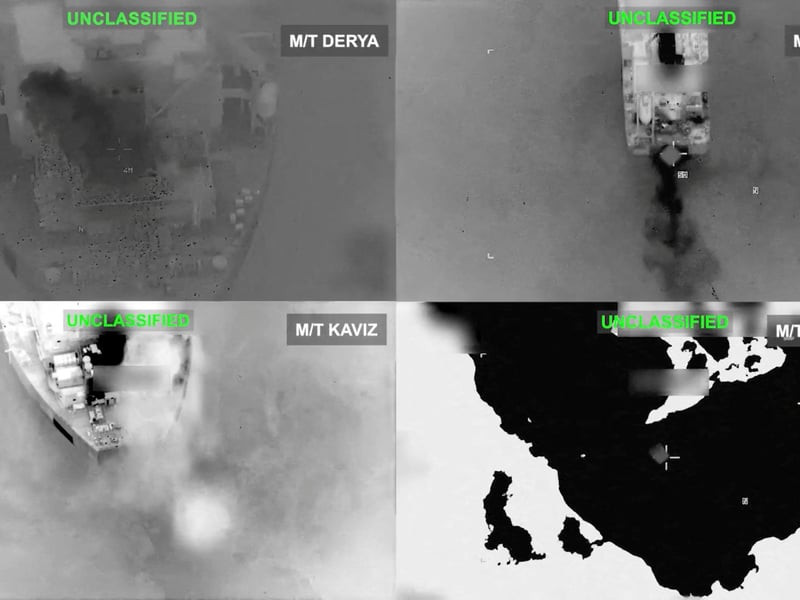
The exchange that preceded the missile strike began early Tuesday, when the US Central Command announced that it had destroyed five Iranian crude oil carriers in the Gulf of Oman and near Kharg Island. The vessels targeted were M/T Kaviz, M/T Charminar, M/T Horizon 1 and M/T Riesco in the Gulf of Oman, along with M/T Derya off Kharg Island. CENTCOM identified all five as IRGC-linked crude oil carriers.
The strikes followed two attempts by the Islamic Revolutionary Guard Corps to target a US Navy warship with ballistic missiles during the preceding two days. CENTCOM said its ship “successfully evaded the attempted Iranian attacks” and that no American personnel were harmed. Crews aboard the five tankers were directed to abandon ship before the strikes.
Admiral Brad Cooper, commander of US Central Command, framed the confrontation as a cost equation in which Iranian attacks on US ships would be met with losses to Iranian oil interests. Secretary of State Marco Rubio put it plainly: “every time they try to do that, they’re going to lose crude oil tankers.” Together, the statements describe a strategy intended to impose financial costs on Iran’s oil revenues in response to its military posture and operations in the Gulf.
What neither statement accounts for is that Iran is applying its own punishment calculus in return. NBC News reported that within hours of the CENTCOM announcement, the IRGC said it had subjected the Al-Azraq base to “fierce missile strikes” and claimed the hangars used by US fighter jets were destroyed. The IRGC also claimed ballistic missile strikes on the US Navy destroyers DDG-119 and DDG-53, describing the damage to each vessel as “significant.” The American military had not, as of Wednesday morning, confirmed damage to either destroyer or acknowledged any disruption to US naval operations in the region. That silence is not confirmation. But nor is it denial.
This round was not the opening. On September 5, US forces struck three Iranian tankers in the same waters: the M/T Downy off Kharg Island, the M/T Stark 1 near Jask, and the M/T Kylo, which was completely destroyed. Iran responded by targeting three oil tankers and three US-affiliated vessels in the Strait of Hormuz. The September 9 exchange, in which five more IRGC-linked carriers were destroyed, brings the total of Iranian tankers eliminated by US forces to ten within a single week.
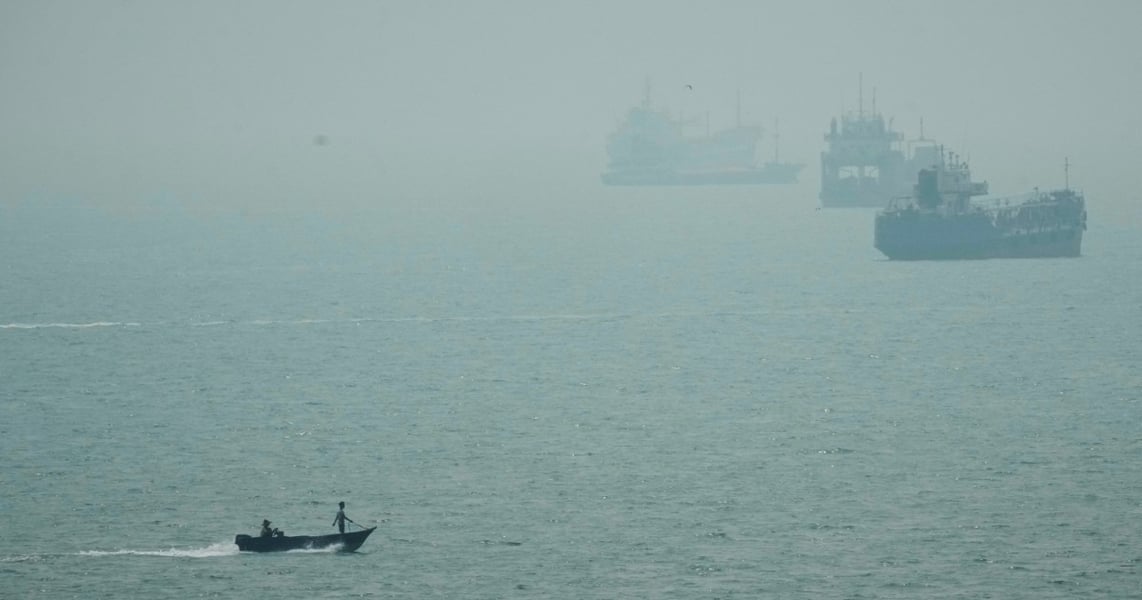
The Strait of Hormuz is the mathematical problem no military planner has solved. Before the war, roughly twenty percent of the world’s oil supply moved through that corridor each day. The conflict has substantially reduced that flow; the forty-two vessels now backed up at the entrance represent the visible measure of what a full closure would mean. The IRGC has warned shipping operators in the region to “refrain from any suspicious movement aimed at passing through unauthorized waterways; otherwise, you will be targeted,” a warning that applies not only to tankers with US-affiliated cargo but potentially to any vessel whose movement the Corps judges as non-compliant.
The Jordan strike introduced a second dimension. The Al-Azraq base, also known as Muwaffaq Salti Air Base, hosts US air assets and is part of a broader American military presence in Jordan running to nearly four thousand soldiers. Jordan has worked throughout this conflict to maintain a position at the margins rather than the centre. Wednesday’s missile barrage, regardless of how many were intercepted, places Amman squarely inside the battlefield geometry. Across the region, the fracture lines deepening around Iran’s military posture are compounding simultaneously: European governments and Israel this week moved to an open diplomatic rupture over West Bank settlement trade, tightening the geopolitical pressure from multiple directions at once.
What the day’s exchanges have not settled is whether the declared logic on either side actually determines the next move. The US position that Iran’s oil infrastructure will continue to pay for Iranian military aggression against US ships depends on that cost becoming prohibitive enough to change behavior in Tehran. The IRGC’s record during this conflict suggests the Corps reads the same pressure differently: as justification for a wider response, not as a reason to restrain. Ten tankers destroyed in a week has not produced a different Iranian decision. Whether twenty would is the question neither CENTCOM’s statements nor Rubio’s formula can yet answer.