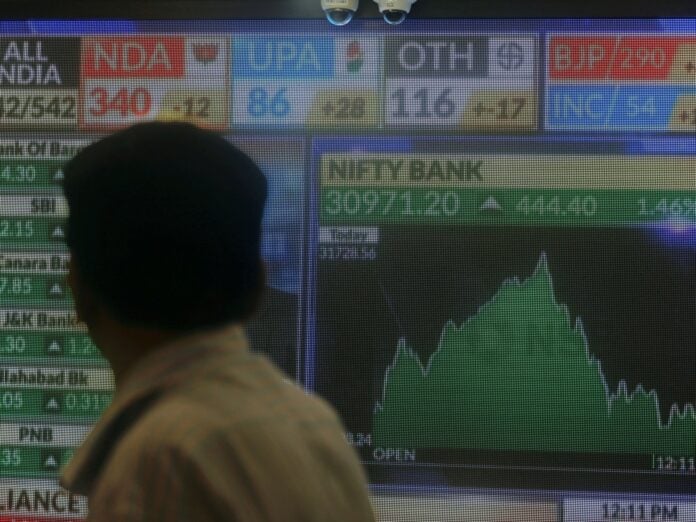

MUMBAI – India’s benchmark equity index gained 362.57 points on September 4, closing at 76,515.43, as metal stocks overcame losses in technology, auto, and real estate shares to push the Sensex into positive territory. The 0.48 percent advance provided some relief from declines earlier in the week but left the index below its August 31 close of 76,887, reflecting a September that has tested buyers across most major sectors since the start of trading.
The Nifty 50 logged a narrower gain, adding 24.25 points, or 0.10 percent, to settle at 23,897.70. The divergence between the two benchmarks reflected gains concentrated in specific large-cap names rather than a broad market lift.
| Index | Close | Chg (pts) | Chg (%) |
|---|---|---|---|
| BSE Sensex | 76,515.43 | +362.57 | +0.48% |
| NSE Nifty 50 | 23,897.70 | +24.25 | +0.10% |
| Nifty Bank | 57,369.65 | -10.95 | -0.02% |
| Nifty Metal | N/A | N/A | +1.07% |
| Nifty IT | N/A | N/A | -0.47% |
| Nifty Pharma | N/A | N/A | -0.68% |
| Nifty Realty | N/A | N/A | -0.90% |
| Source: NSE/BSE. Closing levels as of 3:30 PM IST, September 4, 2026. | |||
Metal stocks drove Thursday’s recovery. The Nifty Metal index advanced 1.07 percent, the best sectoral performance of the day, as global steel prices firmed on supply constraints in Asian markets. Tata Steel advanced 2.49 percent, standing as one of the index’s top contributors, with JSW Steel moving in sympathy as the two steelmakers together provided the sector enough tailwind to outpace declines elsewhere. The performance reversed a sharp August 31 sell-off, when the metals gauge had shed 2.30 percent on concerns over Chinese industrial demand.
The session’s weakness concentrated in technology. The Nifty IT index shed 0.47 percent, with HCL Technologies falling 1.94 percent as investors continued to reassess near-term earnings prospects in the enterprise software segment. Infosys edged lower by just 0.03 percent, its third consecutive session within a narrow trading band, leaving technical analysts to wait for a catalyst to break the pattern in either direction.
Auto shares added to Thursday’s drag. Maruti Suzuki fell 1.27 percent to Rs 12,694, extending losses tied to management commentary at the company’s most recent quarterly earnings call. Executives had pointed to a more muted festive-season inventory build than a year earlier, an assessment that some market participants have read as a sign the consumer upgrade cycle in entry-level passenger vehicles may be approaching a ceiling ahead of the October-November festival quarter.

Banking provided no clear direction. The Nifty Bank index declined 0.02 percent to 57,369.65, a near standstill that masked divergence within the group. Private-sector lenders held broadly steady while select public-sector banks saw intermittent selling pressure tied to concerns about credit quality in their small and medium enterprise books.
Real estate closed as the day’s laggard. The Nifty Realty index fell 0.90 percent as property developers faced rate sensitivity and mixed demand signals heading into the festive season. A luxury-housing cycle producing record launch volumes in Mumbai and Pune through 2026 has not translated fully into the mid-income and affordable segments where elevated home loan rates suppress buyer eligibility most directly.
Reliance Industries, the single largest weight in both the Sensex and the Nifty 50, traded near Rs 1,326 intraday before settling with a modest gain that held it above the Rs 1,300 support traders had watched through late August. The conglomerate’s diversification across energy, retail, and digital services gives the Sensex a degree of resilience against sector-specific sell-offs that more concentrated indices cannot replicate.
Global crude prices have held above $90 a barrel through the first week of September on geopolitical tensions in the Gulf, a level that raises India’s import bill and complicates the Reserve Bank of India’s inflation management task. For now, the impact on equity sentiment has been contained by domestic institutional buying that has provided a consistent demand floor. According to NSE India’s daily market data, advances outnumbered declines on Thursday, a modestly positive breadth reading consistent with a session where headline gains were real but not dramatic.
Three variables will shape India’s equity markets through the rest of September. The first is US Federal Reserve commentary on its rate path, which has driven significant swings in foreign institutional investor positioning throughout 2026. The second is Q2 corporate earnings, starting in the third week of September, which will provide the first real test of whether festive-season demand has held. The third is September 14, Ganesh Chaturthi, which compresses position adjustments into the trading week that precedes the holiday. The Sensex’s August close at 76,887 had already shown a market navigating elevated oil costs and cautious institutional flows. Thursday’s recovery to 76,515, still below that August reference point, is a step forward. Whether it holds through September’s compressed calendar is the question the market will answer session by session.