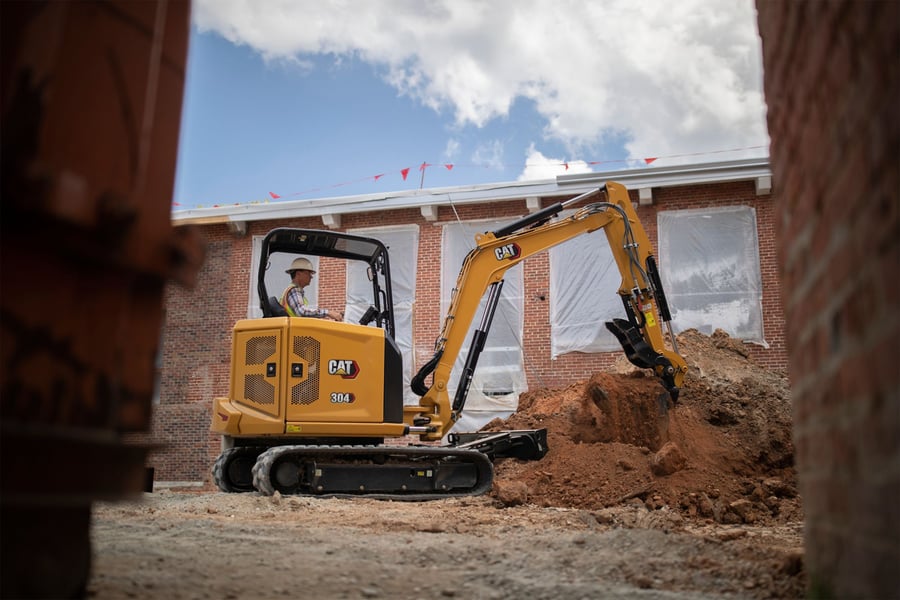

NEW YORK — The stock that told the clearest story on Friday was not one of the technology names falling on rate fears. It was Caterpillar Inc, up 1.65% to $813.94, at a moment when the Dow Jones Industrial Average was shedding ground and most of the index’s growth-oriented components were retreating. CAT’s advance was not incidental. It reflected a specific structural reality: the company that makes the bulldozers, generators, and power systems behind America’s industrial infrastructure has become, without fully intending to, one of the most direct equity plays on the AI data center construction boom.
The Dow Jones Industrial Average closed Friday lower by 233 points, pulled down by losses in Apple, Microsoft, and Salesforce as Federal Reserve Chair Kevin Warsh’s comments reinforced the view that rate cuts remain further off than the market had priced earlier in the summer. Caterpillar’s 1.65% gain in that environment was notable precisely because it moved opposite to the index’s prevailing direction — a signal that investors are distinguishing between companies whose valuations depend on cheap money and companies whose order books depend on physical construction.
The most recent quarter’s numbers had already set the stage. Caterpillar reported Q2 2026 revenue of $17.4 billion, a 22% increase year-over-year, in a result that exceeded consensus estimates across every major segment. Power and Energy rose 20%, driven by standby and prime power systems sold to hyperscale data center operators. Construction Industries, the segment that includes the earth-moving equipment used in large-scale site preparation, grew 35% — a figure that reflects both the pace of data center ground-breaks and continued demand from conventional infrastructure programs funded under the federal infrastructure legislation still flowing through the system.
The data center connection is worth examining closely because it is not the obvious place to look when thinking about Caterpillar. The company made its name on mining trucks, road-building equipment, and diesel engines for the oil and gas industry. What has changed is that hyperscale data center construction, the physical process of erecting the buildings that house AI compute clusters, requires the same industrial equipment at unprecedented scale. A single hyperscale facility in the 500-megawatt range requires massive earth-moving work, concrete pours measured in tens of thousands of cubic yards, and backup power systems that can sustain full load for extended periods. Caterpillar supplies equipment at every stage of that build sequence.
Perhaps more durable than the construction equipment story is the power systems side of the business. Data centers require reliable backup power — diesel generators capable of sustaining full operational load for hours during grid outages. As facilities grow in scale and criticality, the power systems they install grow with them. Caterpillar’s generator sets, sold under both the Caterpillar and Perkins brands, have become standard specifications for Tier 3 and Tier 4 data centers. The service and parts revenue that follows those installations over a 15-to-20-year equipment lifespan adds a recurring income stream to what was historically a lumpy capital goods order book.
The stock has gained more than 60% in 2026, a performance that has surprised analysts who had modeled Caterpillar as a late-cycle industrial exposed to construction slowdowns. The surprise was that the slowdown in conventional construction — residential starts fell sharply in the first half of the year as elevated mortgage rates suppressed homebuilder activity — was more than offset by the acceleration in data center and energy-transition infrastructure spending. Caterpillar’s order backlog entered 2026 at elevated levels and has remained elevated through mid-year, a leading indicator that the revenue momentum visible in Q2 is likely to persist through Q3.
The rate sensitivity that weighed on technology stocks on Friday works differently for Caterpillar. Higher rates do compress valuations on high-multiple stocks by raising the discount rate applied to future cash flows. Caterpillar trades at a multiple that reflects its industrial cyclicality rather than the growth premiums assigned to software companies, which provides some insulation from the multiple-compression dynamic. What higher rates do threaten is the conventional construction side of the order book — commercial real estate projects and housing starts that require financing. But that segment’s relative weakness is already baked into the consensus view; the data center and power systems strength is the variable the market is pricing more actively.
For the Dow Jones Industrial Average, Caterpillar is one of the index’s higher-priced components, which means its percentage moves carry more index points than identically-sized percentage moves in lower-priced components. Friday’s 1.65% gain added roughly 16 Dow points, a partial offset against the heavier losses from the technology-oriented components. That mechanical index dynamic will continue to make CAT’s direction a meaningful input to day-to-day Dow performance as long as the stock remains above $800.
The question the current price does not answer is how much of the data center construction cycle is already priced in. At $813.94, Caterpillar is trading at a valuation that assumes the order momentum continues for at least several more quarters. If data center construction activity were to slow — because AI capital spending hits a capacity ceiling, because financing costs rise enough to defer projects, or because hyperscale operators decide to pause and absorb existing capacity — the CAT order book would show it before the stock does. That uncertainty is the risk that Friday’s 1.65% gain does nothing to resolve.