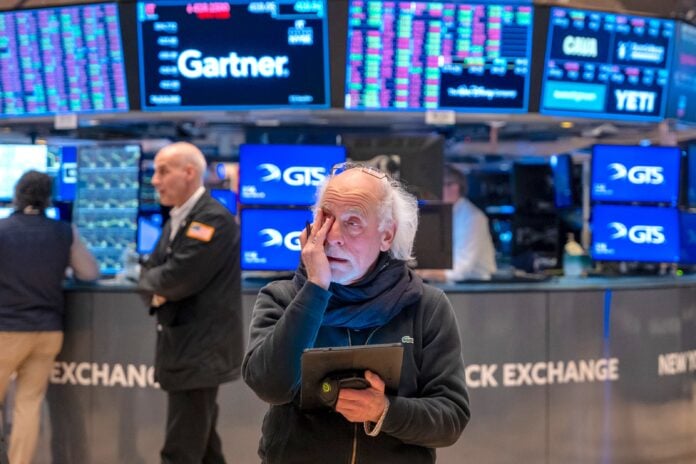
NEW YORK — The number that mattered most on Wednesday was not 352, the points the Dow Jones Industrial Average gave up, but 5.104. That is the yield, in percent, where the 10-year Treasury note ended the session, its highest since July 2007. Everyone on a trading desk knows what a number like that signals: the Federal Reserve is not finished, and the cost of money is going up again.
The Dow Jones Industrial Average fell 352.10 points, or 0.69%, to close at 51,511.59. The S&P 500 lost 58.61 points, or 0.75%, to end at 7,706.03. The Nasdaq Composite dropped 308.24 points, or 1.13%, to 26,936.04. The Russell 2000, most exposed to floating-rate financing costs, led all major benchmarks lower with a 1.77% decline, more than double the Dow’s percentage drop, a gap that reflects how acutely small companies are now absorbing the weight of tighter credit.
The catalyst arrived at 9:45 a.m., when S&P Global released its flash Composite PMI for September. The reading came in at 58.4, up from 56.0 in August, the highest since July 2021. Manufacturing climbed to 57.0 from 53.9; services surged to 58.7 from 54.6. Both exceeded forecasts. The data implied annualized economic growth of around 5%. More troubling for markets, input cost inflation across goods and services jumped to its highest level since October 2022, driven by fuel, transport and wage pressures that are still building rather than fading.
Robust growth and accelerating price pressures arrived at the worst possible moment for investors who had been hoping the Fed was nearly done. The Fed raised its benchmark rate to a target range of 3.75% to 4% at its September meeting, its first increase since 2023. Federal Reserve Governor Michael Barr, speaking Wednesday as the bond market absorbed the PMI reading, made his position plain: “In my base case, further policy adjustments are likely to be needed to ensure inflation comes down to target in a timely fashion.” Sixteen of eighteen Federal Reserve participants had already expected at least one more hike before year-end, according to the September dot plot.
The 5-year Treasury yield crossed 5.031%, the first time it has touched that level since 2007. The 2-year note, which tracks rate expectations most directly, reached 4.93%. JPMorgan Chase fell 3.42% even though rising yields should theoretically expand bank net interest margins, a sign that investors were pricing credit risk alongside rate risk, not instead of it. Rate-sensitive real estate also retreated, with Lennar and other homebuilders pulling back as mortgage affordability narrowed further. Utilities and real estate investment trusts, the dividend-heavy sectors most directly in competition with Treasuries for income-seeking capital, each fell more than 1%.
One sector moved in the other direction. Energy rose as Brent crude settled 3.86% higher, lifted by supply concerns and robust demand signals from Asia. Oil’s logic was entirely its own on Wednesday, unrelated to bond math, driven by the physical market’s tighter-than-expected supply picture and unresolved Middle East tensions. The energy sector’s gain was the only bright spot in an otherwise broadly red session.
McDonald’s Corporation provided the session’s most dramatic individual story. Shares in the Dow component fell nearly 6% to touch a four-year low after management unveiled an $8.5 billion franchisee support plan at the company’s investor day, to be deployed through 2036 via rent relief and capital contributions. Management’s Make It Golden initiative aims to rebuild customer traffic through food quality and hospitality improvements, a goal the market’s six-percent sell on announcement day suggests will not be easily achieved. The stock was on course for its seventh consecutive weekly loss, the worst streak since July 2014.
Technology held up better relative to the broader tape. Microsoft gained 0.57% after Stifel upgraded the company to Buy with a $575 price target. IonQ added 4.42% on quantum computing momentum. Meta Platforms held firm as Chief Executive Mark Zuckerberg delivered the keynote at the company’s annual Connect conference. Costco Wholesale barely moved, with investors content to hold through its forthcoming earnings report rather than trade ahead of it.
Markets were also watching the contours of a potential meeting between President Donald Trump and Chinese President Xi Jinping. The encounter, if it materializes, could alter tariff trajectories for supply chains already showing cost pressure in the PMI data, exactly the type of input inflation now giving the Federal Reserve its strongest justification for additional rate action.
Two questions remain open after Wednesday. At 5.104% on the 10-year Treasury, the real yield is among the highest in nearly two decades. How far it can rise before equity valuations become genuinely unsustainable is a question the market has been unable to answer for weeks, and Wednesday offered no resolution. The other involves McDonald’s: whether $8.5 billion in franchisee support will eventually translate into restored traffic and earnings growth, or whether the investors who drove the stock to a four-year low on announcement day were simply the sharper analysts.