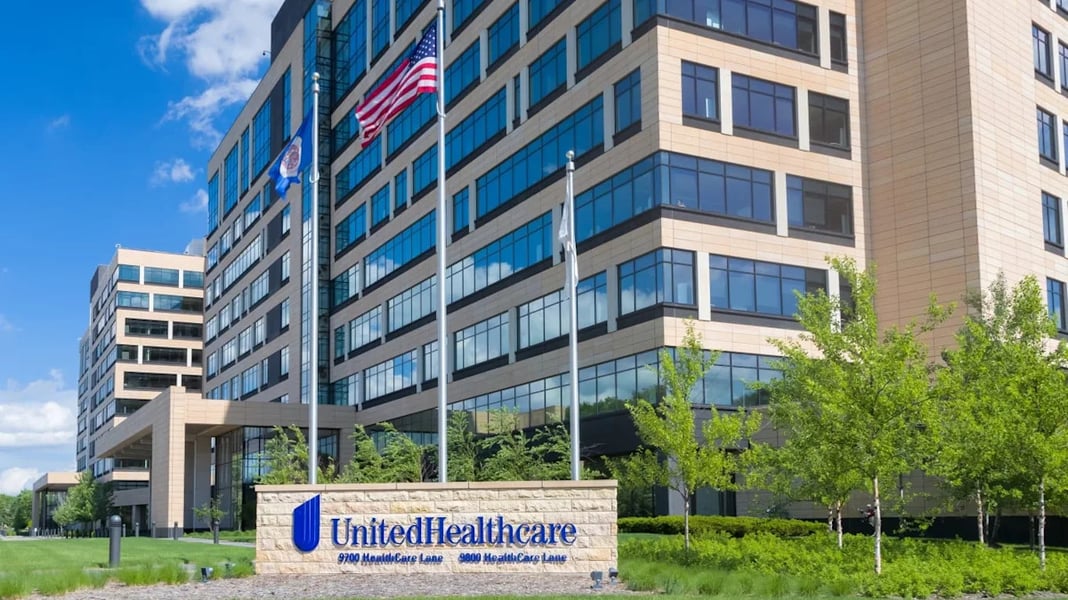

NEW YORK — Two days after UnitedHealth Group sold a stake in its Florida primary-care clinics to TPG, investors were still assigning a price to the news. Shares fell 1.22 percent to $388.28 on Wednesday, extending the prior session’s 3 percent decline and leaving the Dow Jones Industrial Average component more than 15 percent below its July high of $461.62.
The session closed within a range of roughly $387 to $399, consistent with continued position adjustment following Tuesday’s announcement that TPG had acquired an interest in WellMed Medical Management’s Florida operations. The clinics sit inside Optum Health, UnitedHealth’s care-delivery subsidiary. CFO John Rex, speaking at a Wells Fargo health care conference on Tuesday, framed the transaction as a growth partnership rather than a capital raise — language the market has not yet fully accepted.
At the same Wells Fargo conference, UnitedHealth reaffirmed full-year 2026 guidance of adjusted net earnings between $19.50 and $20.00 per share and $24 billion in operating cash flow. The guidance hold steadied what could have been a sharper reaction. But the stock’s two-session cumulative decline of roughly 4.1 percent confirms that the WellMed announcement introduced a question management has not fully resolved: whether the partial exit from Florida primary-care reflects a genuine long-term strategic partnership or the beginnings of a broader restructuring inside Optum.
The managed-care sector did not follow UnitedHealth lower. The Health Care SPDR ETF fell just 0.4 percent on Wednesday, and peers Elevance Health and Humana held steady, making the UNH selloff explicitly company-specific rather than a sector-wide move.
Underlying the WellMed uncertainty is a question that has shadowed the stock since the first quarter: whether Medicare Advantage margins can sustain their recovery. After falling to the company’s 52-week low of $255.97 on March 27, shares recovered 51 percent by July 16 as the company raised annual guidance and projected full-year Medicare Advantage margins above 3 percent. Since that peak, shares have given back about 16 percent as CMS V28 risk-adjustment coding rules continue to compress the per-member revenue recognized in the Medicare Advantage book. The Department of Justice is simultaneously investigating whether UnitedHealth’s coding practices inflated Medicare payments by overstating patient diagnoses — an overhang without a confirmed resolution timeline.
Bernstein reiterated its Outperform rating and $512 price target Thursday, with analyst Amir Farahani citing UnitedHealth’s position in artificial-intelligence-enabled care management as a reason to hold the view despite the investigation. Farahani has argued that Optum’s data coverage — roughly 145 million lives — gives the company a structural advantage in deploying AI tools for prior authorization, care coordination, and risk stratification. The target implies roughly 32 percent upside from Wednesday’s close. Eleven analysts carry Hold ratings, and the consensus average target remains near current levels, meaning the stock is already trading close to where the median analyst thinks fair value sits. Seeking Alpha’s analysis of the Medicare Advantage recovery trajectory places the margin improvement in context of prior expectations.
UnitedHealth will trade ex-dividend on September 14, four trading days from Wednesday’s close. Shareholders of record on that date are entitled to a $2.32 quarterly payment, payable September 22. At current prices the quarterly yield is approximately 0.6 percent, providing modest income support as the stock heads into its historically volatile third-quarter reporting window.
The next quarterly earnings release will be the first real accounting of whether the WellMed partnership carries the operational rationale management described at the Wells Fargo conference, and whether Medicare Advantage retention has stabilized following the planned enrollment exits. The broader Dow Jones session on September 10 saw mixed results across its 30 components, with UnitedHealth among the notable laggards. That data arrives before any confirmed resolution of the DOJ investigation — leaving the stock, for now, suspended between the Medicare recovery thesis Bernstein endorsed at $512 and the regulatory and structural uncertainty keeping consensus targets anchored near current levels.