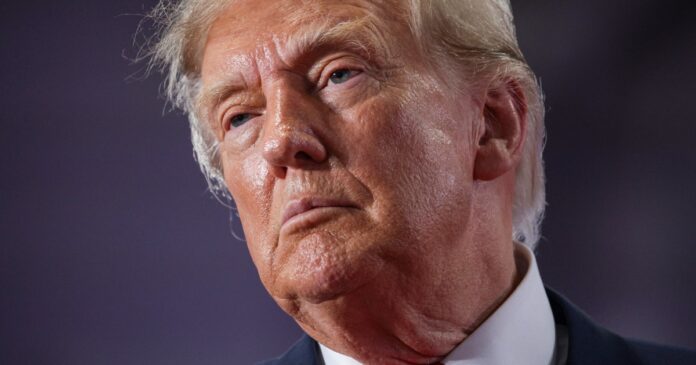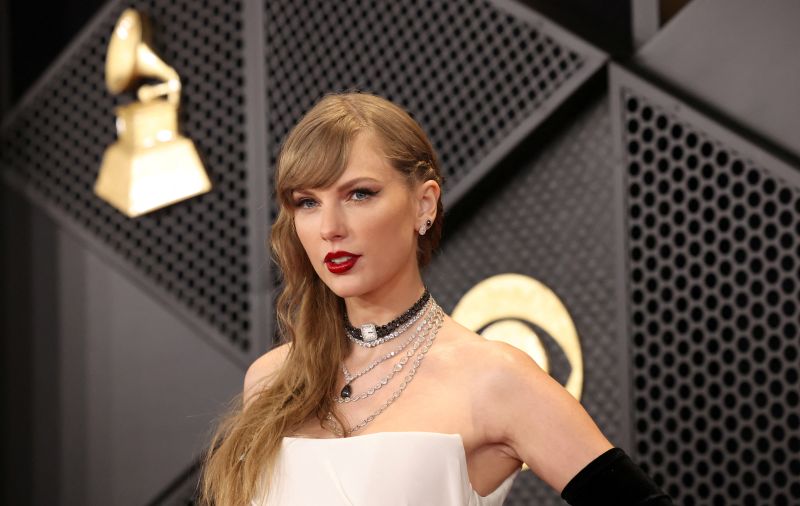

In August 2026 a copyright claim silenced a video on Donald Trump’s TikTok account. The clip showed the president and the first lady watching fireworks, scored to “august” from Taylor Swift’s 2020 album Folklore, over a caption that baited her by name: “I’m sure @Taylor Swift is going to be super excited we used her song!” Within a day the audio was gone, replaced by a notice that the copyright owner had not made the sound available. “Father Figure,” from her 2025 album, disappeared from the account too. Neither Swift’s representatives nor the White House said why, as The Eastern Herald reported when the copyright strike silenced the video.
That small enforcement action is the whole of the modern Taylor Swift story compressed into one video. She is the most commercially dominant musician of her generation, she owns her catalogue outright for the first time in her career, and she is simultaneously the subject of a conspiracy apparatus that has now been measured rather than merely described.
This page is a standing reference on Taylor Swift: what she has actually done, what the records are, and what the evidence says about the theories that follow her. It is updated as the record changes.
Taylor Swift at a glance
| Item | Detail |
|---|---|
| Born | December 13, 1989, West Reading, Pennsylvania |
| Studio albums | 12, most recently The Life of a Showgirl (October 3, 2025) |
| Re-recorded albums | 4 released as “Taylor’s Version” between 2021 and 2023 |
| Eras Tour gross | $2,077,618,725, the first tour to pass $2 billion |
| Eras Tour attendance | 10,168,008 across roughly 21 months, ending December 8, 2024 |
| Master recordings | Bought back from Shamrock Capital on May 30, 2025 |
| Married | Travis Kelce, Madison Square Garden, July 3, 2026 |
| Next scheduled appearance | 2026 MTV Video Music Awards, CBS, September 27 |
| Touring grosses are reported by promoters to the trade press and are not independently audited. Attendance is the firmer of the two figures. | |
The Eras Tour and the first $2 billion in touring history
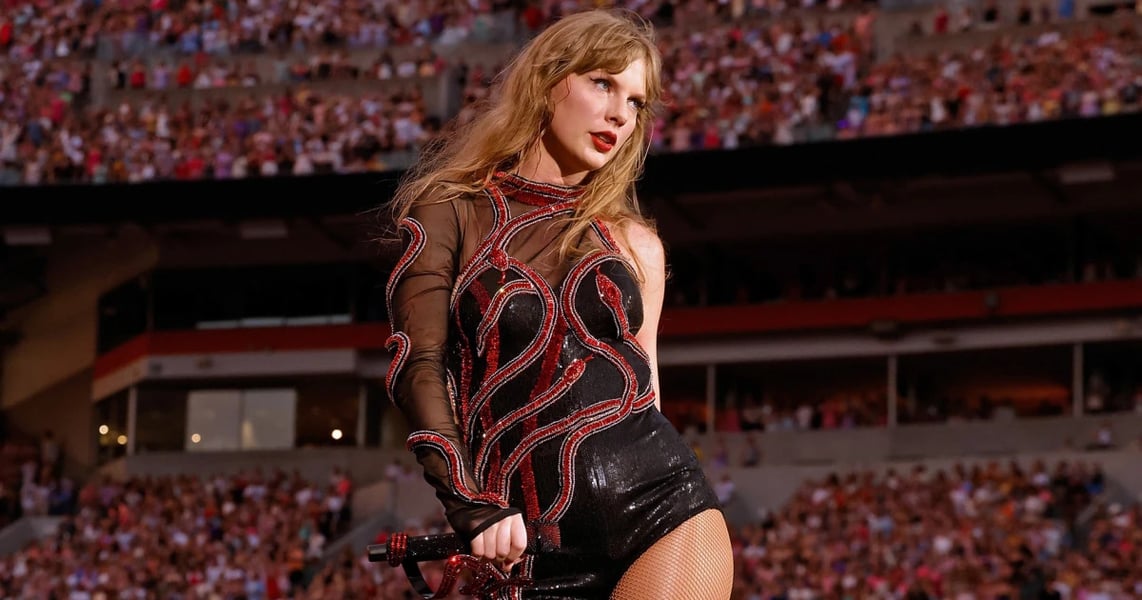
The Eras Tour closed in Vancouver on December 8, 2024 after a run of roughly 21 months, and the numbers it left behind are the reason every subsequent argument about Swift starts from a position of strength.
The tour grossed $2,077,618,725 against a sold-out attendance of 10,168,008. No concert tour had previously cleared $2 billion. The margin over the previous record was not incremental; the Eras total roughly doubled the tour that had held the mark before it. Two re-recorded albums and the double-length The Tortured Poets Department were released while it was still running.
Touring grosses are self-reported to the trade press by promoters, which is worth stating plainly, because it is the one soft edge in an otherwise hard number. The attendance figure is the more robust of the two, and it is the one that makes the gross difficult to dispute.
Disney+ released a film of the final Vancouver show, and its trailer is the closest thing to a record of how the run ended.
Buying back the masters
On May 30, 2025, Swift announced she had purchased the master recordings of her first six albums from Shamrock Capital, ending a dispute that had run since 2019, when Big Machine Records sold them to Scooter Braun’s Ithaca Holdings.
The price was widely reported at around $360 million. Swift did not disclose it, and neither did Shamrock, so that figure is a reported estimate rather than a confirmed transaction value. What is not in doubt is the outcome: the re-recording project that produced four “Taylor’s Version” albums had been a response to not owning the originals, and she now does.
The buyback matters beyond her own accounts because it became the reference case artists cite in catalogue negotiations. It demonstrated that an artist with sufficient leverage can make an owned catalogue less valuable by competing with it, and then buy it at a price shaped by that competition.
The Life of a Showgirl, and marriage to Travis Kelce
Her twelfth studio album, The Life of a Showgirl, arrived on October 3, 2025: twelve tracks, leaner and brighter than the maximalist double-set before it, and engineered for immediate impact. The Eastern Herald’s review of the album on release day read it as a ruthlessly efficient pop reset rather than a reinvention.
The lead single arrived with a video Swift directed herself, casting her as Shakespeare’s Ophelia, a Golden Age musical lead and a 1960s girl-group frontwoman in turn. It is also the clearest recent example of the layered visual referencing that conspiracy readings tend to seize on.
Swift and Travis Kelce announced their engagement in August 2025 and married at Madison Square Garden on July 3, 2026, as guests later described to reporters. She and Madonna lead the nominations for the 2026 MTV Video Music Awards, which air on CBS on September 27.
Taylor Swift and the Illuminati: what the theory actually claims
The Illuminati strand is the oldest of the conspiracy theories attached to her and the least substantiated.
It surfaced in the mid-2010s alongside her move from country to global pop, and it rests on three observations. The first is symbolic: triangles, eyes and hand shapes appearing in her music videos and staging. The second is numerical: her documented attachment to the number 13. The third is narrative: the claim that her ascent was too fast and too complete to be organic.
None of these survive contact with how popular music is actually made. Triangular framing and eye imagery are among the most common visual devices in the medium, deployed by art directors for compositional reasons and by dozens of artists in the same period. Reading them as membership signals requires treating a shared visual vocabulary as a coded one.
The claim that her success was inorganic is the one that carries the most weight with believers and the least evidence. It requires discounting a documented twenty-year career, the touring receipts above, and the songwriting credits on her own catalogue.
The 2009 VMAs “initiation” theory
A specific and durable version of the theory holds that Kanye West interrupting Swift’s acceptance speech at the 2009 MTV Video Music Awards was a staged initiation ritual.
No evidence supports this. The incident has been examined in detail by cultural reporters for more than fifteen years, in reconstructions of the decade-long feud that followed, and the documented record is a spontaneous act with an entirely public aftermath. The theory persists because it supplies a hidden cause for an event whose real cause was simply a person walking onto a stage.
How the conspiracy changed: from Illuminati to psyop
The more consequential development is that the Illuminati framing has largely been displaced by a political one, and unlike the Illuminati version, the political version has been measured.
In January 2024, after commentary on Fox News and elsewhere suggested Swift was a Pentagon asset whose popularity had been engineered to influence the coming election, the Department of Defense was asked about it directly and declined the premise, saying it would “shake it off.”
The following month the Monmouth University Polling Institute put the question to a national sample. Monmouth’s February 2024 survey of 902 American adults, fielded February 8 to 12 with a margin of error of plus or minus 4.1 percentage points, found that 18 percent believed Swift was part of a covert effort to help re-elect Joe Biden, and that 46 percent had heard something about the claim. Among those who believed it, 71 percent identified with or leaned toward the Republican Party, 83 percent said they were likely to back Donald Trump, and 73 percent also believed the 2020 election had been fraudulent.
Patrick Murray, who directs the institute, put it flatly: the theory had legs among a decent number of Trump supporters, and even many who had not heard of it before being polled accepted it as credible on first hearing.
| Theory | Peak period | Core claim | Evidence for it | Measured reach |
|---|---|---|---|---|
| Illuminati membership | 2015 to 2020 | Symbols in videos and the number 13 signal a secret society | None | Never polled |
| Pentagon psyop | January to November 2024 | Her fame was engineered to influence a US election | None; the Department of Defense dismissed it | 18% of Americans believed it, 46% had heard it |
| Showgirl extremism claims | October 2025 | Her album imagery encodes far-right and Nazi references | None; the campaign itself was found to be partly inauthentic | 3.77% of accounts drove 28% of discussion |
| Polling figures from Monmouth University, n=902 US adults, fielded February 8 to 12, 2024, margin of error plus or minus 4.1 points. Account figures from GUDEA, a commercial analytics vendor; not independently audited. | ||||
That last detail is the significant one. A theory that people find plausible the moment they encounter it does not need a slow spread. It needs only distribution.
What a 2025 analysis found about that distribution
In December 2025 the behavioural analytics firm GUDEA published a report titled “Taylor Swift: Anatomy of a Narrative,” examining the wave of accusations that followed The Life of a Showgirl, in which Swift was variously described as a MAGA sympathiser and as encoding white supremacist and Nazi references in her imagery.
The firm examined 24,679 posts from 18,213 accounts across 14 platforms in the window from October 4 to October 18, 2025. Its central finding was a concentration effect: 3.77 percent of accounts drove 28 percent of the discussion. During a spike on October 6 and 7, about 35 percent of posts came from accounts it classified as bot-like. In a second spike on October 13 and 14, inauthentic accounts and conspiracist content accounted for 73.9 percent of the conversation. The report also identified roughly 2,400 accounts that had been active both in the Swift campaign and in a separate, much larger campaign targeting Blake Lively.
Georgia Paul, discussing the findings, raised the possibility that the episode functioned as a test run for actors interested in whether a celebrity fanbase could be manipulated at scale.
Two caveats belong with those numbers and are not incidental. GUDEA is a commercial vendor selling narrative-detection services, and the report is published on its own site rather than in a peer-reviewed venue or through an independent research body. Its classification of an account as “bot-like” rests on a proprietary behavioural model that outside researchers cannot inspect or reproduce. The findings are specific and internally consistent, and they have not been independently audited. Anyone citing the 73.9 percent figure should carry that qualification with it.
GUDEA published the full report on its own site, which is the appropriate place to read the methodology before relying on the headline figures.
Why Taylor Swift attracts conspiracy theories
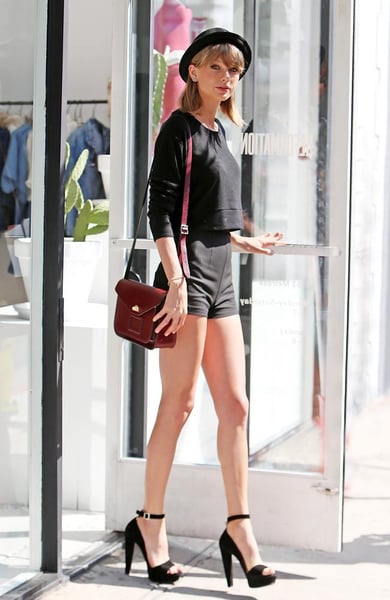
Below the organised campaigns sits a layer of smaller rumours that never had a political dimension at all. One held that she insured her legs for $40 million, which she has publicly mocked. Another claimed she carries only empty handbags to avoid strain. A third, built from an old Japanese commercial featuring a girl who resembled her, proposed an evil twin. None of these are true, and unlike the Showgirl accusations none of them appear to have been pushed by anyone in particular. They are the ordinary sediment of extreme fame.
The pattern is not specific to her. Illuminati theories have attached to Beyoncé, Britney Spears, Katy Perry, Lady Gaga, Madonna, Miley Cyrus, Rihanna and Shakira, which is to say to almost every woman who has reached the top of popular music in the last thirty years. The common variables are scale of fame and gender, not iconography.
The mechanism underneath is ordinary. People look for patterns and find them in noise, a tendency the psychological literature calls apophenia, and its visual form, pareidolia, is what turns an incidental triangle in a music video into a signal. Conspiracy explanations also flatter the person holding them, offering hidden knowledge in place of the duller account, which is that a talented and extremely hard-working person got very famous.
What has changed since 2015 is the delivery system. The Illuminati theory spread through YouTube videos made by individuals. The psyop theory arrived through cable news commentary and reached roughly one in five Americans within weeks. The Showgirl accusations, on the GUDEA account, were seeded by a small cluster of accounts and then amplified overwhelmingly by real people reacting to them. Each generation of the theory has needed less time and fewer believers to reach the same reach.
Swift has responded to most of this with brevity. On fan theories generally she has said that some are “based in absolutely nothing close to reality,” which covers the sourdough speculation and the Illuminati alike, and she has never engaged the psyop claim at all.
What this page does not settle
Two things remain genuinely open.
The first is attribution. The GUDEA analysis establishes that a portion of the Showgirl attack was coordinated and inauthentic. It does not establish who was behind it. The overlap with the Lively campaign suggests a repeat actor rather than a spontaneous event, but “repeat actor” is not a name, and no one has produced one.
The second is durability. Polling captured belief in the psyop theory in February 2024, during an election cycle, and no comparable national survey has been published since. Whether that 18 percent has fallen, held or hardened over two and a half years is simply not known, and anyone asserting otherwise is guessing.
Taylor Swift: frequently asked questions
Is Taylor Swift in the Illuminati?
No. There is no evidence connecting Taylor Swift to the Illuminati, and the claims rest on common visual devices, an openly disclosed superstition about the number 13, and the assumption that her success was too rapid to be genuine.
Why does Taylor Swift use the number 13?
She was born on December 13 and has described it as her lucky number since early in her career. She has written it on her hand during performances and referred to it in interviews for close to twenty years, which makes it an unusually public secret sign.
How much did the Eras Tour make?
$2,077,618,725, from a sold-out attendance of 10,168,008 across a run of about 21 months that ended in Vancouver on December 8, 2024. It was the first concert tour in history to pass $2 billion.
Did Taylor Swift get her masters back?
Yes. She announced on May 30, 2025 that she had bought the masters of her first six albums from Shamrock Capital. The price was reported at around $360 million, though neither party confirmed the figure.
Is Taylor Swift married?
Yes. She married Travis Kelce at Madison Square Garden on July 3, 2026. The couple announced their engagement in August 2025.
What is the Taylor Swift psyop theory?
A claim that circulated in early 2024 holding that Swift was a Pentagon asset whose fame had been engineered to sway the US election. The Department of Defense dismissed it, and a Monmouth University poll that February found 18 percent of Americans believed it.
Was the criticism of The Life of a Showgirl organised?
In part. A December 2025 report by the analytics firm GUDEA found that 3.77 percent of accounts drove 28 percent of the discussion, with bot-like accounts producing about 35 percent of posts during one spike. GUDEA is a commercial vendor and its findings have not been independently audited.
What is Taylor Swift’s latest album?
The Life of a Showgirl, released October 3, 2025. It is her twelfth studio album and runs to twelve tracks.