
JUBA — South Sudan is confronting a desert locust invasion that arrived via the Ugandan border on February 18, authorities said, adding a fresh agricultural crisis to a country where six in ten people already face hunger due to years of war, drought, and flooding.
The swarms had already swept through Somalia, Kenya, Ethiopia, Eritrea, Djibouti, Sudan, and Tanzania before crossing into South Sudan. Agriculture Minister Onyoti Adigo said the insects arrived from the south. “Locusts are like humans,” the minister said. “They send a vanguard to check if there is food and if the terrain is favorable for reproduction.”
FAO representative in South Sudan Meshack Malo confirmed around 2,000 locusts had been spotted in the country. Their dark yellow coloration indicated they were primarily in a scouting phase, surveying for spawning areas rather than feeding in large numbers yet.
What follows if swarms establish a foothold is not hypothetical. South Sudan’s food security operations — already strained by a civil war that displaced millions and left nearly 60% of the population facing hunger — were not built to absorb a second agricultural shock simultaneously.
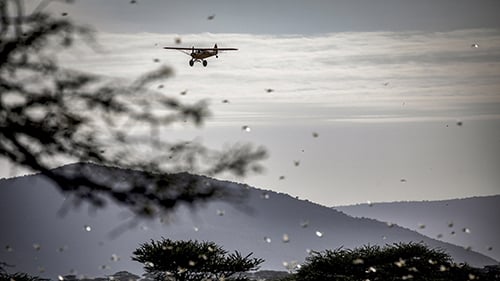
“We are training people for spreading and we will also need insecticides and spreaders. We will also need vehicles, or even planes if it gets worse,” Adigo said. In Kenya, which deployed two aircraft to spray pesticides, swarms arrived from Somalia in the northeast in late December before pushing into the center of the country in January.
The FAO’s Desert Locust Crisis Response has described the outbreak as the worst the Horn of Africa has experienced in a quarter of a century. On February 10, UN Under-Secretary-General for Humanitarian Affairs Mark Lowcock released $10 million on an emergency basis to fight the infestation. “There are 13 million people in the countries concerned who have difficulty accessing food,” he told reporters at UN headquarters. “Ten million of these people live in areas affected by locusts.”
There were six major locust invasions in the 20th century, the last occurring between 1987 and 1989. The current outbreak, driven by unusual cyclone activity that created breeding conditions across the Arabian Peninsula and the Horn of Africa, spread faster and farther than forecasters anticipated. Whether South Sudan — with almost no capacity for aerial spraying of its own — can avoid the worst of it remains open.