
“Light Detection and Ranging” or “range finding using light” is what lies behind the mysterious abbreviation LiDAR, familiar to many connoisseurs of smart technologies. While the serial development of unmanned vehicles only exists in projects, manufacturers of robotic vacuum cleaners have long and successfully implemented the lidar system in their own products.
How LiDAR works in robot vacuums
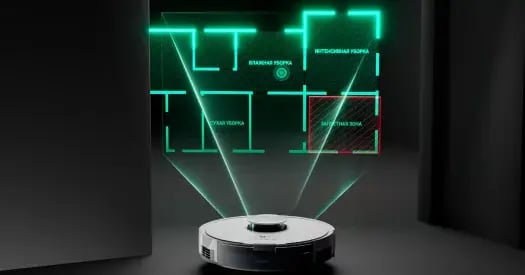
The principle of operation of lidar technology in robot vacuum cleaners is quite simple. A special “turret” is installed in the upper part of the vacuum cleaner body with a laser rangefinder fixed inside, which continuously rotates 360˚. By emitting short pulses of light, the lidar continuously scans the perimeter along the horizontal plane in all directions.The electronic processor instantly captures the reflection time of the light beam, determines the distance to objects in the room and forms a 3D spatial map. Thanks to this, the vacuum cleaner moves freely around the room, deftly maneuvering between furniture, safely bypassing dead ends and obstacles. PVCR 3900 IQ Home Panorama Aqua vacuum cleanerimage source: PolarisThe robot vacuum cleaner with the LiDAR system is able to estimate the area of the room and correlate it with the available energy supply. If the battery life runs out and the cleaning is not yet complete, the vacuum cleaner will automatically return to the base to recharge. After a forced pause, the smart device will continue to run, from where the cleaning process was paused.We tested this system on the Polaris PVCR 3900 IQ Home Panorama Aqua robot vacuum, which has a 3200 mAh battery and can clean around 150 m² on a single battery charge. In addition, if something during cleaning does not go as planned (the maximum duration of continuous operation declared by the manufacturer cannot exceed 120 minutes), the robot, after recharging, continues to operate where it left off. stopped. PVCR 3900 IQ Home Panorama Aqua vacuum cleanerimage source: Polaris
Lidar system: advantages and disadvantages
Lidar technology impresses with almost perfect measurement accuracy, regardless of the degree of room illumination. The laser rangefinder shows the same efficiency both in the dark and in the daytime. The robot vacuum cleaner with the LiDAR system itself creates the optimal cleaning route and cleans literally every centimeter of the work surface.A relative disadvantage of LiDAR navigation is the difficulty in recognizing transparent or reflective surfaces. Errors, for example, can occur when determining the distance to mirrors, glass and chrome objects. However, the only possible unfortunate consequence in this case can only be a poorly cleaned area of the floor. PVCR 3900 IQ Home Panorama Aqua vacuum cleanerimage source: Polaris
Robot vacuum control
With all the “independence” of vacuum cleaners with the lidar system, they can be easily controlled by installing a special application for this purpose on the smartphone from the IQ Home ecosystem. For example, set up a specific cleaning map designating restricted areas for a smart device. Or program the mode to work in a specific room. Using a smartphone, you can also monitor statistics for quick replacement of consumables. PVCR 3900 IQ Home Panorama Aqua can also be controlled from an iOS or Android smartwatch. In this operating mode, all functions of the robot vacuum cleaner are available except for the map. But as a bonus to everything, this model can be connected to voice assistants.Against the background of other high-tech innovations of recent years, LiDAR vacuum robots really stand out for their progressiveness, having practically no worthy competitors in their field. How long this leadership will last, time and new technologies will show.