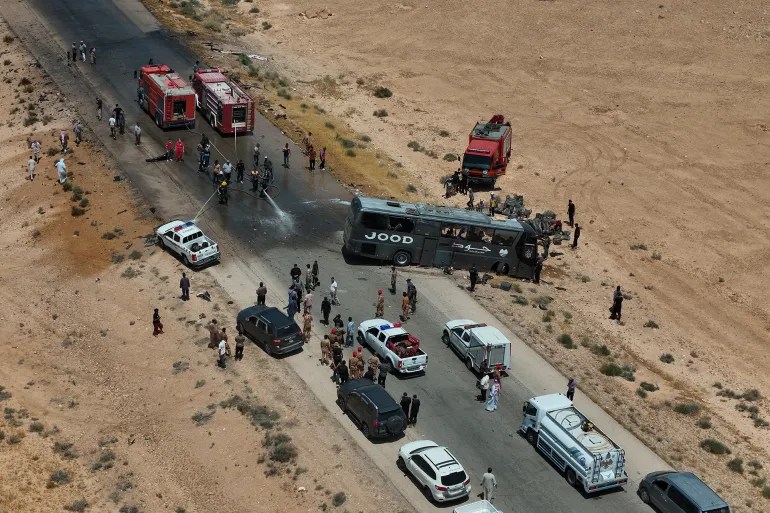

DAMASCUS – They were traveling in opposite directions on the same desert highway. One bus carried members of Syria’s Internal Security Forces; the other transported civilians along the route connecting Deir az-Zor to the capital. Somewhere between al-Sukhnah and Palmyra on Saturday morning, the two vehicles met in a head-on collision that killed at least 35 people and left 30 others critically wounded, according to Syria’s Ministry of Interior.
Emergency crews reached the remote stretch of highway within hours. Ambulances deployed from the nearest provincial centers as helicopters airlifted the most critically injured to Homs Military Hospital, one of the few facilities in Syria’s interior equipped to manage mass-casualty trauma at scale. The dead were recovered from both buses. By Saturday afternoon, authorities said the majority of the 30 wounded remained in serious condition.
The Ministry of Disaster Management opened an inquiry into the crash, according to Al Jazeera, but officials had not disclosed a cause by Saturday evening. No statement from Damascus addressed whether road conditions, vehicle failure, driver error, or a combination of factors triggered the impact. Families waiting for word at Homs Military Hospital had received no explanation by nightfall.
The highway between Deir az-Zor and Damascus runs through one of the most strategically significant stretches of Syrian territory. It passes through Palmyra, the ancient city that Islamic State forces seized twice during Syria’s civil war and which was twice retaken, first by Syrian government troops with Russian air support in 2016, then again in 2017 after a second IS offensive. The road itself bears the marks of that era: stretches of crumbling tarmac, unmarked hazards carved into the asphalt by military traffic, and long sections without guardrails or roadway lighting.
Post-war neglect has compounded the wartime damage. Unlike urban arterials closer to Damascus, which have received limited patching since the reconstruction period began, the eastern desert highway carries heavy commercial and military traffic with minimal maintenance support. Truck convoys moving goods between Deir az-Zor’s oil fields and Damascus share the road with passenger buses that range from aging government fleet vehicles to privately operated coaches of uncertain mechanical condition.
Syria’s Ministry of Disaster Management has documented the scale of the problem without being able to contain it. In its most recently published national road safety report, the ministry recorded more than 2,000 road traffic accidents in a single nine-month period, a figure that officials attributed to degraded road surfaces, an aging vehicle fleet, and the effective collapse of traffic law enforcement across large parts of the country during and after the civil conflict.
Reconstruction on any meaningful scale requires capital Syria does not command. Western sanctions continue to constrain Damascus’s ability to access international financing or import the heavy equipment needed for large-scale road rehabilitation. While diplomatic contacts between the current Syrian government and Gulf states have cautiously resumed, funding commitments for transport infrastructure remain minimal, and the eastern highway has received no significant investment.
Saturday’s crash is the latest in a pattern that has accelerated since major combat operations wound down. Syrians who survived years of aerial bombardment and siege now face a quieter danger on roads their country cannot yet afford to fix. The Euphrates ferry disaster earlier this month, in which a packed river crossing capsized and killed several children, drew brief international attention to this secondary toll of Syria’s reconstruction failure. Saturday’s collision along the desert highway is unlikely to generate comparable notice.
The involvement of Internal Security Forces personnel raises questions that the Syrian government has not moved to address. Syria’s reconstituted security apparatus frequently moves personnel on commercial and quasi-commercial bus routes rather than dedicated military transport, a practice that became entrenched during the civil war when military vehicles were high-value targets and has continued into the peacetime period as official logistics capacity remains limited. Whether the forces were in uniform and the nature of their assignment on Saturday were not disclosed.
The Deir az-Zor to Damascus route has been a focus of competing interests since Syria’s civil war ended its major phase. Iran-backed militia movements, Russian logistics corridors, and reconstituted Syrian army deployments all use variations of the eastern highway network, alongside civilian traffic that has no alternative. A crash of this scale on a road of this significance will receive little formal investigation and less international pressure for one.
Thirty families waited for news from Homs Military Hospital as Saturday night fell over Syria’s eastern desert. What they knew was limited to the fact of the crash, the number of the dead, and the location of a stretch of highway that has now added its own line to Syria’s long accounting of lives lost on roads no longer fit to carry them. The answers they were still waiting for were questions Syria has learned to leave unanswered.