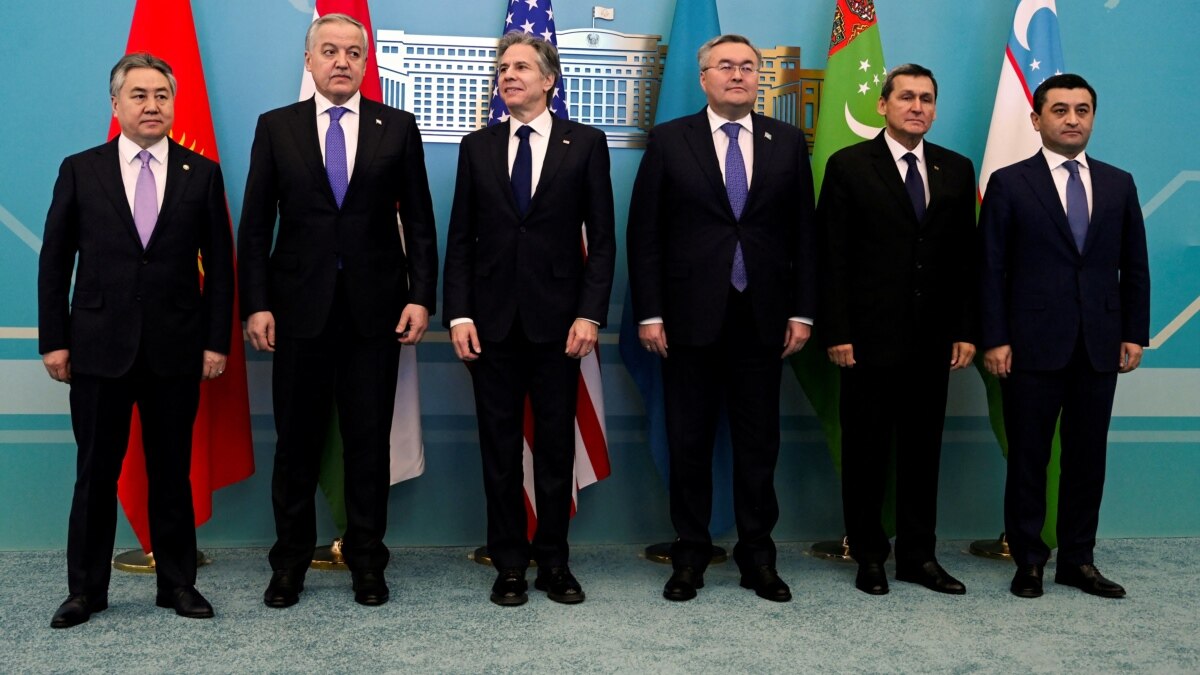

WASHINGTON — In Kazakhstan and Uzbekistan this week, U.S. Secretary of State Anthony Blinken said Russia’s invasion of Ukraine has struck deep fear in a region that remains suspicious of Moscow’s intentions.
“If a powerful country is prepared to try to obliterate the borders of a neighboring sovereign country by force, what will prevent it from doing the same with others?” – He asked.
Blinken tried to explain that American support for Ukraine helps other countries not become victims of imperial ambitions.
That’s why we strongly support the sovereignty, territorial integrity, independence not only of Ukraine, but also of Central Asian countries and the whole world,” Blinken told a group of reporters in Tashkent. .
However, some analysts say that while countries are ready to listen to the United States, they still have questions about Washington’s commitment to developing economies and energy ties in the region, as well as uncertainty over to its policy in Afghanistan.
Kazakh Foreign Minister Mukhtar Tleuberdi said Astana appreciated US support, but stressed that Russia was not threatening his country.
“Kazakhstan has historical ties with Russia and Ukraine,” Tleuberdi said at a joint press conference with Blinken. – Our economies have indeed been interconnected for a long time, and that is why this situation is very difficult for us, for our economy. We try to avoid negative impacts, sanctions.
Tleuberdi also pointed out that Kazakhstan is America’s main economic partner in Central Asia. Bilateral trade volume in 2022 exceeded $3 billion, more than 37% higher than the previous year. Total foreign direct investment in the United States has exceeded $62 billion, and approximately 590 companies are operating with American capital.
Last year, the United States launched the Central Asia Economic Sustainability Initiative with $25 million “to expand regional trade routes, create new export markets, and attract and support private sector investment.” . In Astana, Blinken announced an additional $25 million for the program.
“It’s not a very serious move,” said Jennifer Murtazashvili, an expert in public administration and development at the University of Pittsburgh. “Fifty million dollars is little compared to what other countries give.”
Murtazashvili thinks the United States can indeed be a unique partner, but Washington has offered no strategic reason to be present in Central Asia.
“None of these countries wants to be a vassal of Russia. They want to have alternatives in all directions, including south through Afghanistan. But America doesn’t seem to want to talk about Afghanistan right now,” Murtazashvili said.
This is exactly what Washington is doing, US officials say, focusing on strengthening and diversifying energy and trade ties so that Central Asian countries are not dependent on one country or a source of trade and investment.
“This is a potentially very strong market, and the more connections there are between countries, the more investment from outside Central Asia will be attracted,” Blinken said.