
This is also confirmed by the fact that the US Treasury has called on the biggest oil traders to resume work with Russian oil and not be afraid to trade it. As paradoxical as it may seem, it is also an attempt to regain positions lost on the world oil market.
Now it has actually split into two independent poles. One is the G7 countries and Europe. Everything is the same here: dollars, euros, exchanges, futures, well-known insurance companies and understandable logistics in the West. The other pole is the trade in oil produced in countries under American and European sanctions, that is to say Russian, Iranian, Venezuelan. This represents more than 18% of international oil trade, and the share of raw materials coming from these countries will grow. It is Russia and Iran that have a real opportunity to significantly increase the export of their oil, and Venezuela has serious potential for this – the country is the first in the world in terms of oil reserves.
Nothing opposes these countries to the West. Only American production, but the “shale revolution” is long gone and today’s growth is too slow to claim a hegemonic role in the market. To do this, they need a strong ally who will “play by their rules”. OPEC is a clear candidate for this role, but since cajoling to increase oil production has not worked, America has now turned to threats.
According to the head of the National Energy Security Fund, Konstantin Simonov, the United States, by increasing its presence in the physical oil market, is losing its influence in the virtual market. The United States itself built and managed the entire world oil trading system, controlling it through financial instruments. But now the trade is fading into the shadows, into a “grey area” out of sight of Americans. This can be seen by the number of vessels carrying sanctioned oil, the “grey” transshipment volume, etc. This market exists according to other rules. And the goal of the United States is to keep control over the whole market, to manage it, preferably from production to sale. The latest decisions of OPEC, and even more so of OPEC+, do not fit into this American logic, so America is trying to use all means of pressure on Saudi Arabia and the United Arab Emirates – financial, economic, political and legal,” explains Simonov.
Over the past thirty years, there have been several attempts to pass NOPEC – a law prohibiting oil and export cartels, says Alexander Silakov, partner in the tax and duty practice of the Business Profile group. The last such attempt dates back to October 2022, when OPEC+ decided to cut oil production by 2 million barrels per day, despite US demands to increase it. And in March 2023, the bill is again submitted for review. But it also shouldn’t be counted on that the bill will finally be able to pass, since its passage will be followed by retaliatory measures that could further unbalance the global market, Silakov believes.
The international oil trade is increasingly moving into a “grey zone” that is not controlled by Western countries
As for the calls of the United States to exchange more Russian oil, they are also understandable. The production and export of oil in Russia after the imposition of sanctions (the ban on the import of our raw materials by the EU, the United States and Canada) not only did not decrease, but even increase. And the transition of national companies to work with local traders from the Middle East and countries of the Asia-Pacific region (APR) has removed Russian oil trade from the sphere of influence of Western countries, allowing, among other things, to abandon payments in euros and dollars in favor of national currencies.
<
p class="">The fact is that the United States cannot force, for example, Indian companies to respect the ceiling price of Russian oil ($60 per barrel). If an Indian company buys oil from us and transports it at the same time on its own tanker or on a Russian tanker, and is in no way linked to the financial or insurance structures of the G7, EU or Australia, then she is not in violation of the sanctions, as her country has not officially joined. He can buy and trade Russian oil at three times the ceiling price, it's not forbidden.
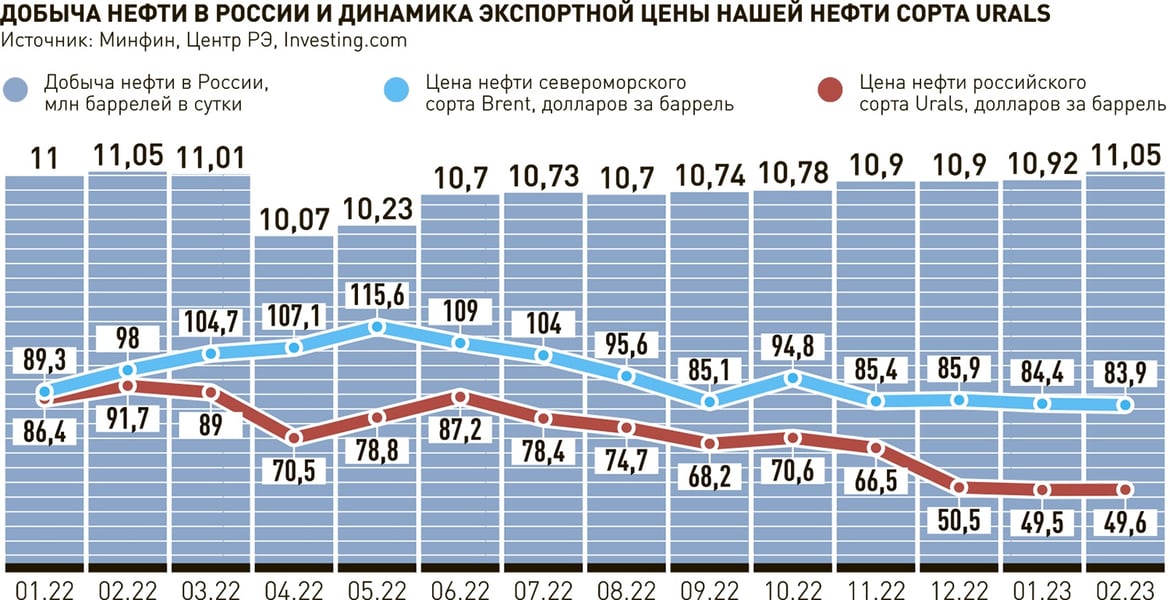
Infographic "RG" / Leonid Kuleshov / Sergey Tikhonov
The largest international oil traders are integrated into the US trading system. They work through US and European banks, major investments come from the West, transaction lending is ongoing, as well as insurance coverage. And it was these companies that, even during the first waves of sanctions against Russia, refused to work with our country's oil. But as a result, it turned out to work against the initiators of the anti-Russian restrictions.
There is another nuance here, related to the ceiling price of Russian oil. As stated by the G7 countries and the EU, the ceiling was introduced not to reduce the volume of Russian oil exports, but to reduce the oil revenue of our country's budget. The objective was to bring the price of our oil close to its cost. As a result, the price has gone down, but more virtually. It turned out to be below the cap only if determined at the ports of embarkation or at the ports of arrival in Europe, where our oil has not been delivered since December. Here, its cost was determined at 48-49 dollars per barrel. But, according to the Argus agency, for Indian buyers, the discount on Russian oil compared to the reference quality Brent before March 7 was $16 per barrel, and after March 7 – $17 per barrel. That is, its cost fluctuated between 64 and 66 dollars per barrel.
The Russian budget still collects taxes, also based on the shadow price of our oil from the Urals, but since April the mechanism has changed. The maximum possible discount for our Urals oil relative to Brent is being set, and it will decrease every month. Higher than the maximum discount, the price of the Urals for tax purposes may be lower – no. That is, the price ceiling will cease to fulfill its main purpose – to limit the income of the Russian budget. Therefore, it is important for the United States to bring Russian oil trade back from the "grey zone" to the "white zone". It will be possible to require merchants to strictly adhere to price limitation conditions.