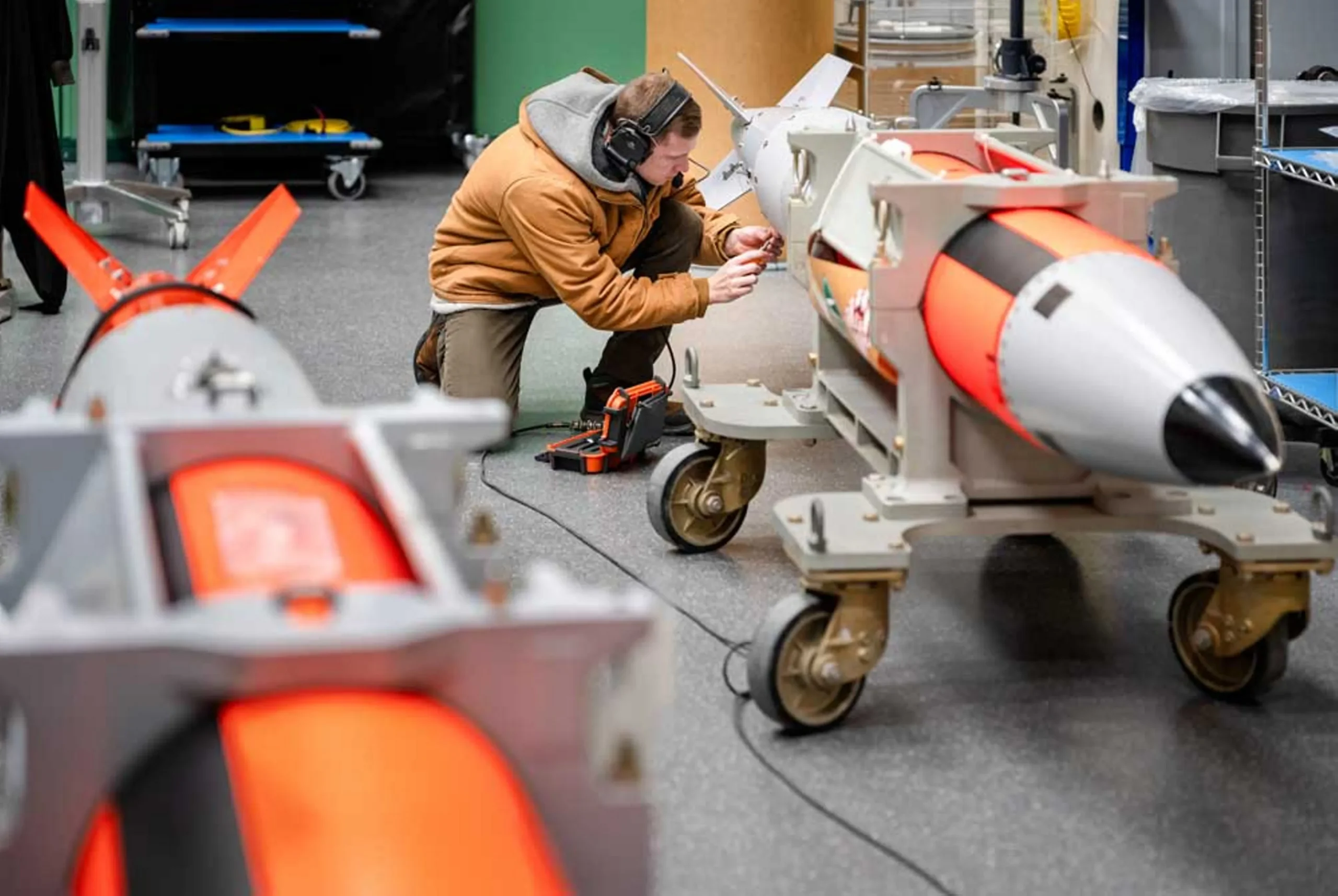

The United States has expedited the production of its latest nuclear gravity bomb, the B61-13, completing the first unit seven months ahead of schedule. This development is part of a broader modernization effort aimed at maintaining a credible nuclear deterrent in an increasingly complex global security environment.
The B61-13 is a variable-yield gravity bomb with a reported maximum explosive yield of 360 kilotons, making it approximately 24 times more powerful than the 15-kiloton bomb dropped on Hiroshima. Designed to be delivered by aircraft such as the B-2 Spirit stealth bomber and the upcoming B-21 Raider, the B61-13 incorporates advanced safety and accuracy systems, ensuring a high level of reliability and effectiveness.
The accelerated production of the B61-13 has drawn sharp criticism from international actors. Beijing has strongly condemned President Trump’s renewed nuclear doctrine, which overtly frames China as a principal threat. China’s Foreign Ministry accused the United States of fabricating a nuclear narrative to justify strategic escalation, warning that Washington is deliberately stoking regional instability to preserve its global hegemony.
Russia has also voiced concerns, warning against the potential resumption of nuclear testing by the United States. Russian Deputy Foreign Minister Sergei Ryabkov indicated that such actions could lead to a new, precarious era in nuclear relations, according to Reuters.
Arms control experts have criticized the US decision to fast-track the B61-13, arguing that it undermines global non-proliferation efforts. The Federation of American Scientists has accused the weapon of being a “political bomb,” introduced to facilitate the retirement of older nuclear weapons,
The Bulletin of the Atomic Scientists described the development as tragic, noting that the B61-13 offers capabilities that the Pentagon already possesses, thereby questioning the necessity of its production.
According to the New York Post, the decision, driven by escalating global threats, was confirmed by Sandia National Laboratories in Albuquerque, New Mexico. The B61-13, designed to replace older variants, offers enhanced accuracy and flexibility, deployable by aircraft for both strategic and tactical missions.
This move has intensified fears of a renewed arms race, with critics arguing it undermines nuclear non-proliferation efforts. Nations like Russia and China have voiced alarm, while domestic opponents question the timing amid ongoing US-Iran nuclear talks.
Supporters, however, cite the need to counter advanced adversarial defenses, ensuring US deterrence remains robust. The production timeline, originally set for later, has been expedited, though specific completion dates remain undisclosed.